
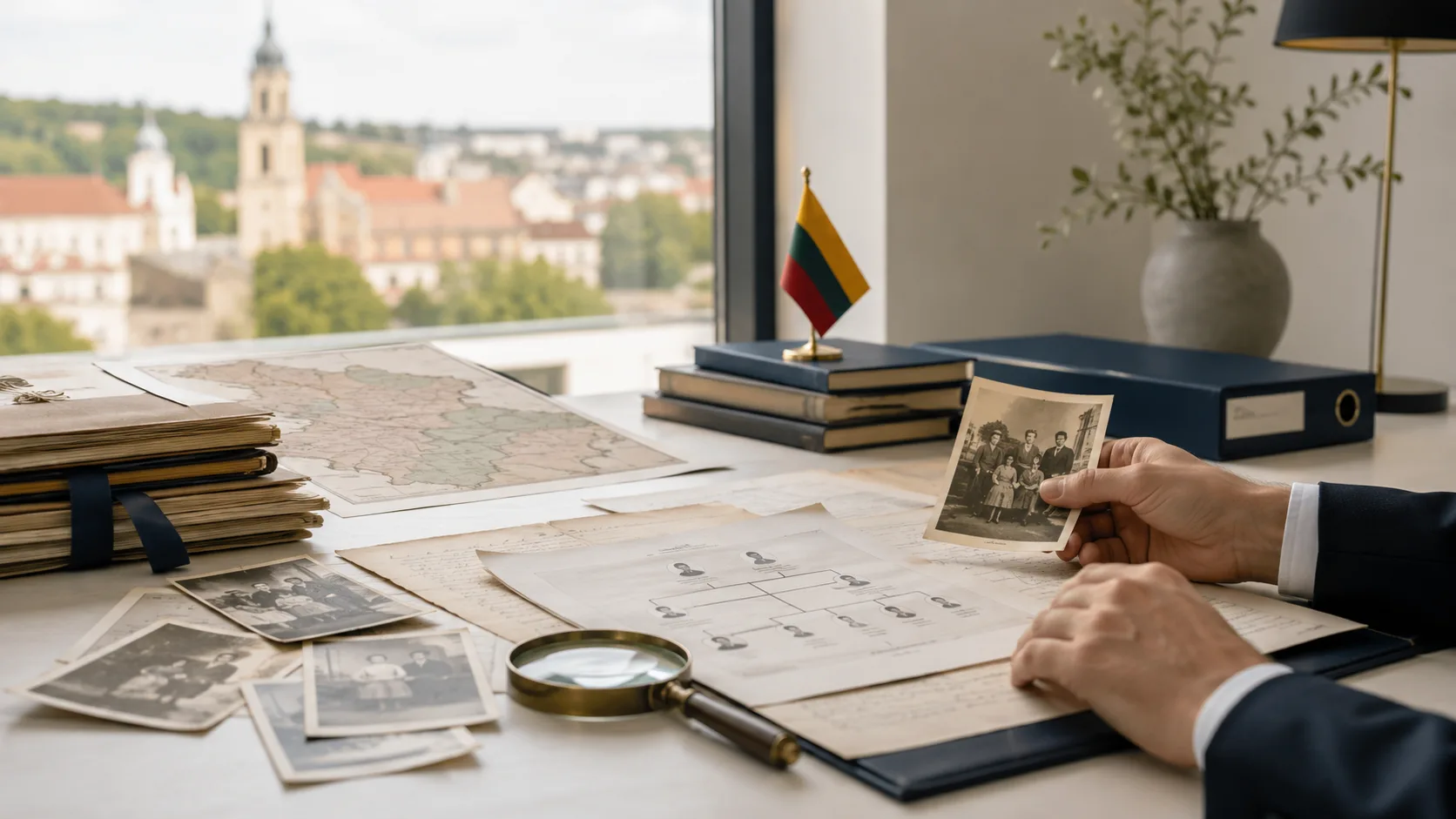
For many Americans with Lithuanian ancestry, the most difficult part of citizenship restoration is not proving a family connection. It is proving that a parent, grandparent, or great-grandparent held Lithuanian citizenship before 1940. This becomes especially challenging when the family no longer has an old Lithuanian passport, internal ID, or other obvious citizenship document.
The absence of a passport does not automatically make a case impossible. Lithuanian citizenship restoration documents may include several types of historical records, archival certificates, civil status documents, and supporting evidence from Lithuania or from the country where the ancestor later lived. The key issue is whether the documents, taken together, can show that the ancestor was a citizen of the Republic of Lithuania before June 15, 1940 and that the applicant is a direct descendant.
Why Proof of Lithuanian Citizenship Before 1940 Matters
Lithuanian citizenship by descent eligibility is usually built around a specific historical point: the ancestor must have held citizenship of the Republic of Lithuania before June 15, 1940. This date matters because it relates to the period before Lithuania lost its independence during Soviet occupation.
For applicants in the United States, the qualifying ancestor is often a grandparent or great-grandparent who was born in Lithuania, left for the United States, Canada, South Africa, Australia, the United Kingdom, or another country, and whose documents were later lost, damaged, translated inconsistently, or never preserved by the family.
However, Lithuanian origin and Lithuanian citizenship are not always the same thing. Being born in Lithuania may be relevant, but it does not always prove citizenship by itself. A strong application normally needs documents proving Lithuanian citizenship before 1940, documents proving the family line, and documents explaining name changes or migration history where relevant.
An Old Passport Is Strong Evidence, But Not the Only Evidence
An interwar Lithuanian passport is one of the clearest forms of proof of Lithuanian citizenship by descent. It may directly identify the person as a citizen and show that the document was issued by Lithuanian authorities during the relevant period. Yet many families do not have this document, especially if the ancestor left Europe during war, displacement, or political instability.
If you are researching Lithuanian citizenship by descent with no passport, the case may still be supported by other documents. These can include Lithuanian internal identity records, foreign Lithuanian passports issued by Lithuanian diplomatic or consular institutions, military service records, civil service documents, personal certificates, birth records that directly refer to citizenship, or other official Lithuanian documents issued before June 15, 1940.
When direct evidence is unavailable, indirect documents may become important. These can include records showing that the person studied, worked, lived, owned property, married, had children, or was otherwise officially recorded in Lithuania before 1940. Such documents do not always prove citizenship alone, but they may help establish a broader evidentiary picture.
What Documents Can Prove Lithuanian Citizenship Before 1940
The strongest documents proving Lithuanian citizenship before 1940 are those that directly connect the ancestor to the Republic of Lithuania as a citizen. A passport, an internal identity document, a certificate issued by Lithuanian authorities, or a military or civil service record may be especially valuable because it can show more than birthplace or ethnicity.
Birth certificates can also matter, but they must be read carefully. A birth record issued in Lithuania may support the case, especially if it falls within the relevant historical period and territory. Still, the record should be assessed in context. Some birth documents prove where a person was born, while others may also contain information relevant to citizenship.
Other Lithuanian citizenship before 1940 documents may include school records, employment records, residence records, property records, marriage records, population lists, and archive extracts. In some cases, foreign documents may support the case if they identify the person as Lithuanian, record a former nationality, list a Lithuanian place of birth, or confirm migration from Lithuania. These documents are usually stronger when they are consistent with Lithuanian archival evidence.
How Lithuanian Archives Citizenship Records Can Help
Lithuanian archives citizenship records are often central when a family does not have original documents. Many U.S.-based applicants begin with family stories, American naturalization papers, immigration records, or old spelling variants of a surname. Archive research can then help locate Lithuanian records that are more relevant to citizenship restoration.
Different types of records may be held in different Lithuanian archives. Vital records such as birth, marriage, and death records may help prove the family line. Historical state records may help prove residence, identity, service, education, or citizenship-related facts. Records connected with deportation, exile, or forced displacement may also be relevant in specific cases.
Archive research is rarely limited to one spelling of a name. Lithuanian, Polish, Russian, Yiddish, German, and English versions of names may appear in different records. A surname that looks fixed in a U.S. document may have been written differently in Lithuanian or Russian records. This is why the search should consider alternative spellings, patronymics, old place names, and administrative borders from the relevant period.
Proving the Family Line to the Lithuanian Ancestor
Proof of Lithuanian citizenship by descent is not only about the ancestor. The applicant must also prove a direct family connection to that person. For a claim through a grandparent or great-grandparent, this usually means creating a complete chain of civil records from the applicant back to the Lithuanian ancestor.
For example, Lithuanian citizenship through grandparents documents may include the applicant’s birth certificate, the parent’s birth certificate, the grandparent’s birth certificate, and marriage certificates where surnames changed. If the claim goes through a great-grandparent, one more generation must be documented.
Name changes are especially important for U.S. families. A Lithuanian surname may have been shortened, anglicized, misspelled by immigration officials, changed through marriage, or recorded differently in naturalization documents. If the documents use different names for the same person, the file should explain the connection with official records whenever possible.
U.S. Documents That May Support the Evidence
U.S. documents usually do not replace Lithuanian records, but they can help reconstruct the case. Naturalization certificates, petitions for naturalization, ship manifests, alien registration records, draft records, marriage records, death certificates, Social Security records, and census records may all contain useful details.
These documents may show when the ancestor left Lithuania, what country or place of birth was recorded, whether the person used a previous name, and whether the person was treated as a citizen or national of another country. They may also help connect family members across generations.
For Lithuanian citizenship restoration documents, U.S. records are most useful when they are consistent with Lithuanian records. A U.S. naturalization file may identify the ancestor’s former nationality or previous residence, while a Lithuanian archive record may establish the citizenship-related fact itself. Together, they can create a more coherent evidentiary file.
What to Do If You Only Have Partial Information
Many applicants begin with incomplete information. They may know only an ancestor’s American name, approximate year of birth, family town, religion, or arrival period. This is common and does not necessarily prevent further research.
The practical starting point is to collect every available family and public record before searching abroad. Even small details can help: a village name, a parent’s first name, a spouse’s maiden name, an old photograph, a cemetery inscription, a naturalization petition, or a passenger list. These details can help identify the correct person in Lithuanian archives and avoid confusing two people with similar names.
If the ancestor was born before the Republic of Lithuania was established in 1918, the case may need closer analysis. A person who left the territory before Lithuania became an independent state may not have held Lithuanian citizenship before 1940. If the person lived in Lithuania after 1918, the available records may still need to show whether citizenship was acquired or recognized.
Common Problems in No-Passport Cases
The most common problem is assuming that Lithuanian ethnicity automatically proves citizenship. It does not. A document stating that a person was Lithuanian by nationality, ethnicity, language, or origin may be helpful, but it should not be treated as identical to proof of citizenship.
Another problem is relying on a single foreign record without checking Lithuanian archives. A U.S. death certificate or census record may contain useful clues, but such documents often include information provided by relatives or officials who did not verify historical citizenship.
Territory can also complicate the analysis. Some areas associated with Lithuanian families had complex political histories before 1940, including regions where borders and administrative control changed. In such cases, the applicant may need more than a basic birth record to support the claim.
Finally, documents must be internally consistent. If dates, names, places, or family relationships conflict, the file should address those conflicts with stronger records or a clear documentary chain.
How to Build a Strong Evidence File Without a Passport
A strong no-passport case usually combines several categories of evidence. The first category proves the ancestor’s identity and connection to Lithuania. The second supports the claim that the ancestor held Lithuanian citizenship before June 15, 1940. The third proves the applicant’s direct descent. The fourth explains migration, name changes, and any gaps in the record.
This approach is more reliable than searching for one perfect document. In many cases, no single document tells the whole story. Instead, Lithuanian citizenship by descent documents may need to work together: an archive certificate, a birth or marriage record, a foreign naturalization file, and a chain of family civil records may collectively support the application.
The exact documents needed depend on the family history, the ancestor’s dates, place of residence, migration route, and available archival records. For this reason, no general article can guarantee eligibility or predict the outcome of a specific case. The safest approach is to treat the document search as a legal-historical evidence project rather than a simple genealogy exercise.
FAQ
Can I prove Lithuanian citizenship before 1940 without an old passport?
Yes, it may be possible. A passport is strong evidence, but other records can also help prove Lithuanian citizenship before 1940. These may include Lithuanian archive records, military or civil service documents, personal certificates, birth records with direct citizenship references, residence records, study or employment records, and supporting foreign documents.
Is being born in Lithuania enough for citizenship restoration?
Not always. Birth in Lithuania can be important, but it does not automatically prove that the person held Lithuanian citizenship before June 15, 1940. The record must be assessed together with the person’s date of birth, place of residence, family circumstances, and other available documents.
What documents are needed for Lithuanian citizenship by descent?
The file usually needs proof of the ancestor’s Lithuanian citizenship before 1940, proof of direct descent from that ancestor, identity documents for the applicant, and documents explaining name or surname changes. Depending on the case, it may also require documents showing when the ancestor left Lithuania and where they lived afterward.
Can U.S. naturalization records prove Lithuanian citizenship?
U.S. naturalization records can be useful, but they usually work best as supporting evidence. They may show former nationality, place of birth, migration details, or name changes. However, Lithuanian archival or official records are often needed to establish the citizenship-related fact more directly.
What if my grandparent’s name is spelled differently in every record?
Different spellings are common in Lithuanian citizenship through grandparents documents. Names may appear in Lithuanian, Polish, Russian, Yiddish, German, or English forms. The important issue is whether the documents can reasonably show that they refer to the same person through matching dates, places, relatives, spouses, or other identifying details.
Do I need my parent to restore Lithuanian citizenship first?
In many descent-based cases, the applicant may be able to rely directly on a qualifying parent, grandparent, or great-grandparent without requiring the intermediate generation to restore citizenship first. However, the full family chain still needs to be documented.
Where are Lithuanian citizenship records usually found?
Relevant records may be found in Lithuanian archives, including archives that hold civil status records, interwar state records, residence records, military or civil service records, and documents connected with exile or displacement. The correct archive depends on the type of document and the ancestor’s history.
Can a great-grandchild qualify for Lithuanian citizenship by descent?
A great-grandchild may be relevant in Lithuanian citizenship by descent eligibility if the family line connects directly to a person who held Lithuanian citizenship before June 15, 1940 and the other legal requirements are met. The documentary chain must clearly prove each generation.