
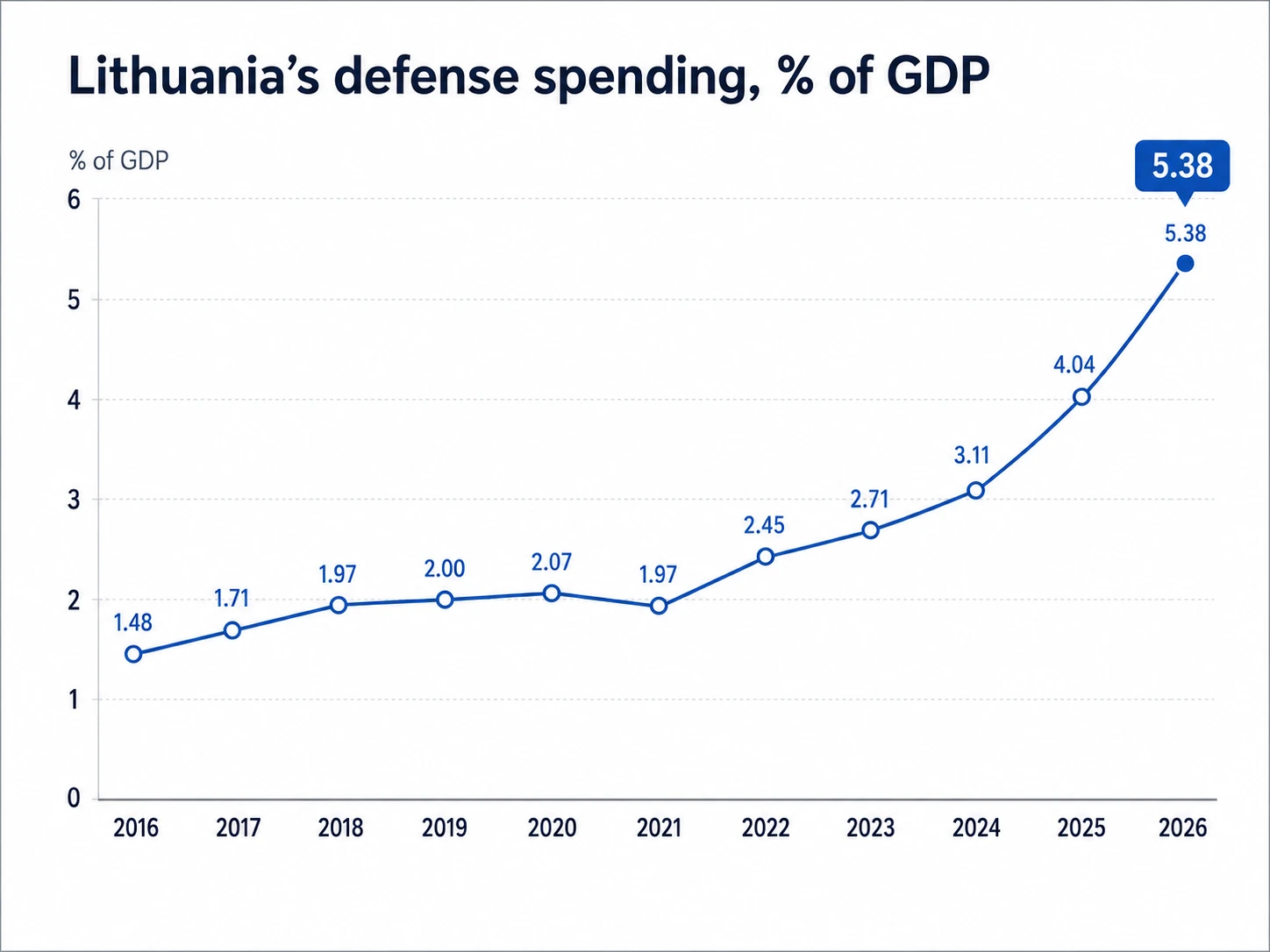
Lithuania defense spending has become one of the most important topics in NATO security discussions. In 2026, the country’s military expenditure is set to reach 5.38% of GDP, or approximately €4.79 billion. This makes Lithuania the first NATO country to move above the 5% level in its national defense budget and places it at the center of wider debates about European security, Russia, Ukraine, and NATO burden-sharing.
For readers in the United States, Lithuania’s decision is relevant for more than foreign policy analysis. Many Americans with Lithuanian ancestry follow developments in the country because of family history, citizenship restoration, or broader interest in Lithuania’s modern role in Europe. While defense spending does not affect eligibility for Lithuanian citizenship restoration, it helps explain the country’s current priorities and the security environment in which Lithuania operates.
Why Lithuania Is Increasing Defense Spending
Lithuania is increasing defense spending because it sees national defense as a long-term strategic necessity. The country is located on NATO’s eastern flank and borders Belarus, while Russia’s Kaliningrad region is situated nearby. This geography makes Lithuania one of the most security-sensitive NATO members in Europe.
The main driver behind Lithuania NATO defense spending is the regional threat environment created by Russia’s war against Ukraine and the broader risk of military pressure against countries close to Russia’s borders. Lithuanian officials have repeatedly presented stronger defense financing as a way to improve deterrence before a crisis occurs, rather than responding after the security situation has already deteriorated.
This is why the search intent behind queries such as “why is Lithuania increasing defense spending” is mostly informational. Users are usually trying to understand why a small Baltic country is allocating such a high share of its economy to defense, how this relates to Russia, and what it means for NATO’s eastern border.
Lithuania’s 2026 Defense Budget
The Lithuania defense budget 2026 is expected to reach approximately €4.79 billion, or 5.38% of GDP. This is a record level for the country and marks a significant increase compared with earlier NATO benchmarks, where the main political target was often 2% of GDP.
The additional funding is expected to support several key areas of national defense. These include the development of air defense, modernization of the Lithuanian Armed Forces, and the acquisition of heavy military equipment. One of the most visible examples is the planned purchase of Leopard 2A8 tanks, which reflects Lithuania’s effort to strengthen its land forces and improve readiness for a high-intensity security environment.
Lithuania military spending GDP figures also show a broader change in European defense policy. Instead of treating military expenditure as a narrow budget item, Lithuania is using defense investment as a central part of state resilience. For a country on NATO’s eastern flank, higher spending is intended to support both national security and the Alliance’s collective defense posture.
Lithuania and NATO’s 5 Percent GDP Debate
Lithuania is a NATO country and has been a member of the Alliance since 2004. Its defense policy is therefore closely connected to NATO’s system of collective defense. When Lithuania increases military spending, the decision is not only domestic. It also affects NATO planning, regional deterrence, and the balance of responsibilities among allies.
The phrase “Lithuania NATO 5 percent GDP” has become especially relevant because NATO members have been discussing higher long-term defense spending targets. Lithuania’s move above 5% of GDP places it ahead of many allies and makes it a prominent example in debates about whether European NATO members are doing enough to strengthen their own defense capacity.
For the United States, this issue matters because American policy toward NATO often includes questions about burden-sharing. Lithuania’s high defense spending allows it to present itself as an ally that is making a substantial contribution relative to the size of its economy. This may become especially important as the United States reviews its military presence and commitments in Europe.
Lithuania, Russia, and NATO’s Eastern Flank
Lithuania Russia threat NATO searches usually reflect a wider concern about the Baltic region. Lithuania, Latvia, and Estonia are NATO members located close to Russia and Belarus. Because of this, their security planning is shaped by geography, history, and the experience of nearby conflict in Ukraine.
Lithuania’s defense policy is based on the idea that credible deterrence requires preparation, allied coordination, and modern military capabilities. Air defense, heavy equipment, infrastructure, and rapid mobilization are all important for a country that must be able to defend itself while also integrating with broader NATO operations.
The increase in Lithuania defense spending should therefore be understood as part of a regional security strategy. It is not simply a symbolic response to Russia. It is a practical attempt to strengthen the country’s ability to resist pressure, support NATO defense planning, and reduce the risk that aggression would appear easy or low-cost.
Lithuania’s Military Assistance to Ukraine
Lithuania has also connected its defense policy with long-term support for Ukraine. The country previously committed to allocating 0.25% of GDP annually for military assistance to Ukraine. This commitment reflects Lithuania’s view that Ukraine’s defense is directly connected to the security of the Baltic region and Europe more broadly.
This support does not replace Lithuania’s own defense investments. Instead, it forms part of the same strategic approach. Lithuania is increasing its national military capacity while also supporting Ukraine’s ability to resist Russian aggression. For Lithuanian policymakers, both priorities are linked to the same objective: limiting the security threat posed by Russia and strengthening the defense of democratic European states.
For U.S.-based readers, this helps explain why Lithuania appears frequently in discussions about Ukraine, NATO, and European security. Although Lithuania is a relatively small country, it has taken a visible position in supporting Ukraine and raising defense expenditure above levels seen in most NATO states.
What This Means for Americans With Lithuanian Roots
For Americans with Lithuanian ancestry, Lithuania’s growing role in NATO may create renewed interest in the country’s history, sovereignty, and citizenship laws. Many descendants of Lithuanian citizens begin researching Lithuania because of family records, migration history, or the possibility of citizenship restoration. Current security news can make that connection feel more immediate.
However, Lithuania defense spending does not affect the legal rules for citizenship restoration. Eligibility usually depends on ancestry, historical citizenship, and documentary evidence. In many cases, applicants need to show a direct family connection to a person who held Lithuanian citizenship during the relevant historical period. The exact documents required can depend on the applicant’s family history, place of birth, name changes, archival records, and the position of Lithuanian authorities in a specific case.
Defense policy may help applicants understand modern Lithuania, but it should not be treated as part of the legal eligibility test. A person does not become eligible for Lithuanian citizenship because Lithuania is a NATO member, because it increased military spending, or because it supports Ukraine. Citizenship restoration remains a document-based legal process.
Why Lithuania’s Security Policy Matters in a Citizenship Context
Lithuanian citizenship restoration is often connected to family histories shaped by war, occupation, displacement, and migration. Many Lithuanian families left Europe during periods of political pressure or instability. Because of that, modern questions about Lithuania’s independence, security, and NATO role can feel personally relevant to descendants abroad.
Understanding Lithuania’s defense policy can help applicants place their family history in a broader national context. Lithuania’s current investment in defense reflects the same fundamental priority that shaped much of its twentieth-century history: the protection of statehood and sovereignty. For people exploring Lithuanian ancestry, this background may add meaning to the restoration process, even though it does not change the legal criteria.
The safest way to approach citizenship restoration is to separate historical and emotional interest from legal eligibility. Current events can explain why Lithuania matters, but the applicant’s case will usually depend on documents, lineage, and the specific citizenship rules that apply to their family situation.
FAQ
Is Lithuania a NATO country?
Yes. Lithuania is a NATO country and has been a member of the Alliance since 2004. This means its defense policy is connected to NATO’s collective defense system and wider security planning on the eastern flank.
How much will Lithuania spend on defense in 2026?
In 2026, Lithuania’s military spending is expected to reach 5.38% of GDP, or approximately €4.79 billion. This makes the Lithuania defense budget 2026 one of the most significant defense commitments in NATO when measured as a share of GDP.
Why is Lithuania increasing defense spending?
Lithuania is increasing defense spending because of the security threat posed by Russia, the war against Ukraine, and the country’s position on NATO’s eastern flank. The goal is to improve deterrence, strengthen military readiness, and modernize national defense capabilities.
What will Lithuania spend the additional defense funding on?
The additional funding is expected to support air defense, modernization of the armed forces, and the acquisition of heavy military equipment. The planned purchase of Leopard 2A8 tanks is one example of Lithuania’s focus on strengthening its military capabilities.
Does Lithuania’s defense spending affect citizenship restoration?
No. Lithuania defense spending does not affect eligibility for citizenship restoration. Eligibility usually depends on ancestry, historical Lithuanian citizenship, family documents, and the applicant’s individual situation.
Why does Lithuania support Ukraine militarily?
Lithuania views Ukraine’s defense as closely connected to wider European and Baltic security. The country has committed to allocating 0.25% of GDP annually for military assistance to Ukraine, while also increasing its own national defense budget.
Why should Americans with Lithuanian ancestry pay attention to this issue?
Americans with Lithuanian ancestry may see Lithuania’s defense policy as part of the country’s modern identity and historical continuity. While it does not determine citizenship eligibility, it can help descendants better understand the country they may be reconnecting with through Lithuanian citizenship restoration.