
Let’s maintain transparency: Lineage tracing Central or Eastern Europe heritage presents a significant asset. Potential remains untapped.
For global clients—Australia, South Africa, North America—a family tree transcends mere history. It is a direct portal into the European Union. Complexity arises quickly. Mixed heritage common (grandparent Vilnius, another Warsaw). Frequent 20th-century border shifts generate uncertainty regarding exact jurisdictional claims.
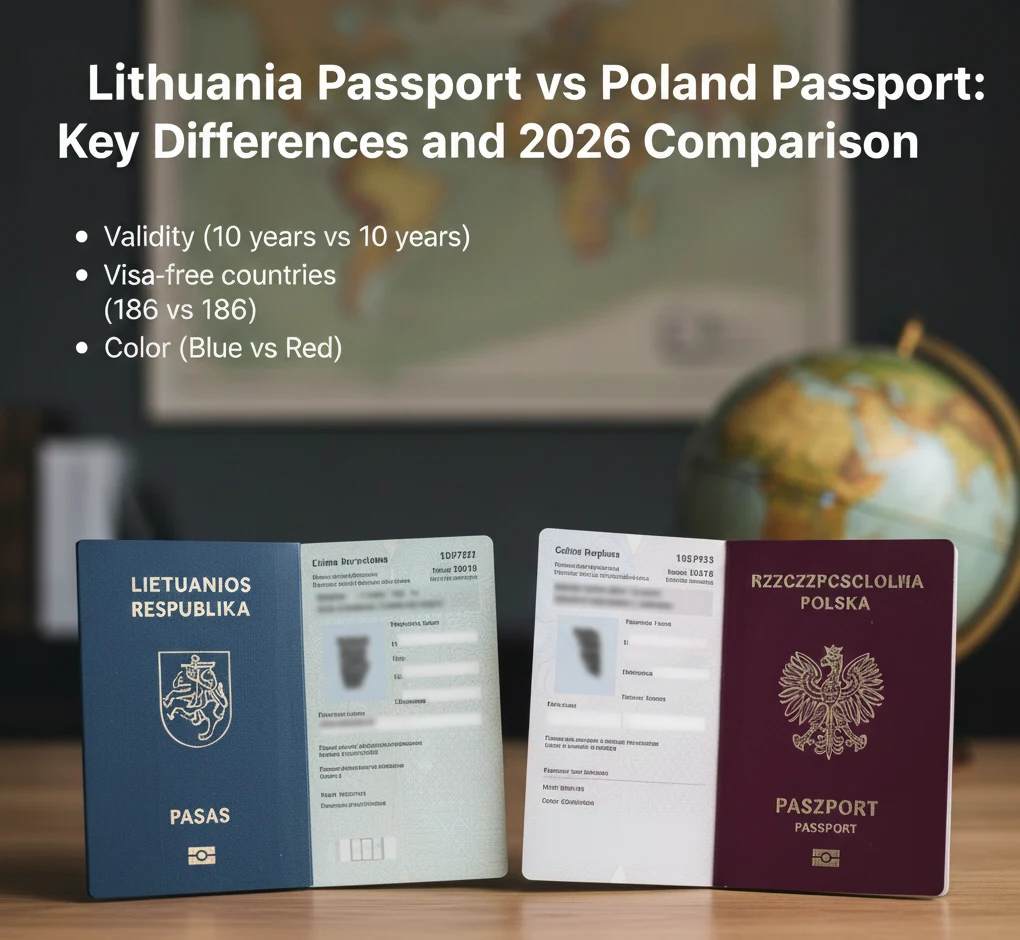
This demands resolution: The Lithuanian Passport vs Polish Passport.
Both nations major players. Both hold full EU membership. Both provide that essential “Plan B”—unrestricted rights reside, work, retire anywhere continental Europe. Disregarding EU status, legal procedures securing Lithuanian nationality versus Polish nationality fundamentally diverge. One system prioritizes clear, archive-based evidence. The other often requires navigating complex military records and subjective “identity” verification.
Objective: Absolute clarity. Focus shifts beyond travel statistics to application feasibility. Which option offers realistic success? Details below.
Lithuania: Exile Advantage (Defining the Best EU Citizenship By Descent)
The Lithuanian travel document frequently recognized “discreet champion” among EU national status options. Why? Despite nation size, legal framework heritage reclamation proves remarkably generous, supporting global diaspora. Nation actively seeks reintegration specific historical descendants, avoiding unnecessary barriers.
Holder Lithuanian document enjoys rights virtually identical French or German national across Europe, thanks full EU and Schengen membership.
Lithuania’s Path: Key Aspects
- Mobility: Visa-free/on-arrival access covers over 180 destinations, US (ESTA), Canada, UK included.
- The Exile Clause (Crucial): Vilnius uniquely permits Dual Status for descendants who fled Soviet/Nazi occupations (1940–1990). This provision addresses majority diaspora claims globally.
- Lineage Depth: Eligibility extends three generations (great-grandparents).
- Clarity: Eligibility based objective facts. Ancestor held national status 1940 and departed? Qualification met. Minimal subjective “grey area” exists regarding ancestor’s “feelings” or “identity”—sharp contrast.
Poland: Continuity is Mandatory
Poland remains a major European power. Substantial diaspora (Polonia) means Polish travel document retains high recognition. Like Lithuania, Poland grants comprehensive access European labor markets and education systems.
Acquisition process presents a challenge. Polish nationality via descent functions “confirmation of possession,” not restoration. Applicants must demonstrate chain national status never broke.
Poland’s Path: Key Aspects
- Global Standing: Ranks consistently among top travel documents worldwide.
- Unbroken Chain Requirement: Proof needed no ancestor ever lost national status (e.g., serving foreign military before 1951, or naturalizing abroad before set dates).
- Bureaucratic Traps: Procedure often demands extensive military records research verify ancestor avoided non-Polish military service—frequent disqualifier early emigrants the US or UK.
Lithuanian Passport vs Polish Passport: Data Comparison
We review data critically. Clients inquire best chance, we provide this comparison.
| Criteria | Lithuania (Exile) | Poland (Confirmation) |
| Global Access | $\sim$180+ | $\sim$180+ |
| EU Rights | Full | Full |
| Dual Status | Securely Protected (Exile route) | Allowed, but “Loss” rules extremely strict |
| Generational Scope | Up to Great-Grandparents | Theoretically limitless, but documentation challenges severe |
| Eligibility Core | Proven 1940 status + Occupation Flight | Continuous status + Absence of disqualifying events |
| Timeline | 9–18 months (Structured) | 12–24 months (Often extended) |
| Language Test | Not required | Not required |
| Archives | Centralized, well-preserved | Scattered; Severe WWII document loss |
| Bureaucracy | Moderate (Predictable) | High (Requires proving a negative) |
Securing Lithuanian Nationality
Clarity Lithuanian system major advantage. Speculation ancestor’s “loyalty” irrelevant. Focus remains timeline.
Eligibility relies three objective criteria:
- Date: Ancestor held national status before June 15, 1940 (first Soviet invasion).
- Exit: Departure occurred June 15, 1940, to March 11, 1990.
- Motive: Escape occupation regimes (covers almost all refugees, DPs, and exile cases).
If lineage aligns this pattern, claim robust. This clear exile definition secures right to retain existing US or Canadian documents.
Securing Polish Nationality
Poland’s methodology reversed. It validates legal status retention.
Applicants must prove:
- Original Status: Ancestor recognized Polish national (records typically 1920+).
- Chain Integrity (The Snare): If ancestor naturalized USA before 1951, or served US, British, or IDF military before certain periods, national status usually automatically forfeited. Loss before subsequent generation’s birth invalidates claim.
- Archaic Laws: Old marriage statutes (women losing status upon marrying non-national) often complicate older claims.
Dual Status: Which is Safer?
Decisive point. Comparing Lithuanian Citizenship vs Polish Citizenship requires assessing security dual status.
- Lithuania’s Stance: Constitution (Article 7) includes unique, legally protected exception for exile descendants. Vilnius recognizes involuntary nature of exit. Dual Status is permitted protected birthright restoration under exile provision.
- Poland’s Stance: Warsaw permits Dual Status today, but grants it less easily diaspora where chain break occurred. The “Paradox” millions assume they possess Polish national status, but military service laws decades ago meant ancestors lost rights. US Army military service rarely affects Lithuanian nationality restoration. Poland? It significantly impacted claims.
Documentation: Ease of Process
Paperwork time. Stage where applications often encounter delays.
The Lithuanian Track
We find Lithuanian nationality restoration efficient and predictable.
- Archives: The Vilnius Central State Archives surprisingly functional. Despite conflicts, key records—document registers, military drafts, census data—saved.
- Clarity: Birth record plus departure documentation usually indicates successful case.
- Modernity: Lithuania operates digitally (e-Residency); migration platform (MIGRIS) reflects streamlined, contemporary approach.
The Polish Track
Poland often requires proving non-existence of an event. Applicants frequently need demonstrate ancestor did not acquire other national status before a specific date.
- Proof Burden: This means time-intensive US or UK archival searches for “non-existence” records—major hurdle.
- Decentralization: Records scattered across many regional voivodeships. Unknown town? Dead end common.
- Rigour: Polish officials known for rejecting files over minor spelling errors or missing “absolute identity proof.”
Passport Strength: Actual Mobility
Practical terms? Identical.
Comparing Lithuanian Citizenship vs Polish Citizenship purely based on travel access moot. Both open EU. Both use the Schengen Zone. Both participate the US Visa Waiver Program.
Real “strength” status security.
- Lithuania: Dual status protected exile clause.
- Poland: Status vulnerable to interpretation continuity laws.
Verdict: Which Passport Fits History?
Who prevails? Choice Lithuanian national status and the Polish option strictly determined family specifics.
| Opt for Lithuania If: | Opt for Poland If: |
| Ancestors fled WWII or Cold War (1940–1990). | Ancestors left before 1940 (Vilnius rules stricter then). |
| Clear, guaranteed path to dual status essential. | Undeniable proof exists ancestor never forfeited status (no naturalization, no specific foreign military). |
| Preference is for modern, digital bureaucracy. | Specific, undisputed Polish records (old army books) already available. |
| Ancestors served foreign armed forces (less likely to disqualify). |
The Final Takeaway: Best EU Citizenship By Descent
Ultimately, best national status one can actually get.
While Poland globally recognized, experience demonstrates for descendants WWII and post-war diaspora, Lithuania provides simpler, higher-probability path second document. Vilnius made clear legal decision to welcome global family. The Lithuania citizenship benefits world-class, but entry door simply more accommodating for those qualifying history.
Ready for certainty? Stop navigating historical ambiguities. Our specialists review family tree and specify exact claim feasibility. Visit https://www.lithuaniancitizenship.com/ to start the journey securing premier EU national status by descent.