
In the high-stakes arena of global mobility, the Baltic region has quietly transformed from post-Soviet recovery into a European heavyweight. For international investors, digital nomads, and—most importantly—descendants of the diaspora, holding a travel document from this area represents securing a “Plan B” in a volatile world.
However, misconceptions blur lines between these neighbors. While geographically close, legal frameworks governing Lithuania vs Estonia are distinct. One is globally renowned for digital governance; the other is emerging as the gold standard for rights restoration.
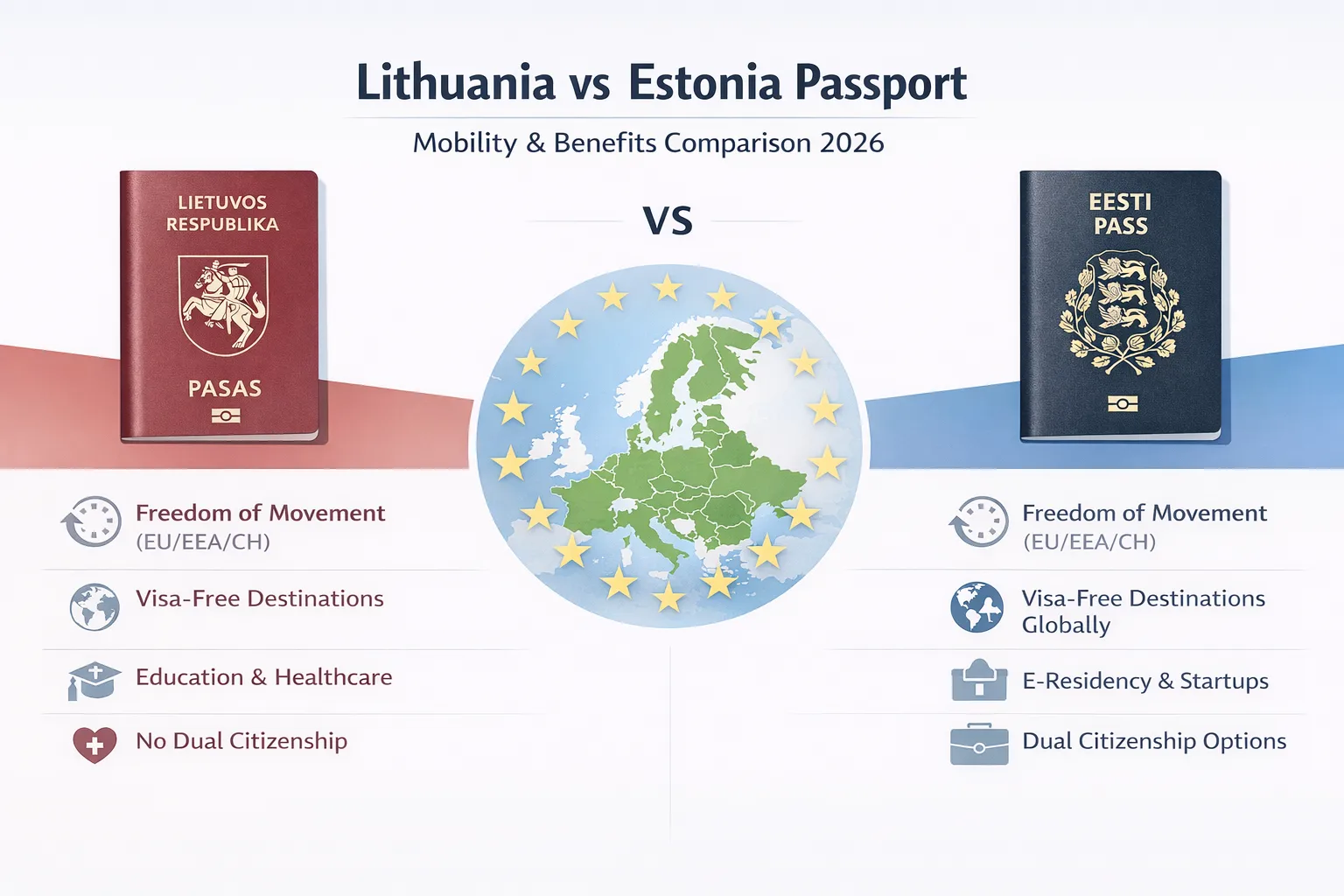
This analysis dissects the lithuanian passport vs estonian passport dynamic for 2026, stripping away marketing to reveal legal realities regarding mobility, eligibility, and the all-important right to dual holding.
Overview—Regional Power in 2026
Why compare these two? Because they represent “New Europe”—agile, secure, rapidly growing economies within the EU and NATO. For someone looking to reclaim rights based on ancestry, the choice often comes down to which family line offers the path of least resistance.
Differences in Strength
On paper, strength metrics appear identical. Both grant full access to the European Single Market. However, the “power” of a credential isn’t just about destination count; it involves acquisition difficulty. Tallinn built a brand around e-Residency (digital status, not travel ID), causing confusion. Vilnius focuses on reinstatement—physical papers for those with blood ties.
Global Mobility
Rankings in 2026 place both firmly in the global top 10. Holders possess a “master key” to the Western world. Whether crossing into the Schengen Zone or landing in Tokyo, border control treats these credentials with equal respect to French or German papers.
Leading the EU
The region securitized its status through deep integration. NATO membership guarantees security; Eurozone membership guarantees economic stability. Unlike newer EU candidates, these statuses are locked in.
Travel Freedom Analysis
Let’s examine raw power. When comparing lithuania passport vs estonia passport privileges, differences measure in single digits—usually involving obscure visa-on-arrival rules for minor destinations.
Access Profile: The Southern Republic
Holders enjoy visa-free or visa-on-arrival access to approximately 185+ destinations. The list is comprehensive, covering the entire Western hemisphere, most of Asia, and developed Oceania.
Access Profile: The Northern Republic
The northern neighbor mirrors this performance. Occasionally, diplomatic spats or specific bilateral agreements might give one nation temporary visa-free status in a specific African or South American nation that the other lacks, but for business travelers, utility remains indistinguishable.
The Big Four: US, UK, Canada, Australia
Both participate in the US Visa Waiver Program (ESTA). Both have freedom of movement agreements with the UK (post-Brexit rules apply to residency, but tourism is open). Canada and Australia offer streamlined electronic authorizations. No functional advantage exists for either document here; both are Tier 1 assets.
Schengen and Market Access
This forms the core value proposition. Both documents grant absolute rights to live, work, study, and retire anywhere in the 27 EU member states (plus Switzerland, Norway, Iceland, and Liechtenstein). Automated e-gates at airports become accessible. You become a European national, full stop.
Ranking in 2026
Depending on the index used, they trade places annually. One year Tallinn is #9, Vilnius #10. Next, they swap. Strategically, treating one as “better” based on travel alone is a mistake. Decisions should hinge on eligibility mechanics, not visa requirements for Burkina Faso.
Legal Frameworks: Diverging Paths
Here paths diverge sharply. Travel rights are similar; acquisition rules are not.
Eligibility Criteria
The northern state operates on a stricter jus sanguinis (right of blood) interpretation regarding continuity. While restoration exists, documentation burdens can be heavier regarding proof of “continuous legal continuity” during occupation years.
Lithuanian citizenship eligibility is notably more structured for the diaspora. Law specifically targets those who left before 1990, creating a clear legal “box” for applicants to fit into.
Descent: Key Distinctions
For the north, proving descent often runs into “1940 cutoff” complexities similar to other post-Soviet states.
For the south, the timeline is explicit:
- Did the ancestor hold status before June 15, 1940?
- Did they leave between 1940 and 1990?
- If yes, general eligibility for reinstatement and dual status applies.
Naturalization and Language
Without blood ties, naturalization becomes necessary.
- North: Requires passing a language exam in Estonian (Finno-Ugric group), widely considered one of the most difficult tongues for English speakers.
- South: Also requires a language exam (Baltic group), which presents challenges.
- Crucial Exception: Restoration by descent in the south exempts applicants from language and residency requirements. Becoming a national without speaking the language or living there is possible.
Dual Status Restrictions
This is the dealbreaker. When analyzing lithuanian citizenship vs estonian citizenship, the “dual” question is paramount.
Estonia: Laws technically prohibit dual allegiance. However, the constitution states “status acquired by birth cannot be taken away.” This creates a legal gray area. Birthright nationals essentially keep both, but naturalized ones cannot. Furthermore, restored individuals often face pressure to choose if they don’t fit narrow birthright definitions.
Lithuania: Laws are explicit. Article 7 permits dual holding for descendants of those who fled occupation (the “Exile” category). It is a codified right, not a loophole. Hiding a US or UK passport is unnecessary; declaring it is standard.
Processing Timelines
Both processes are bureaucratic marathons. Expect 12–18 months for processing in either capital. However, the southern migration system (MIGRIS) is highly digitized, allowing transparent tracking of application stages.
Benefits of the Southern Path
Let’s focus on the value proposition of the Lithuanian route, as it often provides a more accessible path for global diaspora.
EU Rights and Advantages
Holding this status transforms tourists into residents. Bypassing the 90/180-day Schengen restriction that limits Americans and Brits becomes reality. Moving families to Spain or Italy tomorrow requires no permission.
Employment and Business
Lithuania citizenship benefits extend deeply into economics. Working in any EU country without sponsorship visas becomes possible. Registering companies, accessing EU grants, and trading within the single market happens without friction. The country itself acts as a fintech hub, making it an attractive base for digital entrepreneurs.
Education and Healthcare
Children gain access to EU university systems. In many countries, tuition is either free or significantly subsidized for union members, compared to astronomical international fees charged to Americans. Healthcare access via EHIC cards ensures safety across the continent.
Legacy and Lineage
Once restored, this link is permanent. Passing lithuanian nationality down to children and grandchildren secures options for future generations regardless of political stability in home countries.
Comparison with Other Nations
When weighing lithuanian citizenship vs other countries (like Italy or Ireland), this Baltic state stands out for its specific “Exile” provision. While Italy has long wait times for appointments and Ireland has strict registry dates, this option offers a balanced mix of broad eligibility and efficient processing for those with proven 1940-1990 refugee history.
Nationality and Identity
It is not just paperwork. It is history.
Defining Status
Belonging to a nation that survived erasure defines this identity. The passport symbolizes survival. Legal definitions anchor themselves in the interwar republic (1918–1940), viewing the current state as a continuation of that entity.
Historical Context
The diaspora is massive because the exodus was massive. Hundreds of thousands fled Soviet tanks. Current laws acknowledge that tragedy. They are designed to say: “You belong here.”
Why Restore?
Beyond travel perks, many apply to close a circle. Validating the struggle of a grandparent who spent years in a Displaced Persons camp offers emotional reclamation of identity as much as a legal one.
Detailed Comparison: Finding the Right Fit
Let’s break it down by user profile.
For Global Travelers
Verdict: Tie. Both credentials are Tier 1. If the goal involves skipping visa lines, either performs perfectly.
For Dual Status Seekers
Verdict: The South. Legal clarity of Article 7 regarding the “Exile” exception makes it the safer bet for those who must keep current passports. The northern legal environment remains slightly more ambiguous and restrictive regarding dual holding for restored citizens versus birthright ones.
For Long-Term Settlement
Verdict: Tie (Context Dependent). For living in the Baltics specifically, the north offers a digitized, Nordic-style society but with higher costs. The south offers a vibrant, affordable, Central European lifestyle with rapid growth. For living elsewhere in the EU, both documents work equally well.
For Business (e-Residency vs Status)
Do not confuse the two. The north is famous for e-Residency. This digital ID lets you run a company remotely. It confers zero nationality rights, no travel rights, and no residence rights. If needing an actual document to physically move or escape a crisis, Lithuanian citizenship by descent is the superior product. It is full status, not just a digital login.
Ready to explore options? If family roots lead back to this region, do not leave heritage unclaimed. Visit https://www.lithuaniancitizenship.com/ for a specialized assessment and start the journey to reclaiming European rights today.
FAQ
Is it easier to get one or the other?
For descendants of the 1940s exodus, lithuanian citizenship eligibility rules are generally clearer and more accommodating regarding dual nationality. Archival search processes in Vilnius are centralized and robust.
Can I hold dual status?
In the south: Yes, if qualifying under the “Exile” provision (ancestors left 1940–1990). In the north: Technically restricted, though birthright nationals have constitutional protection. The southern neighbor offers more explicit statutory permission for diaspora.
Which document has more visa-free access?
They effectively trade places in rankings year over year. Differences are negligible for average travelers (1-2 minor countries). Both are elite.
Is descent easier in the south?
Many applicants find the “archive-to-passport” pipeline more streamlined there due to clear legal definitions of who qualifies as an exile.
Can I apply for both?
Technically, if parents hail from both nations, eligibility might exist for both. However, maintaining triple allegiance (e.g., US + South + North) is legally complex and often impossible due to conflicting laws in the Baltic states themselves. Choosing one is usually necessary.