
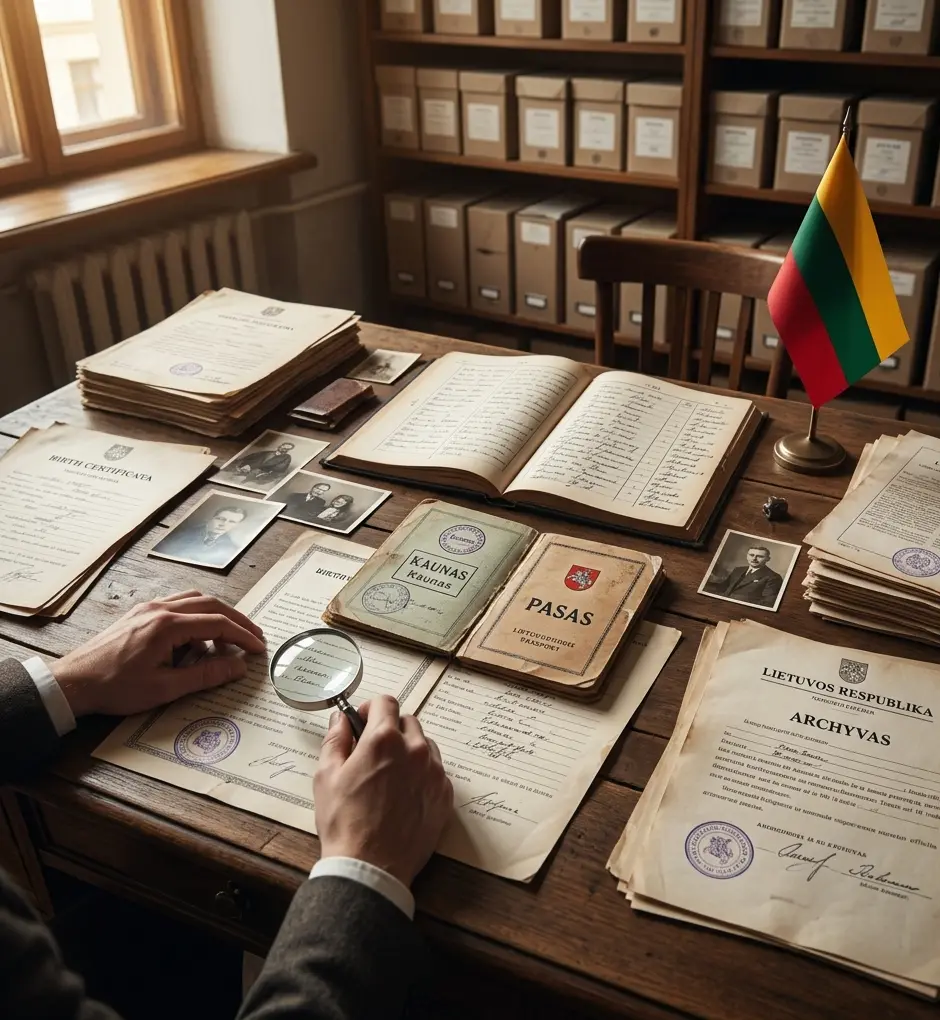
You clean out your grandmother’s attic in Chicago and find an old, heavily stamped piece of paper from Kaunas. A vintage passport. You immediately assume getting a European Union passport is going to be a breeze. You fill out an application form, attach a blurry smartphone photo of the document, and mail it off to the Migration Department.
And then you wait.
A year later, you get a formal rejection letter quoting Article 17 of the Law on Citizenship.
Our legal consultants review these exact denied applications every single week. People severely underestimate the sheer weight of state bureaucracy. Migration officials do not care about your family legends. They do not care about a screenshot you pulled from a commercial genealogy website. They demand absolute, mathematically precise paper trails. You have to prove your ancestor held citizenship before June 15, 1940, and left under specific historical conditions.
Where do those legally binding proofs actually live? Inside massive, highly complex state vaults scattered across Vilnius. Navigating them requires extreme patience, a deep understanding of shifting historical borders, and serious linguistic skills. By 2026, the state expanded its digital portals massively, but those physical, certified stamps remain mandatory for any legal proceeding. Let’s break down exactly where your family history is hiding and how you can extract it without losing your mind.
Lithuanian Archives and Citizenship Research: What You Need to Know
Citizenship by descent is basically a legal battle against time and destroyed documents.
State authorities demand an unbroken documentary chain. You need a birth metric proving your grandfather was born in the territory. You need an internal passport ledger proving he maintained his citizen status. You need departure records proving he fled before 1990. Miss just one crucial link? The migration board destroys your entire legal argument. State archivists hold these links. Understanding their highly specific filing systems separates the successful applicants from the permanent rejections.
Main Lithuanian Archives That Hold Citizenship Records
Documents are not just dumped into one giant basement in the capital. The government divides historical records across specialized institutions based strictly on chronological periods and the type of document.
Lithuanian State Historical Archives
If you are researching ancestors who left before World War I, this is where you start. The lithuanian state historical archives (LVIA) manage pre-1918 history. This institution stores incredibly vast collections of religious registry books.
- The Languages. Documents here utilize Cyrillic, Polish, Latin, or German. Finding a single birth entry often requires manually scrolling through hundreds of unindexed, handwritten pages that are barely legible.
- The Content. Catholic, Lutheran, Orthodox, and Jewish vital records live here. If your great-grandfather emigrated to Pennsylvania coal mines in 1904, his baptismal metric sits inside these specific vaults.
LVIA also holds the Russian Empire census data from 1897. This acts as a crucial supplementary proof when primary birth records burned down during the world wars.
Lithuanian Central State Archives
This is your absolute primary target. The lithuanian central state archives (LCVA) function as the holy grail for restoration cases. They house documents from the First Independent Republic (1918–1940).
If your ancestor lived in independent territory before the Soviet occupation, LCVA holds their records. What exactly survives here? Internal passport issuance cards. Military draft ledgers. Property ownership deeds. Foreign passport issuance registers. Finding a single internal passport card from 1932 inside LCVA completely secures your legal baseline. Migration officials look at LCVA certified extracts and accept them as unquestionable proof of historical citizenship.
Lithuanian National Archives
People use broad terminology incorrectly all the time. When amateur researchers mention the lithuanian national archives, they usually mean the entire overarching state system or specific regional branches scattered across major municipalities like Kaunas, Klaipėda, or Šiauliai.
Regional branches manage localized documents. Notarial records from tiny rural towns, regional court decisions, and local municipal voter lists often sit in these regional hubs rather than the capital city vaults. Tracing a rural ancestor often means we have to dispatch researchers directly to these smaller regional centers.
Lithuanian Special Archives
Dark history requires specialized storage. The lithuanian special archives (LYA) preserve former KGB files, Soviet Ministry of Interior records, and Communist Party documents.
Why on earth would a citizenship applicant need KGB files? Because dual citizenship laws require proving your ancestor fled occupation or suffered deportation. If Soviet authorities packed your family into cattle cars and exiled them to Siberia in 1941, LYA holds the official deportation orders. These grim, terrifying documents serve as flawless legal proof that your family left national territory under extreme duress, satisfying the strictest clauses of our current Citizenship Law.
Lithuanian Archives Department and the National Archive System
Bureaucracies require strict hierarchies. Understanding who oversees document certification helps you navigate the legal hurdles a lot faster.
Structure of the Lithuanian Archives Department
Every state vault operates under strict protocols managed by the lithuanian archives department (Office of the Chief Archivist). This central body dictates preservation standards. They set the reading room access rules. They enforce rigid GDPR compliance alongside historical access laws. You cannot just walk into a vault and grab a folder. You have to request files through their structured hierarchy, legally proving your direct relation if those records contain sensitive mid-century personal data.
What Records Are Stored in Lithuanian Citizenship Archives
Here is a reality check. Dedicated lithuanian citizenship archives simply do not exist as one single physical building. Records proving civic status are scattered chronologically.
You have to piece the puzzle fragments together yourself. An applicant might need LVIA for an 1890 birth metric, LCVA for a 1930 internal passport, and LYA for a 1945 KGB filtration file. Combining these certified extracts creates your customized, legally bulletproof citizenship dossier.
Lithuanian Archives Online: How to Search Records Digitally
Modernization completely changed genealogy. 2026 brought massive upgrades to the digital infrastructure, which allows you to do a lot of remote exploration before you ever commit to physical searches.
Lithuanian Archives Online Platforms and Databases
State digitization efforts finally pushed millions of pages onto the internet. The lithuanian archives online ecosystem primarily relies on portals like ePaveldas and eAnet. These platforms host high-resolution scans of centuries-old church books, municipal registers, and historical census data. You can sit with a laptop in Melbourne or Toronto and look at the exact handwriting of a priest from 1895.
How to Search Lithuanian Archives for Family Records
Digital access does not mean easy access. Learning how to search lithuanian archives requires understanding phonetic evolution. Algorithms cannot translate messy 19th-century cursive.
Names mutated constantly. “Kazlauskas” might appear written in Cyrillic as “Козловский” during the Russian Empire years, or as the Polish “Kozłowski” in specific Catholic church books. If you just type the exact modern spelling into a search bar, you will get zero results. You have to search using localized historical spellings. Knowing your ancestor’s exact village of origin is completely mandatory. Searching broad regions will waste hundreds of hours of your life.
How to Use Lithuanian Archives for Citizenship Applications
Converting historical data into a modern European passport requires strict adherence to legal protocol.
What Documents Prove Lithuanian Ancestry
Article 17 of the Law on Citizenship explicitly defines acceptable evidence. Migration authorities want primary sources.
- Internal passports issued before June 15, 1940.
- Foreign passports issued by diplomatic missions.
- Military service records proving conscription into independent armed forces.
- Documents proving employment in the state civil service.
Secondary sources like birth certificates or property deeds only work when you combine them to build circumstantial cases, usually when primary passports burned during World War II.
How to Request Documents from Lithuanian Archives
Figuring out how to use lithuanian archives officially involves submitting formal inquiries through electronic government gateways. You must provide exact names, birth dates, and geographical locations.
Submitting a vague request like “Find my grandfather Jonas from Kaunas” guarantees an automatic rejection letter. Archivists are not private detectives. They execute searches based strictly on the precise data parameters provided by the applicants.
Processing Times and Access Rules
Bureaucracy operates at its own pace. Standard genealogical requests take anywhere from 20 to 40 working days. Complex searches involving multiple regional branches can take months. Paying state rush fees occasionally expedites simple extract generation, but it absolutely cannot speed up deep, manual investigative work through unindexed ledgers.
Tips for Successful Lithuanian Archive Research
Our legal team hits brick walls constantly. Overcoming them requires highly specific investigative strategies.
Common Challenges When Searching Lithuanian Archives
Name Americanization destroys applications daily. “Juozas Žemaitis” arrived at Ellis Island in 1910 and became “Joseph Smith.” The Migration Department looks at your American birth certificate listing “Joseph Smith” as your father, and then looks at the LCVA extract listing “Juozas Žemaitis.” They reject the file immediately. You must legally prove Joseph and Juozas are the identical human being. This requires hunting down US naturalization petitions, name change decrees, or ship passenger manifests to bridge that specific identity gap.
Secure Your Heritage
Attempting dual citizenship restoration without certified archival proofs is financially and emotionally draining. Hoping state clerks will just overlook missing documents never works. Migration algorithms demand perfect historical compliance. One missing marriage certificate stalls applications for years.
Why risk your European legacy navigating unfamiliar vaults and archaic languages entirely alone?
Securing flawless historical documentation requires a specialized legal strategy. Visit https://www.lithuaniancitizenship.com/ to discover exactly how our investigative team extracts crucial records from state vaults daily. We locate missing passports. We bridge those frustrating name change discrepancies. We build legally bulletproof dossiers proving your exact lithuanian citizenship eligibility. Transform family rumors into a permanent European passport. Secure your ancestral rights today. Do it right the first time.
FAQ
How to search Lithuanian archives online?
Access official state portals like ePaveldas or eAnet. Utilize advanced search functions using historical Polish, Latin, or Cyrillic name variations. Locate specific fond and file numbers before you ever request certified physical copies.
Which Lithuanian archives store citizenship records?
LCVA stores the critical 1918-1940 internal passports and military ledgers. LVIA manages pre-1918 birth metrics. LYA holds the KGB deportation files proving involuntary departure during the Soviet occupation.
How to request documents from Lithuanian archives?
Submit formal electronic inquiries detailing precise ancestral names, birth dates, and specific villages. Pay the required state search fees. Wait 20 to 40 days for the archivists to manually verify the physical ledgers.
What is the Lithuanian archives department?
It functions as our central state authority overseeing all historical vaults. They dictate preservation standards, handle GDPR compliance regarding historical personal data, and manage the official document certification protocols.
Secure Your Heritage: Stop Fighting Bureaucracy Alone
Attempting dual citizenship restoration without certified archival proofs is financially and emotionally draining. Hoping state clerks will just overlook missing documents never works. Migration algorithms demand perfect historical compliance. One missing marriage certificate stalls applications for years.