
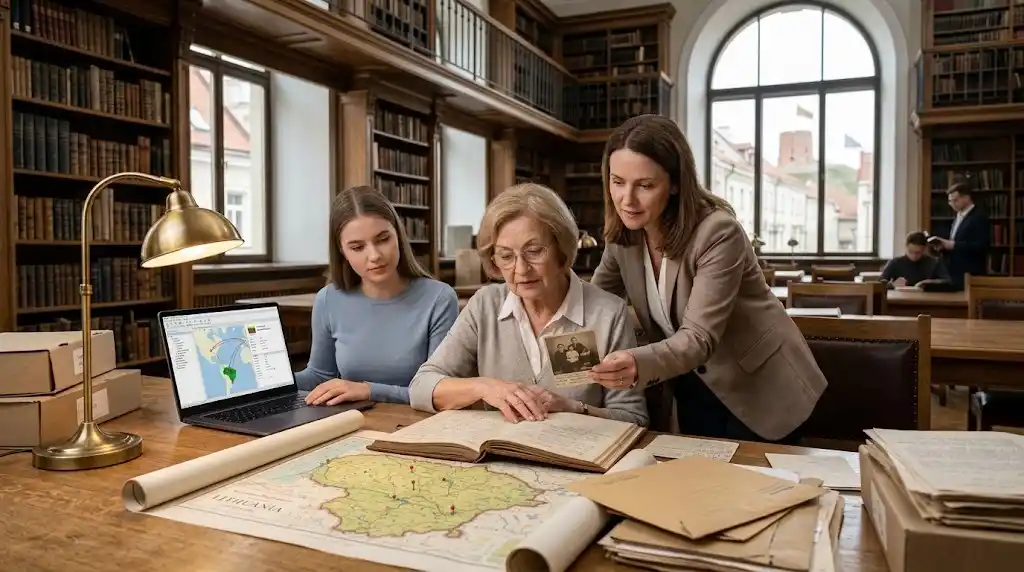
When Lithuanian immigrants settled in Brazil, their names did not always remain exactly as they appeared in records from Lithuania. A first name written one way on a Lithuanian birth or baptism record could appear in a Portuguese form decades later on a Brazilian marriage certificate, immigration document, or death record.
For descendants researching their family history, this can create an important question: are the Lithuanian and Portuguese names actually referring to the same person? A lithuanian ancestor Portuguese name Brazil discrepancy may look significant at first, but a different first name does not necessarily mean that the documentary connection has been lost.
Names can change after migration for many reasons. They may be translated, adapted to local pronunciation, simplified, or recorded differently by officials, churches, employers, and family members. The key is not simply whether the names match letter for letter. It is whether the available records, considered together, can establish that both versions belong to the same ancestor.
Why Did Lithuanian Immigrants Use Portuguese First Names in Brazil?
Immigration often changes the way personal names are written and used. A Lithuanian immigrant arriving in Brazil entered a Portuguese-speaking administrative and social environment. Names that were familiar in Lithuania could be unfamiliar to Brazilian registrars or difficult to reproduce using local spelling conventions.
In some families, the immigrant may have begun using a Portuguese version of the name in everyday life. In others, a Brazilian official or priest may have recorded a locally familiar form even though the person continued using the Lithuanian version elsewhere. As a result, a lithuanian first name changed in Brazil may appear differently depending on when, where, and by whom a particular document was created.
This does not necessarily indicate an official legal name change. The transition may have happened gradually, with several forms appearing in parallel. One document might preserve the original Lithuanian name, another might use a Portuguese equivalent, and a third could contain a shortened or phonetically adapted version.
That is why descendants should avoid evaluating one document in isolation. Understanding how a name was used across the ancestor’s life can be more useful than expecting every Brazilian record to reproduce the original Lithuanian spelling exactly.
Can a Portuguese and Lithuanian First Name Belong to the Same Person?
Yes. A portuguese name Lithuanian ancestor connection may be established by comparing more than the first name itself. Genealogical identification usually depends on a combination of details that remain consistent across different records.
If two documents contain different first names but show the same date of birth, birthplace, parents, spouse, children, residence, or immigration history, those similarities may help establish that the records concern the same individual.
The objective is to build a consistent identity profile. The more independent details that correspond, the stronger the documentary connection may become.
Compare the Date and Place of Birth
Start with the basic biographical information. If a Lithuanian record and a Brazilian record show the same or closely corresponding date and place of birth, this can provide an important link between the two name forms.
Small discrepancies should also be examined in context. Historical records were not always created from original certificates, and information could be provided from memory or copied from earlier documents. Therefore, a minor difference in a date should be investigated together with the other identifying details rather than treated automatically as proof that the records concern different people.
Check Parents’ Names
Parents’ names can be particularly useful when comparing records from different countries. A Brazilian marriage or death certificate may identify the immigrant’s father and mother, while a Lithuanian birth or baptism record may contain the same family information.
Their names may also have spelling variations, so the comparison should not depend exclusively on an exact letter-for-letter match. Instead, consider whether the names, family relationships, locations, and other details form a coherent connection.
Compare Spouse and Children
Marriage and family records can help follow an immigrant after arrival in Brazil. If the person using a Portuguese first name has the same spouse or children associated with the Lithuanian immigrant in other records, these relationships may help connect the identities.
Children’s birth and marriage records can be especially useful because they may describe the same parent differently over time. One certificate may preserve a Lithuanian form, while a later record may use the Portuguese version that became common within the family.
Match Immigration and Residence Details
Immigration records can add another layer of evidence. Arrival information, nationality, age, occupation, destination, relatives, and residence may help distinguish your ancestor from another person with a similar name.
The same principle applies to later Brazilian documents. If several records place the person in the same city, identify the same family members, and follow a consistent chronology, they can help explain a different first name: Brazilian records may still contain enough information to identify the same individual.
Rather than searching for one perfect document, the goal is often to reconstruct a continuous documentary history from Lithuania to Brazil.
How Lithuanian First Names Were Adapted in Brazilian Records
There was no single rule governing how Lithuanian names were adapted after immigration. The same name could be translated, respelled, shortened, or recorded differently at different moments in the person’s life.
This is why understanding Lithuanian name variants in genealogy records can be useful when comparing Brazilian documents with records created in Lithuania. A name difference should be evaluated as part of the broader family history rather than treated as an isolated inconsistency.
Portuguese Equivalents of Lithuanian First Names
Some immigrants may have used a Portuguese form that felt more natural in Brazil. In these cases, researchers may encounter what appears to be a lithuanian name Portuguese equivalent Brazil situation: the Lithuanian record contains one form, while Brazilian records consistently use another.
The important point is not to assume automatically that two names are equivalents simply because they appear in the same family history. The connection should still be supported by dates, relatives, places, immigration information, and other records.
Phonetic and Spelling Adaptations
Sometimes the change was less dramatic. A registrar may have written a Lithuanian name according to how it sounded, or adjusted its spelling to conventions more familiar in Portuguese.
Repeated copying could create additional variants over time. A spelling introduced in an early Brazilian document might then be reproduced in later civil records, even if it differed from the original Lithuanian form.
A lithuanian immigrant Portuguese first name can therefore be part of a broader pattern of linguistic adaptation rather than evidence that the original identity disappeared.
Shortened or Simplified First Names
Long or unfamiliar names may also appear in shortened forms. An immigrant could use a nickname socially while official documents used another form, or a shortened version could eventually become the name most commonly used by the family in Brazil.
For research purposes, each version should be recorded rather than discarded. A less familiar variant may later become the detail that connects an immigration record, church entry, or archival document to the same individual.
Different Names Used in Civil and Church Records
Civil and religious records were created by different institutions and may follow different naming practices. A civil registrar could use the Portuguese form of a first name, while a church record might preserve another version influenced by the immigrant’s language, religious tradition, or information supplied by relatives.
This can create a lithuanian Portuguese name discrepancy even between records produced in Brazil during roughly the same period. Comparing both types of sources can therefore be valuable when reconstructing the ancestor’s identity and explaining how the name changed after migration.
Which Brazilian Records Can Connect the Portuguese and Lithuanian First Names?
Brazilian records can be particularly valuable when an ancestor began using a different first name after immigration. Instead of relying on a single certificate, researchers can compare documents created at different stages of the person’s life. A marriage record, immigration file, child’s birth certificate, and death record may contain different versions of the first name while repeating the same parents, spouse, birthplace, age, or residence.
When investigating a different first name Brazilian records issue, the strongest evidence often comes from several documents that form a consistent chronology. Even if no single record explicitly states that the Lithuanian and Portuguese names belong to the same person, repeated matching details may help connect the two identities.
Immigration and Foreigner Registration Records
Immigration and foreigner registration records are often a useful starting point because they may have been created relatively close to the ancestor’s arrival in Brazil. Depending on the record, they can include the immigrant’s name, nationality, birthplace, age, occupation, date of arrival, residence, or information about relatives.
These documents can be especially helpful when a lithuanian immigrant Portuguese first name began to appear only after settlement in Brazil. An earlier immigration record may preserve a form closer to the original Lithuanian name, while later Brazilian records show the adapted version.
If information about the immigrant is limited, broader research into passenger lists, immigration collections, and archival sources may also help. In such situations, researching your Lithuanian ancestors can provide additional information needed to reconstruct the person’s identity before and after migration.
Marriage Records
Marriage certificates can provide an important bridge between the immigrant’s earlier identity and later family life in Brazil. They may identify the bride or groom’s parents, age, birthplace, nationality, residence, and spouse.
If the ancestor used a Portuguese first name at marriage, these additional details can be compared with Lithuanian records. Matching parents, birthplace, approximate date of birth, and other biographical information may help demonstrate that the person named in the Brazilian marriage record is the same individual documented in Lithuania.
Marriage records can also explain surname changes, particularly when tracing female ancestors. For citizenship research, understanding both first-name and surname variations is important because the entire documentary family line needs to remain identifiable.
Birth Records of Children
The birth certificates of an immigrant’s children can provide additional evidence. A parent’s name may appear repeatedly across the records of several children, sometimes with different spellings or different versions of the first name.
These records may also identify the parent’s nationality, birthplace, spouse, or grandparents of the child. When several certificates contain consistent family information, they can help demonstrate continuity even when the parent’s first name varies.
This becomes particularly useful when proving Lithuanian citizenship through a grandparent, because records from the next generation may form part of the documentary connection between the Lithuanian ancestor and the present-day applicant.
Death Records
Death certificates can contain information that is difficult to find elsewhere, including birthplace, parents’ names, spouse, age, nationality, and residence. They may therefore provide another point of comparison between the Lithuanian and Portuguese versions of an ancestor’s identity.
However, death records should be evaluated carefully because information may have been provided by a relative or another informant rather than by the person concerned. A misspelled name or inaccurate date does not necessarily mean that the record belongs to someone else. It should be compared with earlier documents and the wider family history.
Naturalization Records
If the ancestor became a Brazilian citizen, naturalization records may be particularly informative. They can contain identifying details from the immigrant’s earlier life and may help connect the identity used after settlement with information about nationality, birthplace, age, residence, or arrival in Brazil.
A naturalization file may therefore become an important part of resolving a lithuanian Portuguese name discrepancy. The usefulness of the record depends on what information it contains, so it should be considered together with civil, immigration, and Lithuanian sources rather than treated as standalone proof.
Church and Parish Records
Church records can provide another perspective on the ancestor’s identity. Baptisms, marriages, confirmations, burials, and other parish entries may preserve name forms that differ from those used in Brazilian civil records.
In some cases, religious records may retain a form closer to the immigrant’s European name. In others, they may use a Portuguese or Latinised version. Comparing parish records with civil documents can help establish how the ancestor’s name evolved and whether several forms were being used during the same period.
Which Lithuanian Records Can Confirm the Original First Name?
Brazilian documents can show how an ancestor was known after immigration, but Lithuanian records are often necessary to establish the identity used before departure. The goal is to identify records that correspond to the same person and then connect them with the Brazilian documentary history.
The original Lithuanian spelling does not need to appear identically in every later record. Instead, researchers should compare names together with dates, places, parents, relatives, and other biographical details. This broader approach is especially important when a portuguese name Lithuanian ancestor connection spans several decades and two different administrative systems.
Birth and Baptism Records
Birth and baptism records may provide some of the earliest evidence of the ancestor’s identity. Depending on the historical period and source, they can include the child’s first name, date and place of birth, parents, religion, residence, and other family information.
These records can establish the original or early form of the first name and provide details that can later be compared with Brazilian documents. Parents’ names are particularly useful because they may appear again in marriage, immigration, naturalization, or death records created after emigration.
Lithuanian Passports and Identity Documents
Historical passports and identity documents may help establish how an ancestor’s name was officially recorded before or around the time of emigration. They can also provide additional identifying information, such as a date of birth, place of residence, occupation, photograph, or family details.
A passport is not the only way to establish identity, and many descendants will not have one among their family papers. Where such documents survive, however, they can provide another useful link between the ancestor’s Lithuanian identity and the person who later appears under a Portuguese first name in Brazil.
Archival Records
Lithuanian archives may contain population, residence, civil, administrative, or other historical records relevant to the ancestor. These sources can be particularly important when original family documents have been lost or when Brazilian records provide only limited information about the person’s origins.
Archival research can also help distinguish between people with similar names. If a record identifies the correct parents, village, date of birth, or other family details, it may strengthen the connection to the person later documented in Brazil.
Emigration-Related Records
Records associated with departure or migration may help connect the two sides of the family history. Depending on what survives, they may contain the ancestor’s name, residence, destination, relatives, or other identifying information close to the time when the person left Lithuania.
These documents can be especially useful when the lithuanian first name changed in Brazil shortly after immigration. A record created before departure and a Brazilian record created soon after arrival may provide two points in the same chronology, allowing researchers to compare the surrounding biographical details even when the first names differ.
What If the Portuguese First Name Is Completely Different From the Lithuanian Name?
A completely different first name can make the connection more difficult to establish, but it does not automatically mean that the documentary family line is broken. The first step is to avoid assuming that two names belong to the same person simply because family tradition says so. The relationship needs to be supported by evidence.
Researchers should compare the full identity profile: date and place of birth, parents, spouse, children, occupation, residence, immigration history, nationality, and other details. If these elements consistently point to the same individual, they may help explain why a lithuanian ancestor Portuguese name Brazil case contains two apparently unrelated first names.
It is also useful to search for intermediate records. An earlier Brazilian document may use the Lithuanian form, a later one the Portuguese form, while another record may contain an abbreviation, alternative spelling, or additional given name that helps connect them. Finding such a transition can make the documentary history clearer.
If no obvious bridge exists, additional Brazilian or Lithuanian archival research may be required. The purpose is not to force two different names into a presumed match, but to collect enough independent information to demonstrate that the records consistently describe the same ancestor.
What If Different Brazilian Documents Use Different First Names?
It is possible for the same Lithuanian immigrant to appear under several first names across Brazilian records. An immigration document may preserve a name close to the Lithuanian original, while a marriage certificate uses a Portuguese version and a later death record contains another spelling or shortened form. This does not necessarily indicate that the documents refer to different people.
When dealing with a different first name Brazilian records situation, each document should be compared using more than the name itself. Dates and places of birth, parents’ names, spouse, children, nationality, occupation, and residence can provide important points of continuity. A sequence of records containing consistent biographical information may help demonstrate how the ancestor’s identity was recorded over time.
The chronology is also important. If an early Brazilian record uses the Lithuanian form and later records gradually adopt a Portuguese version, the progression may help explain the difference. However, researchers should not assume that every similar record belongs to the same individual. Each connection should be supported by enough corresponding information to distinguish the ancestor from other people with similar names.
How Can You Prove That Two Different First Names Refer to the Same Ancestor?
There is not always one document that resolves a lithuanian Portuguese name discrepancy. In many cases, the connection emerges only after several Lithuanian and Brazilian records are examined together. The aim is to establish a coherent documentary history in which the person’s relationships, dates, locations, and life events remain consistent despite changes in the first name.
This is particularly important when the ancestor connects several generations in a citizenship-by-descent case. The evidence should allow the family line to be followed from the Lithuanian ancestor through subsequent generations to the present-day applicant.
Match Dates and Places
Dates and locations provide useful reference points when comparing records. A Lithuanian birth record and a Brazilian marriage certificate, for example, may contain different first names but identify the same birthplace and a corresponding date of birth.
Minor variations should be considered in context. Historical documents can contain transcription mistakes, approximate ages, or information supplied from memory. A small discrepancy does not automatically invalidate the connection, but significant differences may require additional research.
Compare Relatives Listed in the Records
Family relationships can provide particularly strong identifying information. Parents, spouses, siblings, and children may appear repeatedly across records created during different periods of the ancestor’s life.
For example, a Brazilian marriage certificate using a Portuguese first name may list parents whose names correspond to those found on a Lithuanian birth record. Later records for the ancestor’s children may then repeat the same spouse and family information. Together, these connections can help demonstrate continuity between the different name forms.
Build a Chronological Document Chain
Arranging records chronologically can make name changes easier to understand. Start with the earliest available Lithuanian documents, continue with emigration or arrival records, and then add Brazilian civil, church, residence, naturalization, and family records in the order they were created.
This approach may reveal when a lithuanian immigrant Portuguese first name first appeared and whether the change happened suddenly or gradually. It can also expose gaps in the evidence that require further research.
A chronological chain is particularly useful when proving Lithuanian citizenship through a grandparent, because each generation and identity must remain identifiable throughout the documentary history.
Look for a Record Containing Both Name Forms
A document containing both versions of the first name can provide a particularly useful connection. For example, one record might show an alternative name, an additional given name, or another form in brackets or alongside the name normally used in Brazil.
Such a document is helpful, but it should not be assumed that one will always exist. Many immigrants used different forms of their names without leaving a record explicitly stating that the two versions were equivalent. In those cases, the connection may need to be established through the combined evidence contained in several documents.
Does a Different First Name Break the Documentary Family Line?
Not necessarily. A different first name is a discrepancy that needs to be understood, but it does not automatically mean that a descendant cannot establish the relationship to a Lithuanian ancestor. The important question is whether the available evidence can reliably connect the person appearing in Lithuanian records with the person documented in Brazil.
This distinction is particularly relevant when assessing Lithuanian citizenship by descent for Brazilians. Citizenship eligibility and documentary proof involve more than comparing names. The ancestor’s legal status and the applicant’s relationship to that ancestor must be established through the relevant records.
A name discrepancy can nevertheless become important if the evidence is insufficient or contradictory. For example, substantially different first names combined with different birthplaces, parents, or dates could raise a more serious identification issue. This is why the complete documentary chain should be reviewed rather than treating the first-name variation either as an automatic problem or as something that can simply be ignored.
A practical example of how historical Brazilian and Lithuanian records can form part of a citizenship case can also be seen in a Brazilian family’s Lithuanian citizenship restoration case, where establishing the ancestral connection required examining the family history across generations.
What If No Record Shows Both the Lithuanian and Portuguese Names?
The absence of a document containing both name forms does not necessarily end the research. Historical name adaptations were not always formally recorded, and an immigrant could begin using another first name without leaving a certificate explicitly connecting the old and new forms.
In such a case, the connection may need to be demonstrated indirectly. Several records might collectively show the same parents, spouse, birthplace, approximate birth date, children, residence, occupation, and immigration history. If these details create a consistent chronology, they can provide evidence that the records concern the same individual despite the different names.
Researchers should also look for documents created around transitional moments in the ancestor’s life, such as immigration, marriage, naturalization, or the birth of the first children in Brazil. These records may contain additional details that help bridge the Lithuanian and Portuguese identities.
If important gaps remain, additional Lithuanian archival and genealogical research may uncover records that were not previously known to the family.
How to Organize Records When Your Ancestor Used More Than One First Name
When several name forms appear, organizing the evidence before preparing a citizenship case can make inconsistencies much easier to identify. A useful approach is to create a chronological record of the ancestor’s life, beginning with the earliest Lithuanian document and continuing through immigration and the Brazilian records created afterward.
For each document, note the exact first name used, surname, date, place, parents, spouse, children, nationality, and other identifying information. This allows different name forms to be compared alongside details that remain consistent.
It is also useful to keep the original documents separate from personal notes or assumptions. The evidence should show what each source actually states. If one record contains an unexplained variation, mark it for further research rather than trying to make it fit the expected family history.
Organizing the evidence this way can turn what initially appears to be a confusing portuguese name Lithuanian ancestor problem into a clearer sequence showing how the same person was identified at different stages of life.
When May Additional Evidence Be Needed?
Additional evidence may be necessary when the available documents do not create a sufficiently clear connection between the Lithuanian and Brazilian identities. This can happen when several important details differ at the same time, when records are missing, or when the ancestor used multiple versions of both a first name and surname.
For example, a lithuanian name Portuguese equivalent Brazil issue may be relatively straightforward when the documents consistently show the same parents, birthplace, spouse, and date of birth. The situation becomes more complicated if those details also vary or if the available Brazilian records contain very little information about the ancestor’s origins.
In such cases, additional civil, church, immigration, naturalization, or archival records may help fill the gaps. Records relating to siblings, spouses, parents, or children can also provide useful connections because they may repeat identifying information that is missing from documents issued directly to the ancestor.
The type of additional evidence required will depend on the specific discrepancy. There is no single document that resolves every name variation. The objective is to create a documentary chain in which the available evidence consistently supports the conclusion that the Lithuanian and Portuguese names refer to the same individual.
For descendants considering citizenship by descent, it can therefore be useful to review the entire family line before deciding whether a name discrepancy is significant. A professional assessment can help identify weak points in the documentary chain and determine whether additional research or records may be needed.
FAQ
Why Did Lithuanian Immigrants Use Portuguese First Names in Brazil?
Lithuanian immigrants could begin using Portuguese first names for practical, linguistic, or social reasons after settling in Brazil. A Lithuanian name might have been translated, simplified, adapted to Portuguese pronunciation, or recorded differently by civil and religious authorities.
The change was not necessarily formal. An immigrant could continue to appear under the Lithuanian version in some documents while using a Portuguese version in others. This is why records from different periods should be compared together rather than expecting one spelling or name form throughout the ancestor’s life.
Can a Lithuanian and Portuguese First Name Belong to the Same Person?
Yes. Different first names can refer to the same person, but the connection should be supported by documentary evidence. Researchers can compare the person’s date and place of birth, parents, spouse, children, residence, immigration history, nationality, and other identifying information.
A lithuanian ancestor Portuguese name Brazil discrepancy should therefore be assessed within the complete documentary history. The fact that the names are different is only one element of the identification process.
How Can I Prove That Two Different First Names Refer to My Lithuanian Ancestor?
Start by comparing Lithuanian and Brazilian records for details that remain consistent despite the name variation. Matching parents, birth information, spouse, children, residence, and immigration details may help establish that the documents relate to the same person.
It can also be useful to arrange the documents chronologically. This may show when the Portuguese version first appeared and whether intermediate records connect it with the Lithuanian name. If the existing documents do not provide a clear connection, additional archival or genealogical research may be necessary.
Which Brazilian Records Can Help Connect the Portuguese and Lithuanian First Names?
Immigration and foreigner registration records, marriage certificates, children’s birth records, death certificates, naturalization files, and church records can all be relevant.
The value of a particular record depends on the information it contains. A marriage certificate identifying the ancestor’s parents and birthplace, for example, may be more useful than a record that provides only a name. Comparing several independent sources is often more informative than relying on a single document.
What If Different Brazilian Documents Show Different First Names?
Several first-name variations do not automatically mean that the documents concern different people. Compare the other identifying information and place the records in chronological order.
If the same parents, spouse, children, birthplace, residence, and other details recur across the documents, they may help establish continuity despite the different first names. More substantial contradictions should be investigated rather than ignored.
What If No Record Shows Both the Lithuanian and Portuguese Versions of the Name?
A document showing both forms can be helpful, but such a record will not always exist. The connection may instead emerge from several records that consistently identify the same person through family relationships, dates, places, and other biographical details.
If the existing evidence leaves an important gap between the Lithuanian and Brazilian identities, further archival research may be needed. The aim is to establish a reliable documentary connection rather than simply assuming that two different names belong to the same ancestor.
Ultimately, a Portuguese first name in Brazilian records does not by itself erase an ancestor’s Lithuanian identity. What matters is whether the available documents can connect the different name forms and preserve a consistent family line from the Lithuanian ancestor to the descendant.