
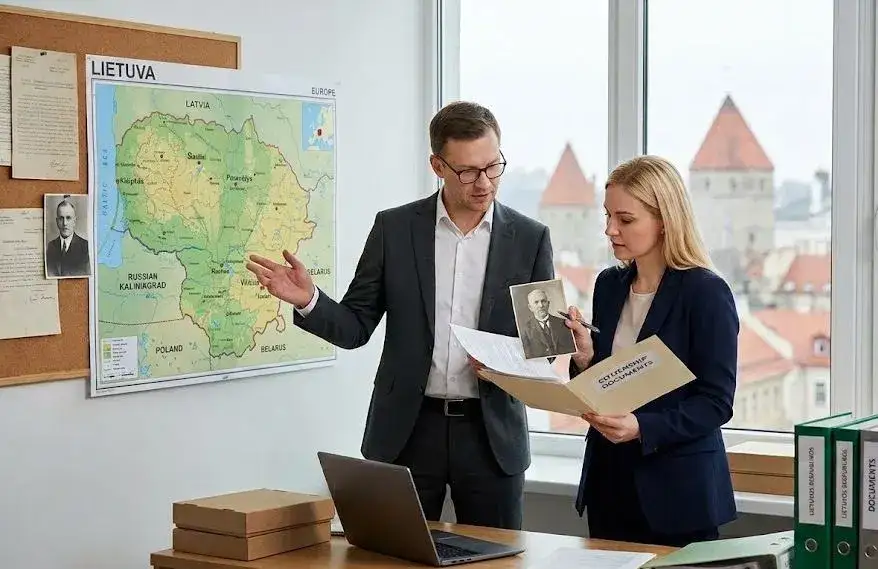
For many Americans with Lithuanian roots, family history begins with a familiar story: a great-grandparent or earlier ancestor left Lithuania in the late nineteenth or early twentieth century and settled in the United States. Generations later, descendants often ask whether that family connection can support Lithuanian citizenship restoration.
The answer depends on one central legal point. Lithuanian citizenship restoration is usually connected not only to Lithuanian ancestry, but to whether the ancestor was a citizen of the Republic of Lithuania before June 15, 1940. Because the modern Republic of Lithuania restored its statehood on February 16, 1918, an ancestor who left before that date may not have held Lithuanian citizenship as a legal status.
This does not always mean the family history is irrelevant. It means that Lithuanian citizenship by descent before 1918 requires especially careful analysis. The key question is not simply whether the ancestor was ethnically Lithuanian or born in Lithuanian lands, but whether there is a provable link to Lithuanian citizenship during the legally relevant period.
Why 1918 Matters for Lithuanian Citizenship Restoration
The year 1918 is important because it marks the restoration of the independent Republic of Lithuania. Before that point, many people who later described themselves as Lithuanian were born or lived in territories controlled by other states or empires. Their ethnicity, language, religion, place of birth, or cultural identity may have been Lithuanian, but citizenship of the Republic of Lithuania may not yet have existed for them.
This is why Lithuanian citizenship restoration 1918 1940 is such a common eligibility framework. In many descent-based cases, the applicant must show that a parent, grandparent, or great-grandparent was a Lithuanian citizen at some point before June 15, 1940. The relevant ancestor also usually needs to fit the historical emigration or exile requirements that allow citizenship to be restored while retaining another citizenship, depending on the facts of the case.
If an ancestor left Lithuania before February 16, 1918 and never returned, never acquired Lithuanian citizenship, and never had legal recognition as a citizen of the Republic of Lithuania, the case may be difficult. Lithuanian ancestry alone is usually not the same as Lithuanian citizenship.
Does Leaving Before 1918 Automatically End Eligibility?
An ancestor leaving before 1918 can be a serious obstacle, but it should not always be treated as the final answer without checking the full family line. The practical issue is whether there is any evidence that the ancestor, or another qualifying ancestor in the direct line, held Lithuanian citizenship during the relevant period.
For example, some family stories are imprecise. A relative may have “left Lithuania before World War I,” but the actual departure date could be later than remembered. U.S. census records, passenger manifests, naturalization files, draft cards, marriage records, and death certificates often contain conflicting dates. A case that appears to involve Lithuanian citizenship by descent pre 1918 ancestors may change after the documents are reviewed.
There may also be situations where a different ancestor in the same family line is more relevant. If one great-grandparent left before 1918, but another parent, grandparent, or great-grandparent remained in Lithuania and held citizenship before 1940, the analysis may shift. Lithuanian citizenship eligibility when an ancestor left before 1918 should therefore focus on the entire direct line, not only the first known emigrant.
Lithuanian Ancestry Is Not Always the Same as Lithuanian Citizenship
A common misunderstanding is that Lithuanian ethnicity automatically creates eligibility for citizenship restoration. For many U.S.-based descendants, family records may show that an ancestor was Lithuanian, spoke Lithuanian, attended a Lithuanian church, or came from a town historically associated with Lithuania. These facts may be valuable for genealogy, but they may not be enough to prove citizenship.
Lithuanian ancestry before 1918 citizenship questions are often complicated because borders, jurisdictions, languages, and record systems changed over time. A person could be described in U.S. records as Lithuanian, Russian, Polish, Jewish, Litvak, or from Kovno, Vilna, Suwalki, or another historical region. These descriptions may help identify the correct place of origin, but they do not automatically prove that the person became a citizen of the Republic of Lithuania.
For citizenship restoration, the stronger evidence usually points to legal status. Documents that directly or indirectly show citizenship of the Republic of Lithuania before June 15, 1940 are more important than general ethnic references. In cases involving ancestors who emigrated before 1918, the absence of that legal status is often the main weakness.
What If Your Great-Grandparents Left Before 1918?
Lithuanian citizenship by descent great grandparents left before 1918 is one of the most common scenarios for Americans. Many Lithuanian families emigrated to the United States before World War I, especially during the late nineteenth century and early twentieth century. Their descendants may still feel a strong cultural connection to Lithuania, but the legal question remains narrower.
If the great-grandparent left before the Republic of Lithuania existed and did not later become a Lithuanian citizen, that ancestor may not support a standard restoration claim. This is especially important when the entire direct line left before 1918 and no one in the family remained in Lithuania during the interwar period.
However, the facts should be checked carefully. A family may have multiple branches, incomplete records, or a mistaken emigration date. Sometimes one sibling emigrated early while another stayed behind. Sometimes U.S. documents list the arrival date incorrectly. Sometimes naturalization records reveal a more precise birthplace or citizenship description than family memory does. These details can affect whether Lithuanian citizenship restoration ancestor left before 1918 is realistically possible.
What Evidence Matters in a Pre-1918 Ancestor Case?
In a case involving Lithuanian citizenship before 1918 ancestors, documents should be reviewed in two directions. First, the applicant needs records proving direct descent from the ancestor. This usually means birth, marriage, name-change, and sometimes naturalization or court records connecting each generation.
Second, the applicant needs evidence connected to the ancestor’s legal status. For a stronger restoration case, the most relevant records are those that show Lithuanian citizenship before June 15, 1940, or facts from which such citizenship may be assessed. These may include Lithuanian passports, internal passports, military records, civil service records, Lithuanian-issued birth or residence records, archive certificates, or other interwar documents.
For an ancestor who left before 1918, U.S. records such as passenger lists and naturalization documents are still useful, but mainly because they establish dates, identity, birthplace, name variants, and migration history. They may confirm that the ancestor left too early, or they may reveal that the actual timeline was different from what the family believed.
Why Birthplace Alone May Not Be Enough
Many applicants assume that being born in Lithuania is enough. In practice, birthplace and citizenship are not identical. A person could have been born in a territory later associated with Lithuania but may not have been a citizen of the Republic of Lithuania. This distinction is especially important for people who left before 1918.
A record saying “born in Lithuania” may help identify the ancestor’s origin. A record saying “Lithuanian” may help confirm ethnicity or community background. But the more important question is whether the person held citizenship of the Republic of Lithuania during the period relevant to restoration.
This is why Lithuanian citizenship through ancestors who emigrated before 1918 often requires a cautious review. The documents may support Lithuanian heritage, but heritage alone may not satisfy citizenship restoration requirements.
Possible Scenarios When an Ancestor Left Before 1918
The most difficult scenario is when the only Lithuanian ancestor in the direct line left before February 16, 1918, settled permanently abroad, and never acquired or held Lithuanian citizenship. In that situation, eligibility for restoration may be weak because there may be no pre-1940 Lithuanian citizenship to restore through that ancestor.
A more promising scenario may exist if another direct ancestor was a Lithuanian citizen between 1918 and 1940. This could be a different grandparent or great-grandparent, or another family line that remained in Lithuania longer than the emigrating ancestor.
A more complex scenario may arise if the ancestor left around the time of Lithuanian statehood, returned to Lithuania, maintained legal residence, received Lithuanian documents, or otherwise acquired recognized citizenship. These cases depend heavily on documents and should not be assessed only from family stories.
How U.S. Records Can Clarify the Timeline
For U.S.-based descendants, American records often become the starting point. Naturalization petitions, declarations of intention, passenger arrival records, census entries, World War I draft cards, Social Security records, church records, and death certificates can help determine when the ancestor actually left Europe and how they described their nationality.
These records are not always consistent. One document may say Russia, another may say Lithuania, and another may list a province or town. That does not automatically make the case impossible. It means the evidence needs to be reconciled carefully.
For Lithuanian citizenship restoration ancestor left before 1918 cases, the date of departure is especially important. If records show that the ancestor emigrated after February 16, 1918, or that the relevant ancestor remained in Lithuania during the interwar period, the eligibility analysis may be different.
What Applicants Should Understand Before Relying on a Pre-1918 Ancestor
The main risk in these cases is assuming that Lithuanian ethnic origin and Lithuanian citizenship restoration are the same pathway. They are related concepts, but they are not identical. A person may have Lithuanian heritage without having a qualifying citizenship restoration claim.
Applicants should also avoid relying only on family memory. Dates such as “before the war,” “around 1914,” “early 1900s,” or “before independence” may be approximate. In citizenship cases, those details can matter. A difference of a few years may affect whether the ancestor could have been a citizen of the Republic of Lithuania.
The safest approach is to reconstruct the family line, identify all possible qualifying ancestors, confirm their places and dates of birth, determine when they left Lithuania, and look for evidence of legal citizenship during the 1918–1940 period.
So, Can You Restore Lithuanian Citizenship If Your Ancestor Left Before 1918?
In many cases, if the only relevant ancestor left Lithuania before February 16, 1918 and never became a citizen of the Republic of Lithuania, Lithuanian citizenship restoration may not be available through that ancestor. The reason is that restoration generally depends on a prior Lithuanian citizenship status, not only on ethnic Lithuanian origin.
However, the answer can change if the family has another direct ancestor who held Lithuanian citizenship before June 15, 1940, if the departure date is incorrect, or if archival records show facts that were not obvious from U.S. documents. Lithuanian citizenship eligibility ancestor left before 1918 cases should therefore be reviewed through documents rather than assumptions.
For descendants of Lithuanian emigrants, pre-1918 ancestry is still historically meaningful. It may help reconstruct family origin, locate archive records, and understand migration history. But for citizenship restoration, the decisive question is usually whether the applicant can prove a qualifying connection to a citizen of the Republic of Lithuania during the legally relevant period.
FAQ
Can you restore Lithuanian citizenship if your ancestor left before 1918?
Usually, this is difficult if that ancestor left before the Republic of Lithuania restored statehood on February 16, 1918 and never held Lithuanian citizenship. Lithuanian citizenship restoration generally depends on proving that a direct ancestor was a citizen of the Republic of Lithuania before June 15, 1940. However, each case depends on the full family line and available documents.
Is Lithuanian citizenship by descent before 1918 possible?
Lithuanian citizenship by descent before 1918 is not usually based on pre-1918 ancestry alone. The stronger question is whether the ancestor, or another direct ancestor, held Lithuanian citizenship between 1918 and 1940. If no one in the direct line held Lithuanian citizenship during that period, restoration may be difficult.
Does Lithuanian ancestry before 1918 prove citizenship?
No. Lithuanian ancestry, ethnicity, language, or birthplace may help with genealogy, but they do not automatically prove Lithuanian citizenship. For restoration purposes, documents usually need to show or support the conclusion that the ancestor held citizenship of the Republic of Lithuania before June 15, 1940.
What if my great-grandparents left Lithuania before 1918?
If your great-grandparents left before 1918 and never became Lithuanian citizens, they may not support a standard restoration claim. Still, you should check whether another parent, grandparent, or great-grandparent in the direct line remained in Lithuania and held citizenship before 1940, or whether the family’s emigration timeline is accurate.
What documents can help in a pre-1918 ancestor case?
Useful records may include U.S. passenger lists, naturalization records, census records, birth and marriage certificates, church records, death records, name-change records, and Lithuanian archive documents. These records can help confirm identity, direct descent, place of origin, emigration date, and whether any qualifying ancestor may have held Lithuanian citizenship between 1918 and 1940.