
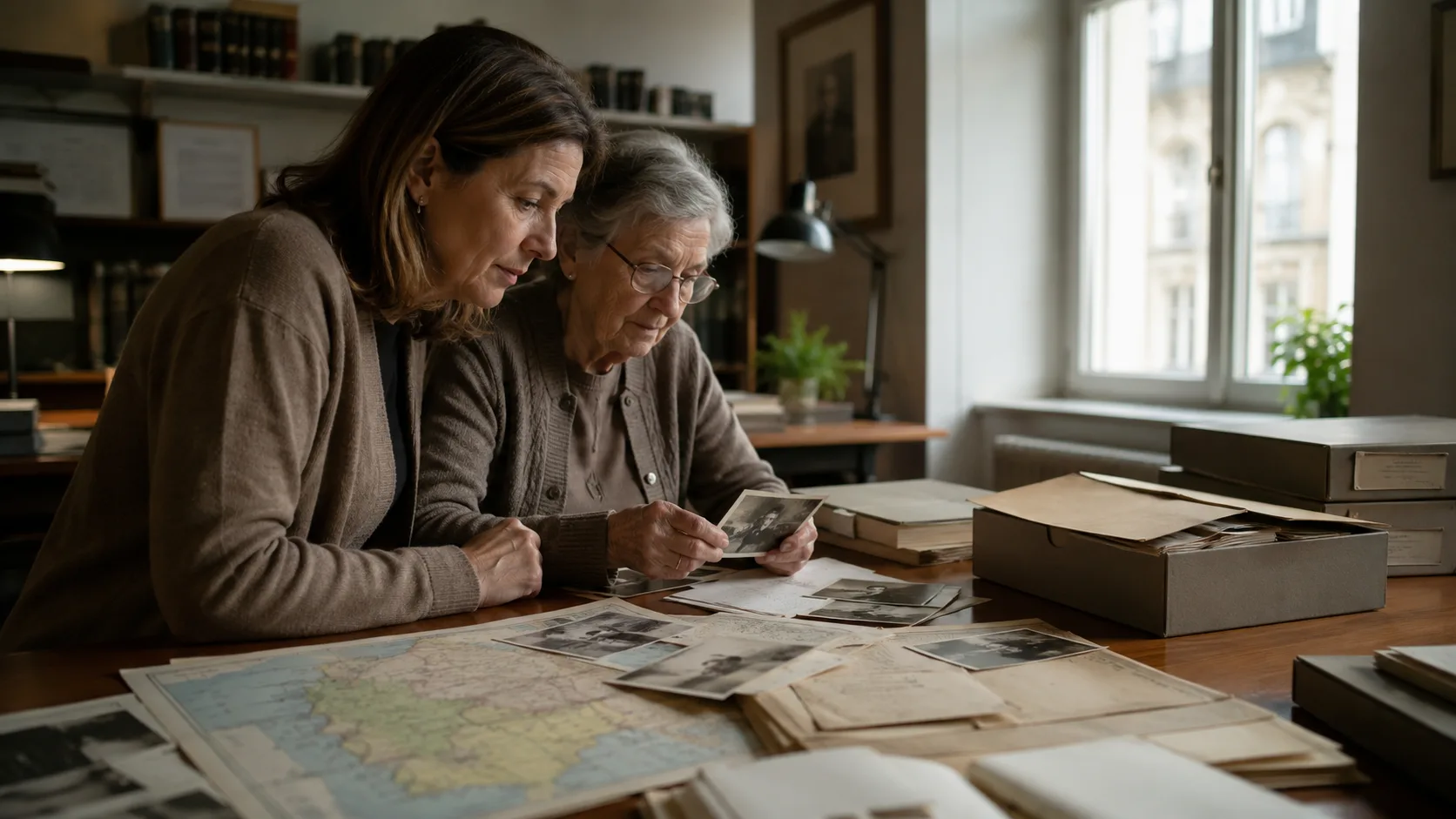
Displaced persons camp records can be an important source for families trying to understand what happened to Lithuanian relatives after World War II. For many Lithuanians, the years between the end of the war and later emigration to the United States, Canada, Australia, the United Kingdom, or other countries were not a simple gap in the family timeline. They were a documented period of movement, registration, temporary residence, resettlement, and changing legal status.
For descendants researching Lithuanian family history, these records may help explain where an ancestor went after leaving Lithuania, which family members traveled together, how names were recorded in different languages, and when the family left Europe. In some cases, DP camp records genealogy research may also support a broader document search connected to Lithuanian citizenship restoration, especially when the records help connect a person’s identity, family line, place of origin, or migration route.
What Were Displaced Persons Camps After World War II?
After World War II, millions of people in Europe were outside their country of origin and could not immediately return home. The Allies used the term “displaced persons,” often shortened to “DPs,” for people with very different wartime experiences, including forced laborers, concentration camp survivors, prisoners, refugees, and people who had fled advancing armies or political persecution. Arolsen Archives describes this group as people who were no longer in their countries of origin after liberation and who had different life stories and experiences of persecution.
Displaced persons camps were temporary facilities where people could be registered, housed, assisted, and later repatriated or resettled. These camps existed in Germany, Austria, Italy, and other parts of postwar Europe. Germany displaced persons camp records are especially important because many Baltic refugees, including Lithuanians, passed through the western occupation zones after the war.
For Lithuanian families, DP camps were often not just shelters. They became temporary communities with schools, religious life, cultural organizations, newspapers, family events, and administrative systems. This is why Lithuanian refugee camp records can sometimes preserve details that do not appear in later U.S. immigration or naturalization records.
Why Lithuanian Families Appeared in DP Camps
Many Lithuanians left Lithuania during the final phase of World War II, especially as the Soviet Union reoccupied the country. Some had been taken to Germany during the war for forced labor. Others left with retreating fronts, were evacuated, or fled because they feared Soviet repression. Archival material on Baltic DP camps notes that various roads led Lithuanians to postwar DP camps in Germany, with the largest number leaving Lithuania in July–October 1944.
This context matters for family history because the reason a person left Lithuania may affect which records exist. A person who was a forced laborer may appear in one type of record. A family that fled west in 1944 may appear in camp lists, refugee registrations, school records, church records, or later emigration files. A person who lived outside the formal camp system may be harder to trace in DP camp collections, even if they were part of the post World War II Lithuanian refugee community.
Lithuanian displaced persons camps after World War II were not always exclusively Lithuanian. Some camps were multinational, while others had strong Lithuanian communities. Records may therefore be organized by camp, occupation zone, nationality, family unit, relief agency, or later destination country.
What Displaced Persons Camp Records May Contain
Displaced persons camp records may include basic identity details, family relationships, places of birth, previous residence, wartime movements, occupation, religion, nationality, camp location, health information, registration numbers, and intended destination. The exact content depends on the type of document, the institution that created it, and the period when it was prepared.
Some of the most useful records for Lithuanian genealogy records World War II research are registration cards, camp lists, questionnaires, emigration files, transport lists, correspondence, and lists of residents. Arolsen Archives’ record group for registrations and files of displaced persons primarily contains documents on the postwar fates of displaced persons up to repatriation or emigration.
Not every record is complete. Some entries may include only a name and camp location, while others may provide a fuller personal history. Names may appear in Lithuanian, German, Polish, Russian, English, or simplified Latin-alphabet forms. Dates may also vary, especially when a person gave approximate information, used a different calendar convention, or was recorded by officials unfamiliar with Lithuanian spelling.
Why DP Camp Records Matter for Lithuanian Family History
For descendants in the United States, a family story may jump from “Lithuania” to “Germany” to “America” without explaining what happened in between. Displaced persons camp records can help fill that gap. They may show where a family stayed after the war, whether relatives were together or separated, which documents were used for later emigration, and when the person left Europe.
These records can also help resolve identity questions. A Lithuanian ancestor may appear under several spellings in U.S. census records, passenger records, naturalization files, church records, and family documents. DP camp records may provide a bridge between the Lithuanian version of a name and the later Americanized form. They may also preserve maiden names, family groupings, birthplaces, or prior residences that are difficult to confirm from U.S. sources alone.
For families researching Lithuanian displaced persons records, the value is often cumulative. One DP record may not answer every question, but it can point to another archive, another camp name, another spelling, or another member of the same family. In many cases, the research process is about connecting several partial records into a consistent historical timeline.
Where Lithuanian DP Camp Records May Be Found
Arolsen Archives displaced persons records are among the most important resources for this type of research. Their collections include registrations and files of displaced persons, children, and missing persons, as well as DP registration lists from camps in Germany, Europe, and other locations. The Arolsen record group for DP registration lists mainly includes postwar registrations of DPs in various camps and some registrations made outside camp settings by government agencies or consulates.
Other records may be found through national archives, Holocaust and refugee research institutions, genealogy databases, local German civil registration offices, church archives, Lithuanian diaspora collections, and U.S. immigration-related files. Ancestry, for example, describes its “Germany, Lists from Displaced Persons Camps, 1938–1985” collection as containing registers of people displaced by World War II, created mainly after the war.
The Center for Jewish History also maintains collection guides for displaced person camp materials, including records related to camps in Germany and Austria. Some collections are administrative rather than personal, but they may still help establish a camp’s history, location, population, or governing body.
Because records are distributed across institutions, a complete search usually requires more than one database. A negative result in one archive does not necessarily mean that no record exists. It may mean that the person was registered under a different spelling, lived outside a camp, appeared in a local civil file rather than a DP file, or was documented in a collection that has not been fully indexed online.
How to Search for Lithuanian Displaced Persons Records
A productive search usually starts with the ancestor’s full name, approximate birth date, birthplace, religion, spouse or parents, and known destination after the war. It is also important to collect every known spelling of the surname. Lithuanian names may have diacritics, gendered endings, patronymic forms, Slavicized spellings, Germanized spellings, or later Americanized versions.
When searching DP camp records genealogy databases, it is often useful to search broadly first and then narrow the results. A family name may be indexed incorrectly, and a person may appear under initials, a shortened given name, or a non-Lithuanian spelling. Searching by birthplace, spouse, child, or camp name can sometimes reveal records that a direct surname search misses.
For Lithuanian DP camps Germany research, camp names can also be difficult. A family may have remembered a nearby city rather than the official camp name. A person may have moved between camps. Records may use German place names, Allied occupation zone terminology, or later administrative names. If a U.S. passenger list or naturalization file mentions a last residence in Germany, that place can become a useful clue for locating the correct DP camp or local archive.
Common Problems in DP Camp Genealogy Research
One common problem is name variation. Lithuanian surnames may appear with missing diacritics, shortened endings, phonetic spellings, or translations. Women’s surnames may change after marriage or appear in forms that reflect Lithuanian grammar. In U.S. records, the same person may later appear under an Americanized surname.
Another problem is incomplete documentation. Some Lithuanian refugee camp records may have been lost, damaged, never created, or not yet digitized. Some people did not live in official camps. Others moved quickly, registered more than once, or used temporary documents during resettlement.
A third issue is conflicting information. A DP record may show one birthplace, while a later U.S. naturalization record gives a broader regional name. A birth date may differ by a few days. A name may be written in German in one record and in Lithuanian in another. These inconsistencies do not automatically make the record unusable, but they usually need to be evaluated carefully in the context of the full document trail.
DP Camp Records and Lithuanian Citizenship Restoration
Displaced persons camp records may be relevant to Lithuanian citizenship restoration research, but they should be understood correctly. In many cases, they are supporting historical records rather than direct proof of eligibility. They may help show that an ancestor was Lithuanian, identify a place of birth or residence, connect family members, explain postwar displacement, or document the path from Lithuania to another country.
For citizenship restoration, the key issues usually depend on the applicant’s specific family line, the ancestor’s Lithuanian citizenship history, the timing and circumstances of departure, later naturalization or citizenship events, and the available official documents. DP camp records can be useful when they help connect these facts, but they may need to be combined with Lithuanian civil records, prewar citizenship documents, birth and marriage records, U.S. naturalization files, or other official evidence.
It is important not to assume that a DP camp record alone proves eligibility. It may support the broader evidentiary picture, but the final relevance depends on the applicant’s situation and the way the records connect to the legal requirements applied by Lithuanian authorities.
How DP Records Can Help Reconstruct a Family Timeline
A strong family history file usually works like a timeline. It starts with the ancestor’s birth and family background in Lithuania, continues through wartime displacement, documents the period in Germany or another country, and then follows the person to the United States or another destination.
Displaced persons camp records can help place a Lithuanian ancestor within that timeline. They may show that the person was in a particular camp in 1946, applied for assistance in 1947, registered for emigration in 1948, or left Europe with family members in a later transport. Arolsen Archives has described its emigration card file as a collection that can help retrace individual paths of people who wanted to leave Germany after World War II.
This timeline can be useful for genealogy, but it may also help explain document gaps. If a family left Lithuania during wartime conditions, certain records may not have traveled with them. If a child was born in a DP camp or nearby German town, the birth record may be held by a local civil registry rather than in a Lithuanian archive. If a marriage took place after displacement, it may appear in German civil or church records rather than in Lithuanian parish records.
What to Do When No DP Camp Record Appears
If no displaced persons camp records appear in an online search, the research should not necessarily stop. The person may have been indexed incorrectly, registered under another spelling, lived in a private residence, appeared in a family member’s file, or been documented in a non-digitized collection.
It may help to search for relatives, not only the direct ancestor. A spouse, sibling, parent, or child may appear in a record that identifies the whole family group. It may also help to search U.S. arrival records, naturalization files, alien registration documents, church records, and obituaries for references to a German town, camp, ship, sponsor, or resettlement agency.
In many Lithuanian family history cases, the best result comes from combining several record types rather than relying on one archive. DP camp records are one part of the postwar evidence trail, but they often become more useful when compared with Lithuanian, German, and U.S. documents.
FAQ
What are displaced persons camp records?
Displaced persons camp records are documents created for people who were displaced in Europe after World War II. They may include camp registrations, resident lists, questionnaires, emigration files, transport records, and administrative documents. For Lithuanian families, these records may help trace where an ancestor lived after leaving Lithuania and before emigrating to another country.
How can DP camp records help Lithuanian genealogy?
DP camp records can help Lithuanian genealogy by connecting names, family members, birthplaces, camp locations, and postwar migration routes. They may explain how a Lithuanian ancestor moved from Lithuania to Germany and then to the United States or another destination. They can also help clarify surname variations and identify records in other archives.
Where can I find Lithuanian displaced persons records?
Lithuanian displaced persons records may be found in Arolsen Archives, DP camp collections, genealogy databases, national archives, local German civil registration offices, church archives, Lithuanian diaspora collections, and U.S. immigration records. The best search usually uses several name variants and compares records from multiple repositories.
Were all Lithuanian refugees after World War II in DP camps?
No. Many Lithuanian refugees lived in DP camps, but not all did. Some lived in private housing, worked outside camp systems, moved between locations, or were recorded by local authorities rather than camp administrations. This means a missing DP camp record does not automatically mean the person was not a postwar Lithuanian refugee.
Are DP camp records enough for Lithuanian citizenship restoration?
Usually, DP camp records are supporting documents rather than complete proof by themselves. They may help establish identity, family connections, displacement history, or migration route, but Lithuanian citizenship restoration typically depends on a broader set of documents and the applicant’s specific family history. The relevance of any DP record should be assessed together with Lithuanian, civil, immigration, and naturalization documents.
Why do names differ across Lithuanian DP camp records?
Names may differ because Lithuanian letters and diacritics were not always recorded correctly, officials used German or English spellings, surnames were transliterated, women’s surnames changed after marriage, or later U.S. records used Americanized forms. These differences are common in postwar records and should be evaluated by comparing dates, relatives, places, and document context.
Can DP camp records show when a Lithuanian ancestor emigrated?
They may. Some DP records include emigration files, destination countries, transport information, registration numbers, or references to resettlement agencies. However, the level of detail varies. A DP camp record may need to be compared with passenger lists, visa files, naturalization records, or U.S. arrival documents to confirm the full emigration timeline.