
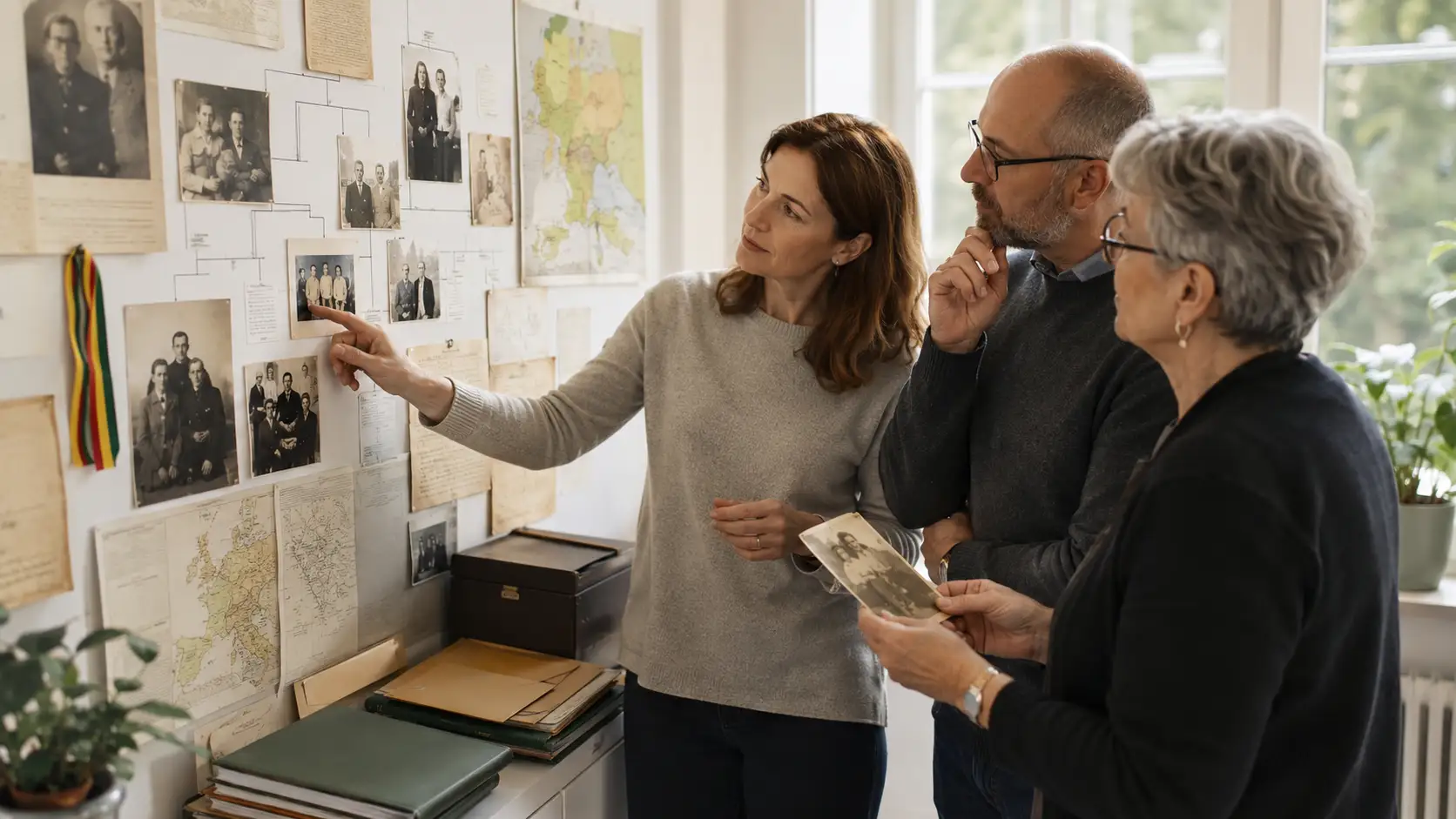
For many Americans with Lithuanian ancestry, the first question is not only whether an ancestor was Lithuanian, but whether the family connection comes through the mother’s side or the father’s side. Some applicants have a Lithuanian grandmother, others have a Lithuanian great-grandfather, and many families have documents that pass through several generations with changed surnames, different spellings, or incomplete civil records.
In most Lithuanian citizenship by descent cases, the central issue is not whether the line is maternal or paternal. What usually matters is whether the applicant can prove a direct legal family line to an ancestor who held citizenship of the Republic of Lithuania before June 15, 1940, and whether the other conditions for restoration or dual citizenship may be met. A maternal line can be relevant. A paternal line can also be relevant. The evidence must connect every generation clearly.
This guide explains how Lithuanian citizenship by descent through mother, father, grandparents, and great-grandparents is usually assessed, what documents may be needed, and why the strength of the direct lineage often matters more than whether the ancestor was on the mother’s or father’s side.
Does Lithuanian Citizenship by Descent Depend on Maternal or Paternal Line?
Lithuanian citizenship by descent is generally based on legal descent, not on a preference for the father’s side or the mother’s side of the family. In practical terms, a person may explore eligibility through either side if the family line can be documented and the Lithuanian ancestor fits the legal criteria.
This means that Lithuanian citizenship by descent through mother may be possible if the applicant’s mother, maternal grandparent, or maternal great-grandparent was connected to Lithuanian citizenship in the relevant legal period. The same logic may apply to Lithuanian citizenship by descent through father, including a father, paternal grandparent, or paternal great-grandparent.
The important distinction is between family tradition and legal proof. A family may know that a grandmother was Lithuanian, but an application usually needs documents showing identity, citizenship, departure history, and the applicant’s relationship to that ancestor. The line cannot usually be proven by family stories alone.
What Matters More Than the Side of the Family?
The most important issue is the Lithuanian citizenship by descent family line. The applicant must usually show a direct connection from themselves to the Lithuanian ancestor through official records. If the ancestor is a grandparent, the documents must connect the applicant to the parent and the parent to the grandparent. If the ancestor is a great-grandparent, the documents must connect each generation without leaving a gap.
This is why the phrase Lithuanian citizenship by descent direct lineage is important. The application is not based on a general ethnic connection to Lithuania. It is usually based on a traceable legal chain from the applicant to a qualifying ancestor. Each link in that chain may need to be supported by birth, marriage, name change, death, naturalization, passport, archive, or other official records.
A maternal line is not weaker simply because surnames changed after marriage. A paternal line is not automatically stronger because the surname stayed the same. What matters is whether the records can show that the people in the chain are the same people and that the relationship between each generation is legally clear.
Lithuanian Citizenship by Descent Through Mother
Lithuanian citizenship by descent through mother may be relevant where the Lithuanian ancestor appears on the maternal side of the applicant’s family. This can include a mother, maternal grandmother, maternal grandfather, maternal great-grandmother, or maternal great-grandfather, depending on the facts of the case.
In many U.S.-based families, the maternal line may involve surname changes after marriage. For example, a Lithuanian-born grandmother may appear under her Lithuanian maiden name in early records, under an Americanized version of that name in immigration records, and under her married surname in later U.S. records. These differences do not automatically make the case impossible, but they usually need to be explained and documented.
A strong maternal-line case usually shows the ancestor’s identity, the ancestor’s Lithuanian citizenship or relevant status, the ancestor’s departure from Lithuania or exile history where applicable, and the uninterrupted legal relationship from that ancestor to the applicant. Marriage records often become especially important because they explain why the surname changed from one generation to the next.
Lithuanian Citizenship by Descent Through Father
Lithuanian citizenship by descent through father may be relevant when the Lithuanian ancestor appears on the paternal side of the family. This may seem easier in some cases because surnames often remain more consistent in the paternal line, but this is not guaranteed. Fathers, grandfathers, and great-grandfathers may also have changed names after immigration, used shortened names in U.S. records, or appeared under different spellings in Lithuanian, Polish, Russian, Yiddish, German, or English-language documents.
A paternal line still needs the same type of proof as a maternal line. The applicant must usually show a direct relationship from the Lithuanian ancestor to the next generation and then to the applicant. A shared surname can help with recognition, but it does not replace formal evidence.
For example, if the case is based on a paternal great-grandfather, the file may need documents connecting the great-grandfather to the grandfather, the grandfather to the father, and the father to the applicant. If any generation has missing or inconsistent records, additional evidence may be needed to support the continuity of the family line.
Lithuanian Citizenship Through Maternal Grandparents
Lithuanian citizenship through maternal grandparents is a common scenario for descendants whose Lithuanian connection comes through their mother’s side. The qualifying ancestor may be the maternal grandmother or maternal grandfather. The applicant’s mother does not necessarily need to have restored Lithuanian citizenship first for the applicant to explore their own eligibility, but the relationship through the mother must be documented.
In this type of case, the applicant usually needs records showing the maternal grandparent’s identity and Lithuanian connection, the birth record of the applicant’s mother showing her relationship to that grandparent, and the applicant’s own birth record showing the relationship to the mother. If the maternal grandparent was a woman whose surname changed after marriage, the marriage certificate may be a key document.
The main risk in maternal grandparent cases is not the maternal nature of the line. It is usually the documentary gap created by changed names, missing marriage certificates, inconsistent places of birth, or records that identify the ancestor as Russian, Polish, Hebrew, Jewish, or from a historical region rather than explicitly as Lithuanian. These issues may be manageable, but they need careful document analysis.
Lithuanian Citizenship Through Paternal Grandparents
Lithuanian citizenship through paternal grandparents follows the same basic logic. If the applicant’s father’s parent was a Lithuanian citizen or otherwise relevant qualifying ancestor, the paternal line may be used to assess eligibility. The applicant must still prove the relationship from the grandparent to the father and from the father to the applicant.
Paternal grandparent cases may appear simpler when the family surname remains stable across generations. However, many Lithuanian surnames were changed, shortened, transliterated, or adapted after emigration. A Lithuanian surname ending may disappear in U.S. records. A name may appear differently in passenger lists, naturalization files, census records, military records, and civil certificates.
Because of this, paternal-line cases should not rely only on surname similarity. The stronger approach is to build a complete document chain, showing that the person in the Lithuanian or migration record is the same person who appears later in U.S. family records.
Lithuanian Citizenship by Descent Through Grandparents and Great-Grandparents
Many applicants research Lithuanian citizenship by descent through grandparents because the Lithuanian-born person in the family was one generation above the parent. In other cases, the relevant ancestor is further back, and the applicant explores Lithuanian citizenship by descent through great grandparents.
The further back the ancestor is, the more important the documentary chain becomes. A case based on a parent may require fewer generational links. A case based on a grandparent requires one additional link. A case based on a great-grandparent requires even more evidence because every generation must be connected clearly.
Great-grandparent cases can be more complex because older records may be held in archives, written in different languages, or affected by historical border changes. The ancestor may have lived in a region that was part of the Republic of Lithuania during the relevant period, or the record may use a historical place name that does not match a modern map. These factors do not automatically prevent a case, but they can affect how the evidence is interpreted.
Can Lithuanian Citizenship Be Passed Through the Mother?
Yes, Lithuanian citizenship may be relevant through the mother’s side if the applicant can prove the required direct lineage and the ancestor meets the applicable criteria. The maternal line is not normally excluded simply because it passes through women or because surnames changed through marriage.
The question “can Lithuanian citizenship be passed through the mother” often comes from applicants whose Lithuanian connection is a mother, grandmother, or great-grandmother. The answer depends on the documents. If the records prove the maternal relationship and the Lithuanian ancestor’s qualifying status, the maternal line may be usable.
The main challenge is often evidence. A mother’s birth certificate, the mother’s parents’ marriage certificate, the maternal ancestor’s birth or citizenship records, and documents explaining surname changes may all be relevant. Where records are inconsistent, supporting documents may be needed to show that the same person appears across different jurisdictions and time periods.
Can Lithuanian Citizenship Be Passed Through the Father?
Lithuanian citizenship may also be relevant through the father’s side if the applicant can prove a direct relationship to a qualifying Lithuanian ancestor. The paternal line is commonly used in citizenship by descent cases, but it is not automatically accepted without proof.
The question “can Lithuanian citizenship be passed through the father” is usually easier to answer in principle than in practice. In principle, the father’s line can matter. In practice, the applicant still needs a documented chain. A father’s birth certificate, the applicant’s birth certificate, the relevant grandparent or great-grandparent records, and evidence of citizenship or departure history may all be necessary depending on the case.
Even where the surname is consistent, the file should show more than a name match. Lithuanian citizenship restoration is normally document-driven. The evidence should connect the applicant to the Lithuanian ancestor in a way that is clear to the reviewing authority.
Lithuanian Descent Certificate vs Citizenship Restoration
A Lithuanian descent certificate is not the same thing as restoration of Lithuanian citizenship. This distinction matters because some applicants use the phrase “Lithuanian descent” broadly when they are actually researching citizenship by descent, while others are asking about a specific document connected to Lithuanian origin.
A Lithuanian descent certificate generally relates to recognition of Lithuanian origin or descent. Citizenship restoration is a separate legal process that usually requires proof of a qualifying citizenship link, not just ethnic background. A person may have Lithuanian roots and still need to prove that the ancestor held citizenship of the Republic of Lithuania in the relevant period.
For SEO and user-intent purposes, many people search for Lithuanian descent certificate when they are trying to understand whether family records, ethnic origin, or archive documents can help them. In a real case, it is important to identify which route the applicant is considering: recognition of Lithuanian descent, a certificate of the right to restore citizenship, or actual reinstatement of citizenship.
Documents That Usually Matter in Maternal and Paternal Line Cases
In both maternal and paternal line cases, the evidence usually needs to prove two things: the qualifying Lithuanian connection and the direct family relationship. The documents may include birth certificates, marriage certificates, death records, naturalization papers, passports, military records, archive records, census records, immigration records, and documents explaining changes of name or surname.
For maternal lines, marriage certificates often play a central role because they connect maiden names and married names. For paternal lines, surname continuity may help, but name variations still need attention. For both lines, foreign documents may need translation, legalization, apostille, or other formal preparation depending on where they were issued and how they are submitted.
The strongest file is usually one where each generation is clearly documented. If an applicant relies on a great-grandparent, the file should not jump from the great-grandparent directly to the applicant without proving the intermediate family links. The reviewing authority needs to see the full lineage.
Common Problems in Maternal and Paternal Lineage Cases
The most common problems are not usually about whether the line is maternal or paternal. They are about records. Names may be spelled differently across documents. Dates of birth may vary by a few days or years. A birthplace may appear as Lithuania in one record, Russia in another, Poland in another, and a historical town name in a third. These differences are common in families affected by migration, war, border changes, and multilingual recordkeeping.
Another issue is proving that an ancestor was a Lithuanian citizen, not only born in Lithuania or ethnically Lithuanian. Birthplace and ethnicity may be useful clues, but they may not be enough by themselves. The case may need documents showing citizenship, residence, service, public records, or other evidence connected to the Republic of Lithuania before June 15, 1940.
A further issue is departure history. In many restoration and dual citizenship cases, the timing and circumstances of leaving Lithuania can matter. U.S. naturalization records, passenger lists, refugee records, foreign passports, marriage records, and other documents may help show when the ancestor left Lithuania and where the family lived later.
How to Choose the Strongest Family Line
Some applicants have Lithuanian ancestors on both the maternal and paternal sides. In that situation, the strongest line is not necessarily the closest emotionally or the one with the most family stories. It is usually the line with the clearest documents, the strongest proof of Lithuanian citizenship, and the fewest unresolved gaps.
A maternal great-grandmother with a complete archive file may be stronger than a paternal grandfather with only oral history. A paternal grandparent with clear citizenship and departure records may be stronger than a maternal line where key certificates are missing. Each line should be assessed based on documentary strength, not assumptions about gender or surname.
It may also be useful to compare the generations. A parent or grandparent line may involve fewer records than a great-grandparent line. However, if the closer ancestor does not meet the legal criteria and the older ancestor does, the more distant line may still be relevant. The best approach is to map the full family tree and then test each possible line against the documents.
FAQ
Can Lithuanian citizenship by descent come through the mother?
Yes, Lithuanian citizenship by descent through mother may be possible if the applicant can prove a direct legal family line to a qualifying Lithuanian ancestor. The maternal side is not usually excluded simply because surnames changed through marriage. The key issue is whether the documents connect each generation clearly.
Can Lithuanian citizenship by descent come through the father?
Yes, Lithuanian citizenship by descent through father may be possible if the paternal line connects the applicant to a qualifying Lithuanian ancestor. A shared surname may help with identification, but it does not replace the need for birth, marriage, citizenship, departure, and other supporting records.
Can I apply through Lithuanian maternal grandparents?
You may be able to apply through Lithuanian maternal grandparents if one of them meets the relevant citizenship criteria and the family relationship is documented. The file usually needs to connect the maternal grandparent to your parent and your parent to you. Marriage and name change records may be especially important in maternal-line cases.
Can I apply through Lithuanian paternal grandparents?
You may be able to apply through Lithuanian paternal grandparents if the paternal grandparent was a qualifying Lithuanian ancestor and the direct family line can be proven. The case should still include documents for each generation, even if the surname appears consistent.
Can Lithuanian citizenship by descent pass through great-grandparents?
Lithuanian citizenship by descent through great grandparents may be relevant in many cases, but it is usually more document-heavy than a parent or grandparent case. The applicant must normally prove the relationship through every generation and show that the great-grandparent meets the applicable Lithuanian citizenship criteria.
Is a maternal line weaker because surnames changed?
No, a maternal line is not automatically weaker because surnames changed. Surname changes are common in citizenship by descent cases. The issue is whether the applicant can explain and document those changes through marriage certificates, name change records, civil certificates, or other reliable evidence.
Is Lithuanian ethnic origin enough for citizenship by descent?
Lithuanian ethnic origin may be relevant, but it is not always enough for citizenship restoration. Many cases require proof that the ancestor held citizenship of the Republic of Lithuania before June 15, 1940, along with proof of direct lineage and other case-specific requirements. A Lithuanian descent certificate and citizenship restoration should not be treated as the same procedure.
What is the most important part of a Lithuanian citizenship by descent family line?
The most important part is a complete and credible direct lineage from the applicant to the qualifying Lithuanian ancestor. The documents should identify each person in the chain and show how one generation is legally connected to the next. Whether that line is maternal or paternal is usually less important than whether the evidence is complete.