
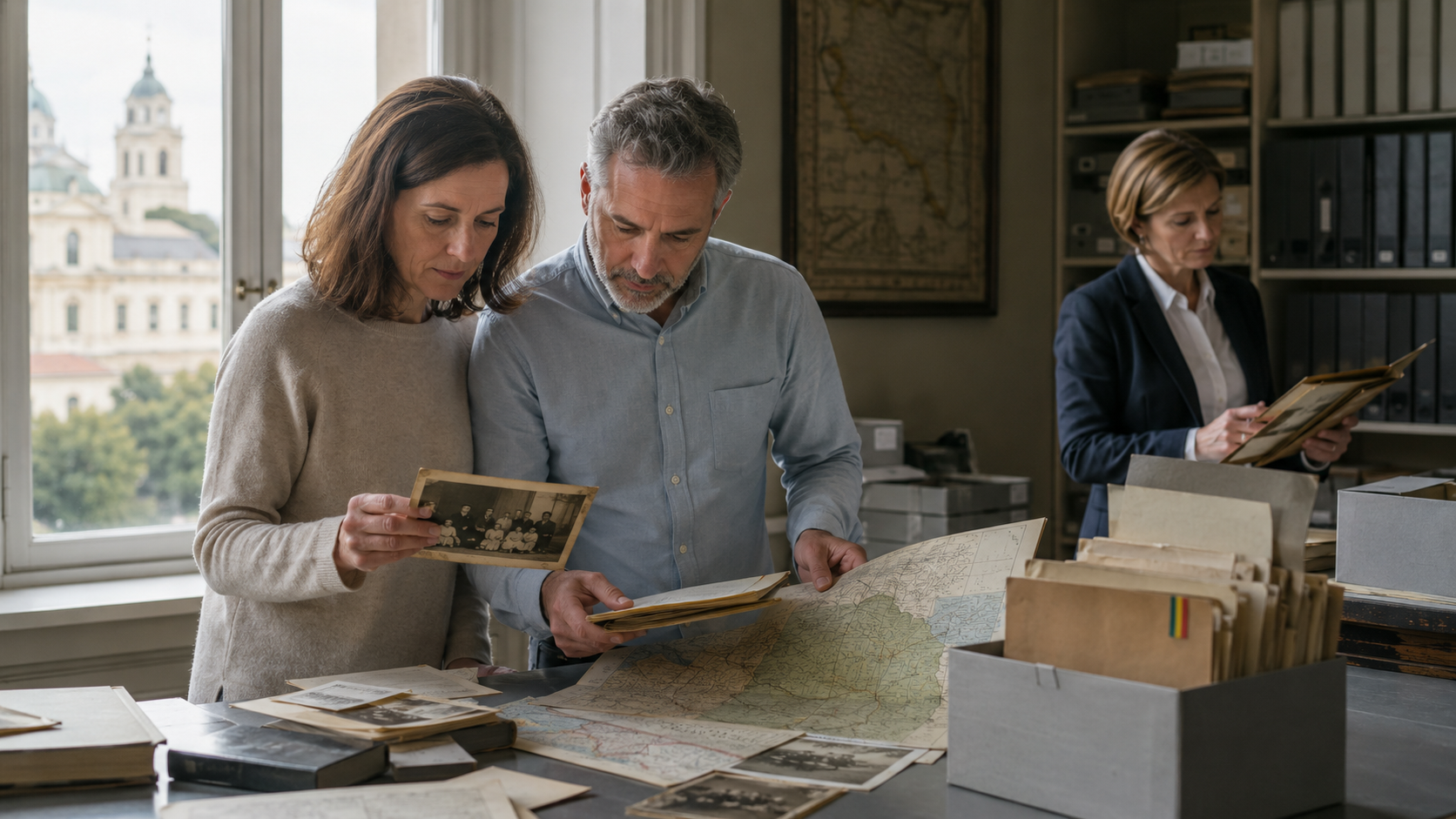
Family records from Central and Eastern Europe can create unexpected questions for people researching Lithuanian citizenship. An ancestor may have identified as Lithuanian, lived in a community historically connected with Lithuania, or spent most of their life in the region, while an old birth certificate lists Poland, the Russian Empire, or a territory that today belongs to Belarus. In other cases, the same town may appear under different country names in documents created only a few decades apart. These differences do not necessarily mean that the family has no connection to Lithuania. They often reflect political changes, shifting borders, and different administrative systems that existed during the nineteenth and twentieth centuries. For this reason, Lithuanian citizenship by descent historical borders cases require more than simply comparing an ancestor’s recorded birthplace with a modern map. The date of birth, historical jurisdiction, citizenship status, residence, and later family history may all be relevant when determining whether a potential legal basis for citizenship exists.
This issue is particularly common when researching a Lithuanian citizenship by descent ancestor born in Poland or a Lithuanian citizenship by descent ancestor born in Belarus. A place that appears outside modern Lithuania today may have had a different political or administrative status when the ancestor lived there. The same problem arises when examining a Lithuanian citizenship ancestor born in Russian Empire, especially because many family records predate the establishment of the modern Lithuanian state. The country written on a historical document should therefore be understood in the context of the period in which that document was created. An ancestor’s place of birth can provide an important starting point for archival research, but it does not independently establish Lithuanian citizenship. A proper assessment normally requires examining the person’s historical legal status and determining whether records exist that can connect the ancestor with Lithuania under the citizenship rules relevant to the family’s circumstances.
The issue becomes especially important in cases involving Vilnius and the surrounding territory. Changes in sovereignty and administration during the twentieth century mean that families researching Lithuanian citizenship by descent Vilnius region may encounter records issued by different authorities or containing different versions of the same place name. A person whose grandfather born in Vilnius appears in Polish or other historical records should not assume that the wording of the birthplace automatically determines the outcome of a citizenship application. Similarly, research into Lithuanian citizenship Vilnius region cases requires separating several different questions: where the ancestor was born, where the person lived, what citizenship status can be established, and which documents survive from the relevant historical period. These distinctions are important because Lithuanian citizenship by descent place of birth is only one element of the broader legal and documentary analysis.
Historical timing can create additional complexity. Someone investigating Lithuanian citizenship by descent before 1918 may be working with records created before Lithuania declared independence, while another family may have documents from the interwar period showing a different administrative framework. Questions involving Lithuanian citizenship by descent pre-1940 borders therefore cannot be resolved solely by translating an old birth certificate or identifying the modern country in which the birthplace is located. Applicants may need to reconstruct the ancestor’s history using civil records, residence information, historical passports, archival files, and other official evidence. The purpose of this research is not simply to prove that the family had Lithuanian heritage, but to determine whether the historical facts can support Lithuanian citizenship by descent and establish the legal connection required for a modern application.
Why Historical Borders Matter for Lithuanian Citizenship
Historical borders can make citizenship research difficult because the country associated with a town or village today may not be the same country that governed the area when an ancestor was born, married, lived there, or emigrated. For families dealing with Lithuanian citizenship by descent historical borders, modern geography is therefore only part of the picture. Researchers may need to identify which authority controlled the territory during the relevant period, what official records were created there, and whether other documents provide evidence of the ancestor’s legal status. This distinction is especially important when records from different decades describe the same birthplace differently. A birth record, marriage certificate, immigration document, and naturalization file may all refer to one location using different languages, spellings, or political jurisdictions. These variations do not automatically create a contradiction. They need to be examined within their historical context and compared with other evidence relating to the same individual.
The timing of the family history is equally important. In a case involving Lithuanian citizenship by descent before 1918, an ancestor may have been born before the establishment of the independent Lithuanian state, meaning the birth record itself cannot simply be treated as proof that the person later held Lithuanian citizenship. Likewise, Lithuanian citizenship by descent pre-1940 borders cases may involve territories whose political status changed during the interwar period. The key question is not merely which country appears beside the birthplace in one document, but what the complete historical record demonstrates about the ancestor. Later residence documents, passports, citizenship records, archival files, or other official evidence may be needed to determine whether the person acquired or held a status relevant to a modern citizenship claim. This is why historical geography and citizenship status should be examined together rather than assuming that one automatically proves the other.
What If Your Ancestor Was Born in Poland, Belarus, or the Russian Empire?
For Lithuanian citizenship by descent, an ancestor born in Poland requires particular attention to dates and historical circumstances. The word “Poland” on a family document does not necessarily provide a complete answer about the ancestor’s connection to Lithuania, especially where records concern territories whose administration changed during the twentieth century. Applicants should first identify the precise town or village, the date associated with the record, and the authority that issued it. They can then examine whether additional evidence exists concerning the ancestor’s residence or citizenship. The same approach applies to a Lithuanian citizenship by descent ancestor born in Belarus. Modern borders should not be projected backward without considering the historical period, but a historical connection with territory associated with Lithuania also should not be treated as automatic evidence of citizenship. The purpose of the research is to establish the ancestor’s documented legal history rather than infer citizenship solely from geography.
When assessing Lithuanian citizenship, an ancestor born in the Russian Empire presents a similar challenge because the place of birth may predate Lithuania’s independence. In such a case, the historical birth record can establish identity, parentage, religion, residence, or another important fact, but further records may be necessary to understand the person’s later citizenship status. This is particularly relevant when the ancestor continued living in the region after 1918, moved elsewhere, or emigrated abroad. The applicant may need to compare records created at different stages of the ancestor’s life to determine whether a potential basis for citizenship restoration or reinstatement exists. Depending on the family history, the analysis may also need to identify qualifying descendants and establish the family line from the ancestor to the current applicant through birth, marriage, name-change, and other civil records. Taken together, these documents can provide a much more reliable picture than the country name written on a single historical certificate.
The Vilnius Region and Lithuanian Citizenship
The Vilnius region is one of the clearest examples of why historical geography must be considered carefully in citizenship research. Families researching Lithuanian citizenship by descent Vilnius region may discover that records relating to the same ancestor were created under different administrations and in different languages. A birthplace may appear as Vilnius in one document, Wilno in another, or be connected with Poland in immigration and naturalization records created abroad. These variations can reflect the historical circumstances in which the documents were issued rather than different places or different people. For this reason, when assessing Lithuanian citizenship in the Vilnius region, a single document should not be compared with Lithuania’s present-day borders in isolation. The date of the record, the authority that issued it, the ancestor’s residence, and any evidence relating to citizenship status may all need to be considered together. This is particularly important where the family possesses foreign documents but few records from Lithuania itself.
For example, an applicant researching a grandfather born in Vilnius may have a U.S. immigration record identifying the birthplace as Poland, while an earlier family record uses another geographical description. This difference alone does not determine whether the applicant has a legal basis for citizenship. Instead, the records should be placed in chronological order and examined alongside evidence showing where the grandfather lived, what legal status he held, and when he left the region. The same principle applies more broadly to Lithuanian citizenship by descent historical borders cases. Historical place names and jurisdictions help explain the family story, but they must be connected with evidence of the ancestor’s status. Once the historical identity and legal position of the ancestor have been established, the next step is to document the relationship between that person and the applicant through each generation.
Does Place of Birth Prove Lithuanian Citizenship?
Place of birth can be an important piece of evidence, but it should not automatically be treated as proof of citizenship. This distinction is central to Lithuanian citizenship by descent place of birth cases because applicants often begin with a birth certificate and assume that the country or city listed there answers the citizenship question. In reality, a historical birth record primarily establishes facts surrounding the birth, while citizenship may need to be demonstrated through additional records. This becomes particularly important where an ancestor was born before Lithuanian independence or in a territory affected by subsequent border changes. In a Lithuanian citizenship by descent before 1918 case, for example, the applicant may need to examine what happened later in the ancestor’s life rather than expecting the original birth record to establish a citizenship status that developed under a later legal framework.
The distinction between birthplace and citizenship is equally relevant where modern geography appears to place the ancestor outside Lithuania. A Lithuanian citizenship by descent ancestor born in Belarus or a Lithuanian citizenship by descent ancestor born in Poland may require research into historical jurisdiction, later residence, and other records associated with the individual. Similarly, if a Lithuanian citizenship ancestor born in Russian Empire later lived in independent Lithuania, documents created during that later period may be important to the assessment. The objective is therefore not to change or reinterpret what an old birth certificate says, but to understand what that record proves and what additional facts still need to be established. This approach helps separate ancestry, historical geography, residence, and citizenship instead of treating them as interchangeable concepts.
What Historical Records Can Help Establish Eligibility?
Once the relevant historical context has been identified, applicants can begin assembling records that provide a fuller picture of the ancestor’s life and status. Depending on the family, useful evidence may include birth and marriage certificates, historical passports, residence records, archival certificates, internal passport files, military or migration records, and foreign immigration or naturalization documents. No single type of record necessarily answers every question. Instead, different sources may work together to establish identity, residence, family relationships, and legal status. This can be especially important in Lithuanian citizenship by descent pre-1940 borders cases, where records from several jurisdictions may need to be compared before the ancestor’s history becomes clear.
The documentary review must also connect the historical ancestor with the person applying today. Establishing the family line from the ancestor to the current applicant may require birth certificates, marriage records, and documents explaining surname or name changes across several generations. Once this chain has been established, the available historical evidence can be assessed to determine whether the applicant may fall within the relevant group of qualifying descendants and whether further archival research is necessary. The records required will depend on the individual family history, particularly when documents have been lost or contain different versions of names, dates, or places. For this reason, gathering documents should follow the historical and legal analysis rather than simply collecting every record that mentions Lithuania.
How Historical Borders Can Affect the Legal Pathway
Once the ancestor’s identity, place of residence, and historical status have been reconstructed, the next step is to determine which citizenship procedure may apply. Historical geography alone does not establish the correct legal pathway. In cases involving Lithuanian citizenship by descent historical borders, records must be considered together to determine whether they support a claim connected with a person who held a relevant Lithuanian citizenship status. Depending on the circumstances, the assessment may involve citizenship restoration or reinstatement, but the appropriate procedure cannot be selected solely because an ancestor was born in a territory historically associated with Lithuania. The ancestor’s documented status, the relevant dates, and the direct family relationship remain central to the analysis.
This is particularly important in Lithuanian citizenship by descent pre-1940 borders cases, where modern borders can create a misleading first impression of the family history. An applicant may discover that an ancestor’s birthplace is now in Poland or Belarus, while other records connect the same person with Lithuania during a legally relevant period. Conversely, a historical territorial connection does not automatically establish citizenship. Before preparing an application, the available records should therefore be reviewed as a complete chronological history. This helps determine whether there is sufficient evidence of the ancestor’s status, whether additional archival research is required, and whether the applicant belongs among the qualifying descendants under the relevant legal pathway.
Conclusion
An ancestor’s birthplace outside the borders of modern Lithuania does not, by itself, answer whether a descendant may have a citizenship claim. A Lithuanian citizenship by descent ancestor born in Poland, a Lithuanian citizenship by descent ancestor born in Belarus, or a Lithuanian citizenship ancestor born in Russian Empire may each require a different historical and documentary analysis. The country appearing on an old certificate must be understood in relation to the date of the document, the political jurisdiction that existed at the time, and the ancestor’s later legal history. This is particularly relevant for families connected with the Vilnius region and other territories whose administration changed during the nineteenth and twentieth centuries.
For this reason, Lithuanian citizenship by descent place of birth should be treated as one part of the assessment rather than the final test of eligibility. Applicants should identify the precise ancestor, reconstruct the relevant historical timeline, find evidence concerning citizenship or legal status, and document the family relationship through each generation. A professional review can then help determine whether the available evidence supports Lithuanian citizenship by descent and which legal procedure may apply. Understanding the historical context before filing can also prevent applicants from dismissing a potentially relevant family history simply because a modern map places their ancestor’s birthplace outside Lithuania.
Frequently Asked Questions
Can I qualify if my Lithuanian ancestor was born in Poland?
Potentially. The birthplace listed as Poland does not determine eligibility by itself. The date, historical jurisdiction, ancestor’s legal status, and supporting records should all be considered.
What if my Lithuanian ancestor was born in modern-day Belarus?
A modern Belarusian birthplace does not necessarily exclude a historical connection with Lithuania. The relevant historical period and the ancestor’s documented status must be examined before conclusions about eligibility can be made.
What if my ancestor was born in the Russian Empire?
If the ancestor was born before Lithuanian independence, the birth record may establish identity and family relationships but may not by itself prove later Lithuanian citizenship. Additional historical records may be required.
Can I qualify if my grandfather was born in Vilnius when it was recorded as Poland?
Potentially. Historical records concerning Vilnius may use different jurisdictions or place names depending on when they were created. Eligibility should be assessed using the complete documentary and citizenship history rather than the country designation on one record.
Does being born in historical Lithuanian territory prove citizenship?
No. Historical geography and citizenship are different issues. A territorial connection can be relevant to research, but citizenship status generally requires its own supporting evidence.
Can records created before 1918 be used?
Yes, historical records can help establish identity, ancestry, residence, and other relevant facts. However, in Lithuanian citizenship by descent before 1918 cases, additional records may be necessary to determine the ancestor’s later legal status.
What documents should I look for?
Useful evidence may include birth and marriage certificates, historical passports, residence or archival records, immigration documents, naturalization records, and documents establishing the direct family relationship between generations.
Do different historical place names create a problem?
Not necessarily. The same city or village may appear under different names, languages, or jurisdictions in records created at different times. These differences should be explained through historical context and supporting documentation.
What should I do before applying?
Start by identifying the exact birthplace and date associated with the ancestor, then reconstruct the historical jurisdiction and collect records concerning the ancestor’s identity and status. After that, establish the family line from the ancestor to the current applicant and determine whether additional archival research or legal analysis is needed before filing.