
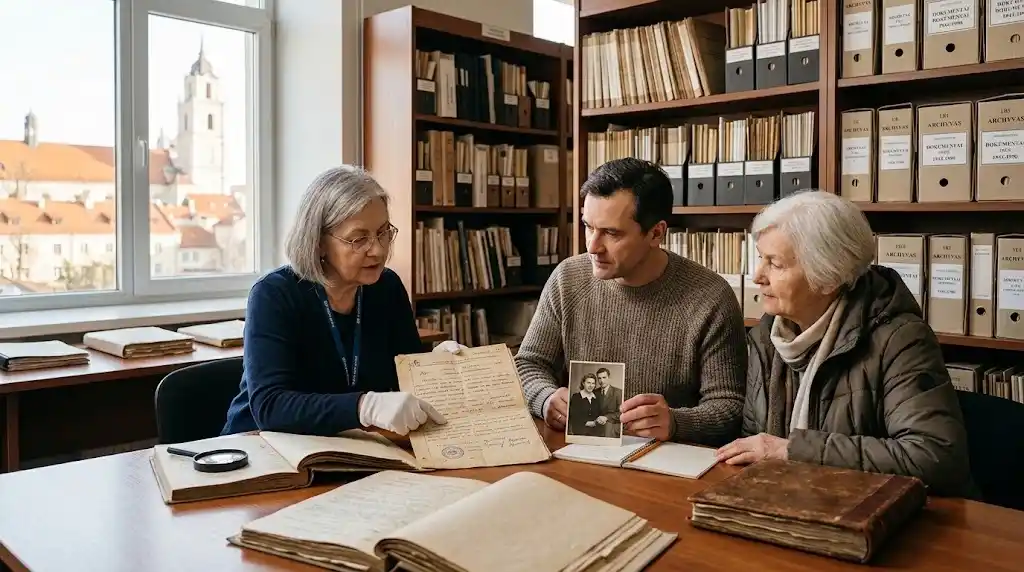
Family research in Lithuania does not always begin with an old Lithuanian passport or a pre-war birth certificate. For families whose relatives remained in or passed through Lithuania during the Soviet period, later documents may preserve valuable information about identity, family relationships, places of birth and residence.
These Lithuanian ancestry records can help reconstruct connections between generations when earlier family documents have been lost or are incomplete. Soviet-period sources may also provide clues leading researchers to older Lithuanian genealogy records held in other archival collections.
However, a Soviet document should be interpreted according to what it actually records. Evidence that a person lived in Lithuania, was described as Lithuanian or belonged to a particular family is not automatically evidence that the person held citizenship of the Republic of Lithuania before the Soviet occupation. The value of the record depends on its contents and the question that needs to be established.
What Soviet-Era Records Can Prove About Lithuanian Ancestry
Soviet-era records Lithuania archives preserve can document different parts of a person’s life. Depending on the record, they may identify parents, spouses or children, record a birthplace or address, show employment or military service, or provide information about displacement, deportation or exile.
When several records are examined together, they can become useful Lithuanian family history records. A residence file might establish where a person lived, while a civil record confirms a family relationship and another archival document provides an earlier place of birth. These details can help researchers connect people across different periods and generations.
Such evidence can be particularly useful when trying to prove Lithuanian ancestry but the family no longer possesses a complete collection of original documents. Soviet-era material may help fill gaps in the family history or identify information needed to continue research in older collections.
At the same time, ancestry and citizenship should not be treated as identical concepts. A Soviet record can provide important genealogical evidence without independently proving that an ancestor was a citizen of Lithuania during an earlier historical period.
Which Soviet-Era Documents Can Help Trace a Lithuanian Family?
There is no single Soviet document that is useful in every family case. The most relevant source depends on where the ancestor lived, what happened to the family and which part of the family line needs to be established.
Different Lithuanian archive records may complement one another. Civil records can establish relationships, residence or employment documents can provide addresses and biographical details, while records connected with repression or displacement may preserve information unavailable elsewhere.
Civil Registration and Family Records
Civil registration records can be particularly useful for reconstructing relationships between generations. Birth, marriage and death information may identify parents, spouses, places of birth and other details needed to connect one family member with another.
These records can also help resolve gaps created by migration, surname changes or missing family papers. When combined with earlier or later documents, they may provide the documentary bridge needed to follow a family line across several decades.
Residence, Employment and Military Records
Residence records may show where an ancestor lived and, depending on the document, provide information about household members, previous addresses or places of origin. Employment files can contain personal details that help distinguish between people with similar names.
Military-related records may also contain biographical information such as dates and places of birth, residence or family details. Their value depends on the individual record, so the information should be compared with other available evidence rather than considered in isolation.
Deportation, Exile and KGB Records
For families affected by Soviet repression, records concerning deportation, exile, imprisonment or surveillance may contain substantial biographical information. Files can include details about relatives, residence, occupation, property, places of birth and the circumstances surrounding displacement.
Lithuanian deportation and exile records can therefore be particularly valuable when a family’s documentary history was disrupted by forced movement or repression. In some cases, these files may provide leads to other archives or identify relatives and locations that were previously unknown to descendants.
What Details Can Soviet Records Reveal?
The value of a Soviet-era document often lies in the combination of details it contains. A single record may identify a person’s birthplace, relatives, address or nationality entry, while several documents together can help establish connections that are not clear from one source alone.
For genealogical research, these details can help distinguish between people with similar names and trace the same person through different stages of life. They may also point researchers toward earlier records or locations where additional evidence could be found.
Family Relationships, Birthplaces and Residence
Family relationships are among the most useful details preserved in Soviet-era records. Depending on the type of document, a record may identify parents, spouses, children or other relatives. Birthplaces and residence information can then help connect these individuals to particular towns, villages or regions.
Addresses can also be valuable when the family moved over time. Comparing residence information with civil, employment or other records may help reconstruct where an ancestor lived and identify additional sources relevant to the same family.
Names, Patronymics and Nationality Entries
Names may appear differently across Lithuanian, Russian and other records. Soviet documents can include patronymics, alternative spellings or versions of names written in different alphabets. These details may help explain why the same ancestor appears under different forms of a name in separate sources.
Some Soviet records also contain a nationality entry. Such an entry can be useful for family-history research, but it should be interpreted carefully. A record describing a person’s nationality as Lithuanian is not, by itself, proof that the person held citizenship of the Republic of Lithuania.
Where Are Soviet-Era Lithuanian Records Kept?
Soviet-period documents are not necessarily held in one institution. The location of a record depends on its type, the authority that created it and the historical circumstances involved.
Researchers may therefore need to consult several Lithuanian archives for ancestry records. Identifying the type of document needed before beginning a search can help determine which archive is most likely to hold relevant material.
Lithuanian Special Archives
The Lithuanian Special Archives preserve records connected with Soviet security institutions and other structures of repression. For families affected by surveillance, imprisonment, deportation or exile, these collections may contain information that is particularly valuable for reconstructing an ancestor’s history.
The contents of individual files vary. A record may include biographical information, relatives, addresses, employment or details concerning repression and displacement. These materials should be assessed together with civil and other archival evidence when reconstructing a family line.
Regional and Central State Archives
Regional and central state archives may preserve other categories of documents relevant to Lithuanian ancestry research. The appropriate archive depends on the location, period and institution responsible for creating the original record.
Because related evidence may be distributed across several collections, researchers often need to follow information from one document to another. A birthplace found in one record, for example, may indicate where to search for civil or earlier family documentation.
How to Use Soviet Records to Reconstruct Your Family Line
The most effective approach is usually to begin with information that is already known and work backwards through each generation. Names, dates of birth, places of residence, marriages and family relationships can be compared across Soviet and other records to establish a consistent documentary chain.
Differences between records should not automatically be treated as contradictions. Transliteration, patronymics, surname changes and the use of different languages may produce several versions of the same person’s name. Dates and locations should therefore be compared alongside names rather than relying on a single detail.
Soviet-era documents can also provide leads to earlier evidence. A birthplace, parent’s name or former address may indicate where pre-war records could be located. For descendants researching how to find Lithuanian ancestors, this process can gradually connect recent family information with older archival material.
The objective is not simply to collect as many documents as possible. Each record should contribute to a specific part of the family history: identifying an ancestor, establishing a relationship, confirming a location or directing the search toward an earlier source.
Can Soviet-Era Records Support a Lithuanian Citizenship by Descent Case?
Soviet-era documents can support a citizenship-by-descent case when they help establish family relationships, identity, residence or other relevant facts. For example, a record identifying an ancestor’s parents or birthplace may help connect generations or direct researchers toward earlier Lithuanian documents.
However, Soviet records should not automatically be treated as proof that an ancestor held citizenship of the Republic of Lithuania. A Soviet passport, residence record or nationality entry was created within a different legal system and may establish different facts. Where historical Lithuanian citizenship is relevant, applicants may still need evidence that can prove pre-1940 Lithuanian citizenship.
The value of Soviet-era evidence therefore depends on the role it plays within the broader documentary chain. It may support Lithuanian citizenship through a grandparent, help establish a missing family connection or identify where additional historical records should be searched.
What If Pre-1940 Lithuanian Documents Are Missing?
Families do not always possess passports, citizenship certificates or other documents issued before 1940. Wars, occupation, migration, deportation and the passage of time may all have contributed to the loss of original records.
If the original Lithuanian citizenship documents are missing, Soviet-era sources may provide information that helps continue the archival search. A later record might identify an ancestor’s birthplace, former residence, parents or other details that lead researchers to older records.
This does not mean that a Soviet document automatically replaces the evidence required for a citizenship case. Its role may instead be to bridge gaps in the family history or provide information needed to locate stronger historical evidence. Depending on what the available records establish, a Certificate of Lithuanian Descent may also be relevant as a separate legal concept.
Common Problems When Reading Soviet-Era Documents
Soviet-era records can be valuable, but they are not always straightforward to interpret. Names may appear in Russian, Lithuanian or another language, and transliteration can produce several spellings for the same person. Patronymics may also appear in records even when they are absent from later family documents.
Administrative boundaries and place names may have changed over time, making historical locations harder to identify. Dates or personal details can also vary between records because of transcription, translation or administrative practices.
For this reason, one difference should not automatically be treated as evidence that two records concern different people. Names, dates, relatives, birthplaces and addresses should be compared together. At the same time, researchers should avoid assuming that similar information proves identity without sufficient supporting evidence.
Frequently Asked Questions
Can Soviet-Era Documents Prove Lithuanian Ancestry?
They can provide evidence of family relationships, birthplaces, residence and other facts relevant to Lithuanian ancestry research. Their value depends on the information contained in the specific record and how it connects with other evidence.
Which Soviet Records Are Most Useful for Tracing Lithuanian Ancestors?
Civil registration, residence, employment, military, deportation, exile and security-service records can all be useful. The most relevant source depends on the ancestor’s circumstances and the information that needs to be established.
Does a Soviet Passport Prove Lithuanian Citizenship?
Not necessarily. A Soviet passport may contain useful information about identity, residence, birthplace or nationality, but it should not automatically be treated as proof of citizenship of the Republic of Lithuania.
What Does “Nationality: Lithuanian” Mean in Soviet Records?
A Lithuanian nationality entry can be relevant to ancestry research, but nationality and citizenship are not the same legal concept. The entry should therefore be interpreted in the context of the particular document and the purpose of the research.
Where Can I Find Soviet-Era Lithuanian Records?
Records may be held by the Lithuanian Special Archives, regional state archives, the Lithuanian Central State Archives or other institutions depending on the type, location and period of the document.
Can Soviet Records Help If Pre-1940 Documents Are Missing?
Yes. They may reveal names, relationships, birthplaces, addresses or other information that helps locate earlier records or reconstruct a missing part of the family line. However, their ability to replace other evidence depends on what the specific document establishes.