
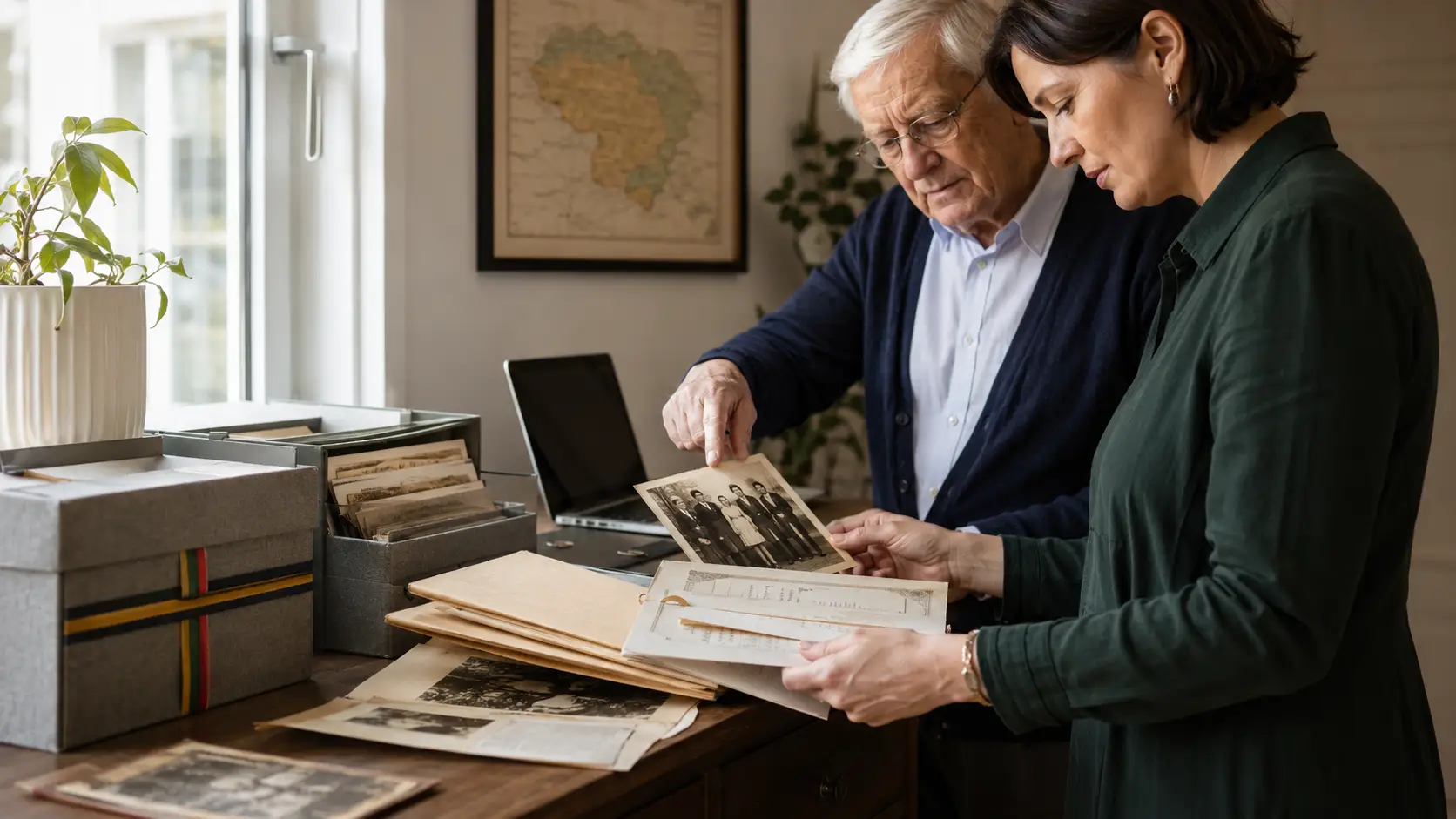
Preparing Lithuanian citizenship by descent documents is often the most important part of a citizenship restoration case. For U.S.-based applicants, the process is not only about proving that a Lithuanian ancestor existed. In many cases, the file must show the ancestor’s Lithuanian citizenship, the applicant’s direct family connection to that ancestor, relevant name changes, and proper certification of U.S. records.
Lithuanian citizenship restoration is document-driven. A strong application usually depends on whether the records clearly connect each generation and whether foreign documents are properly prepared for use in Lithuania. Missing certificates, changed surnames, inconsistent spellings, or uncertified U.S. documents can create delays or requests for additional evidence.
This guide explains which documents for Lithuanian citizenship by descent are commonly needed, how U.S. birth, marriage and naturalization records fit into the process, and what applicants should understand about apostille and translation requirements.
Why Documents Matter in Lithuanian Citizenship by Descent Cases
Lithuanian citizenship by descent is usually assessed through historical and family documentation. The applicant generally needs to show that a parent, grandparent or great-grandparent held citizenship of the Republic of Lithuania before June 15, 1940, and that the applicant descends from that person. Lithuanian diplomatic sources also note that birth or residence in Lithuania alone may not be enough if the documents do not establish Lithuanian citizenship.
For U.S. applicants, the evidence often comes from two sides. One part of the file may come from Lithuania, such as archival records, pre-war passports, military records, civil registration records, or other documents showing the ancestor’s status. Another part usually comes from the United States, such as birth certificates, marriage certificates, death certificates, naturalization records, name change records, and sometimes Social Security or court documents.
The goal is to create a continuous documentary chain. Each record should help answer a specific question: who the ancestor was, whether that person had Lithuanian citizenship, when and how the person left Lithuania, how the applicant is related to that ancestor, and whether any names changed along the way.
Core Lithuanian Citizenship by Descent Required Documents
The exact Lithuanian citizenship by descent required documents may vary depending on the family history, the available records, and the legal basis of the application. However, many files include several core categories.
The applicant normally needs a valid passport or identity document. The file also needs documents showing that the relevant ancestor held Lithuanian citizenship before June 15, 1940. Depending on the case, this may include a pre-war Lithuanian passport, a Lithuanian foreign passport, records of service in the Lithuanian armed forces, civil service records, Lithuanian identity documents, or archival evidence that directly or indirectly confirms citizenship.
The application may also need documents showing that the ancestor left Lithuania before March 11, 1990, or was exiled from occupied Lithuania. U.S. naturalization records, old foreign passports, refugee camp documents, marriage records, or other dated records can sometimes help establish this part of the history.
Another central part of the file is proof of family connection. This usually means birth certificates for each generation between the applicant and the Lithuanian ancestor. If surnames changed through marriage, court order, immigration records, or naturalization, the file may also need marriage certificates, name change orders, naturalization papers, or other official documents explaining the difference.
Proof of Lithuanian Ancestry Documents
Proof of Lithuanian ancestry documents should do more than show ethnic background or family tradition. They should connect the applicant to a specific ancestor who can be tied to Lithuanian citizenship. Family stories, DNA tests, photographs, and private genealogy notes may be useful for research, but they usually cannot replace official records.
For many families, the most valuable evidence is found in Lithuanian archives. Birth, marriage, death, residence, military, school, property, or administrative records may help identify the ancestor and clarify the family line. In some cases, archive records may be needed because U.S. documents only show that the ancestor was born in “Russia,” “Poland,” “Kovno,” “Vilna,” “Lithuania,” or another historical place name without proving citizenship.
Applicants should pay close attention to dates, names, and places. The same person may appear under different spellings in Lithuanian, Polish, Russian, Yiddish, German, or English records. A surname may also change after immigration to the United States. These differences do not automatically make a case impossible, but they usually need to be explained through consistent supporting documents.
U.S. Birth Certificates for Lithuanian Citizenship by Descent
U.S. birth certificates are usually used to prove the family line. The applicant’s birth certificate can show the applicant’s parents. A parent’s birth certificate can show the grandparents. A grandparent’s birth certificate may connect the line to the Lithuanian ancestor, depending on the generation involved.
For a Lithuanian citizenship by descent document checklist, long-form birth certificates are usually preferable because they tend to include more complete parent information. Short-form certificates may not contain enough detail to prove lineage. If a record does not list the parents clearly, the applicant may need another official document to close the gap.
Birth certificates issued in the United States are foreign public documents for Lithuanian purposes. Lithuanian consular guidance states that foreign documents, except passports, must generally be translated into Lithuanian and must bear an apostille or be legalized.
Marriage Certificate for Lithuanian Citizenship by Descent
A marriage certificate for Lithuanian citizenship by descent is often important when surnames changed between generations. This is especially common in U.S. family lines where women changed surnames after marriage, where names were shortened after immigration, or where records use different spellings.
Marriage records can help prove that two differently named people are legally the same person or that a child belongs to the correct family line. For example, if the applicant’s mother appears under a maiden name on her birth certificate and under a married name on the applicant’s birth certificate, the marriage certificate may be needed to connect the two records.
Marriage certificates may also help prove that an ancestor had already left Lithuania by a certain date, depending on where and when the marriage took place. This is not always enough by itself, but it can support the broader documentary history.
Naturalization Records for Lithuanian Citizenship by Descent
Naturalization records for Lithuanian citizenship by descent can be useful for several reasons. They may show when an ancestor became a U.S. citizen, where the ancestor was born, what name the ancestor used, when the ancestor entered the United States, and sometimes which country the person previously belonged to.
U.S. naturalization files may include declarations of intention, petitions for naturalization, certificates of naturalization, oaths of allegiance, or related court records. The National Archives explains that naturalization is the process by which a foreign national becomes a U.S. citizen and notes that older naturalization records may exist in federal, state, county, municipal or other courts depending on the period.
For Lithuanian citizenship restoration documents, naturalization records may help show that the ancestor left Lithuania before March 11, 1990. They may also help explain name changes or confirm family relationships. However, a U.S. naturalization record does not automatically prove that the person was a Lithuanian citizen before June 15, 1940. It is usually one piece of a broader evidentiary file.
Apostille Requirements for U.S. Documents
Lithuanian citizenship apostille requirements are a common source of confusion for U.S. applicants. In general, U.S. civil records used in a Lithuanian citizenship restoration case should be issued as certified copies and then apostilled by the correct authority.
For state-issued records, such as most birth, marriage, divorce, and death certificates, the apostille is usually obtained from the Secretary of State in the U.S. state that issued the document. For federal documents, such as certain federal naturalization-related records, the apostille process may involve the U.S. Department of State. Lithuanian consular guidance specifically distinguishes between state-issued U.S. documents and federal U.S. documents for apostille purposes.
A U.S. birth certificate apostille for Lithuanian citizenship should normally be attached to the certified birth certificate issued by the relevant state or local vital records authority. Applicants should avoid apostilling photocopies unless a specific authority confirms that a notarized copy is acceptable for the intended document type.
Translation into Lithuanian
Foreign documents usually need official translation into Lithuanian. This includes U.S. birth certificates, marriage certificates, naturalization records, court records, and other foreign public documents submitted with the application. Lithuanian consular sources state that foreign documents, except passports, must be translated into Lithuanian and that translations should be official.
Applicants should be careful with names, dates, places, stamps, seals, and handwritten notes. A translation should reflect the document accurately rather than “correcting” historical spellings or modernizing names. If the same person appears under several versions of a name, the application may need to preserve those variants and explain them through supporting records.
The order of apostille and translation can depend on how the documents are prepared and where the translation is completed. In many cases, the apostille itself may also need to be translated because it forms part of the document package. Applicants should confirm the practical requirements before ordering translations.
Common Problems in U.S. Document Files
Many U.S.-based applicants discover that their records do not match perfectly. A Lithuanian surname may have been shortened, translated, misspelled, or adapted after immigration. A birth date may differ by one day because of recordkeeping errors, calendar issues, or later corrections. A place of birth may be listed as Russia, Poland, Lithuania, Kovno, Vilna, Kovna, Kaunas, or another historical form.
These issues are common in ancestry-based citizenship cases. The question is whether the file still creates a credible and consistent chain of identity. Minor spelling differences may be manageable if other records point to the same person. Larger inconsistencies may require additional documents, archive searches, court records, amended certificates, or written explanations.
Another frequent problem is relying on genealogy documents that are useful for research but not sufficient for legal submission. Online family trees, database screenshots, private translations, uncertified copies, or unsourced family notes may help identify leads, but the application usually needs official records or properly certified copies.
How to Build a Practical Document Checklist
A practical Lithuanian citizenship by descent document checklist should begin with the family line. The applicant should identify the Lithuanian ancestor, then map every generation from that ancestor to the applicant. For each generation, the file should contain official records proving parent-child relationships and any name changes.
The second part of the checklist should focus on the ancestor’s Lithuanian citizenship. The strongest documents are usually those issued by Lithuanian authorities before June 15, 1940, or archival records that clearly support citizenship status. If direct proof is unavailable, other records concerning residence, work, study, military service, or life in Lithuania before June 15, 1940 may become relevant, depending on the case.
The third part should address departure, exile, or residence outside Lithuania. Depending on the family history, this may include U.S. naturalization documents, passenger records, refugee records, displaced persons documents, foreign passports, marriage records, or other dated documents.
The final part should cover document preparation. U.S. records should generally be certified, apostilled by the correct authority, and translated into Lithuanian where required. Copies should be handled carefully because notary-certified copies may also require apostille if they are used instead of originals or certified official copies.
When Additional Records May Be Needed
Additional records may be needed when the standard documents do not clearly prove eligibility. This can happen when the ancestor left before 1918, when the family came from a border region, when records list conflicting places of birth, or when there is no direct document showing Lithuanian citizenship.
Extra evidence may also be needed when a person’s name changed several times. For example, an ancestor may have used a Lithuanian surname in Europe, a Polish or Russian version in old records, and an Americanized surname after arrival in the United States. In that situation, the application may need multiple records showing that all versions refer to the same person.
Applicants should also consider whether death certificates, Social Security records, probate records, military draft cards, census records, church records, or court files can support the identity chain. These documents may not all be required in every case, but they can help resolve gaps when primary civil records are missing or inconsistent.
FAQ
What documents are needed for Lithuanian citizenship by descent?
The documents usually include the applicant’s valid passport, proof that the ancestor held Lithuanian citizenship before June 15, 1940, proof that the ancestor left Lithuania or was exiled before March 11, 1990 when relevant, birth certificates proving the family line, and documents explaining name changes, such as marriage certificates, court orders, or naturalization records. Foreign documents generally need proper certification, apostille or legalization, and official Lithuanian translation.
Do U.S. birth certificates need an apostille for Lithuanian citizenship?
In many cases, yes. U.S. birth certificates are foreign public documents, and Lithuanian consular guidance states that foreign documents such as U.S. birth and marriage certificates generally must bear an apostille or be legalized, except for passports. State-issued birth certificates are usually apostilled by the Secretary of State in the state where the certificate was issued.
Is a marriage certificate required for Lithuanian citizenship by descent?
A marriage certificate is commonly needed when it explains a surname change or connects generations in the family line. If a parent, grandparent, or ancestor used different surnames before and after marriage, the marriage certificate can help prove that the records refer to the same person.
Are U.S. naturalization records required for Lithuanian citizenship restoration?
U.S. naturalization records are not always required in the same way for every case, but they can be very important. They may help prove when an ancestor became a U.S. citizen, when the ancestor left Lithuania, what name the ancestor used, and whether a name changed during the immigration or naturalization process.
Can I apply if some Lithuanian citizenship restoration documents are missing?
It may still be possible, depending on which documents are missing and whether alternative evidence can support the case. Missing birth records, unclear citizenship proof, or inconsistent names may require archive searches, additional U.S. records, court documents, or other official evidence. The strength of the file depends on whether the documents collectively prove the required legal and family connections.
Do all documents need to be translated into Lithuanian?
Foreign documents used in the application usually need official translation into Lithuanian, except for passports. This commonly applies to U.S. birth certificates, marriage certificates, naturalization records, court records, and other foreign documents submitted as evidence.