
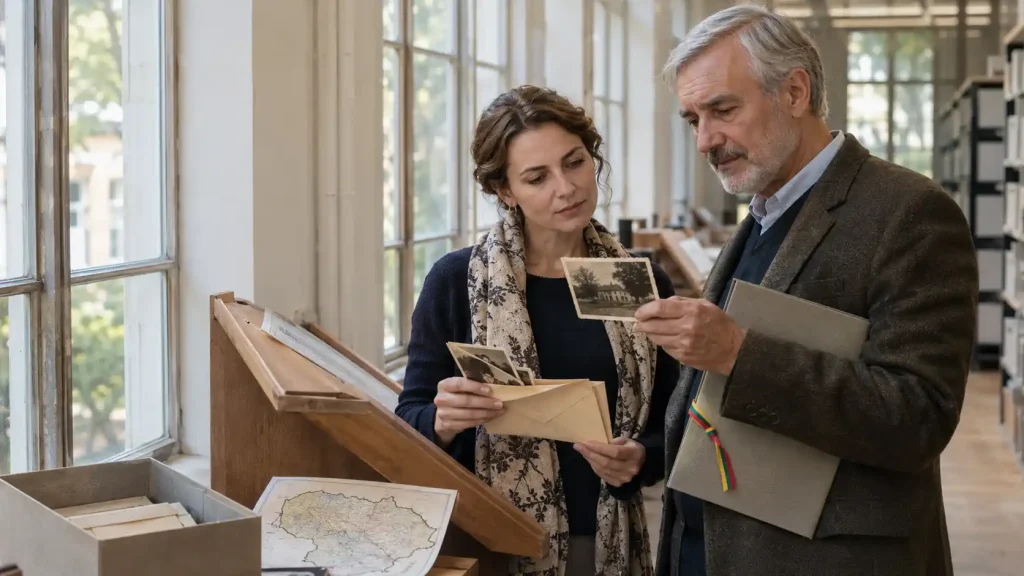
Discovering how your Lithuanian ancestors earned a living can reveal more than their profession. Their work often reflected the community they belonged to, their financial circumstances and the opportunities available in their region.
Researching Lithuanian ancestor occupations can also connect family stories with historical documents. A profession recorded in a marriage register or census may help distinguish individuals with similar names, especially when several families lived in the same village.
For descendants exploring their Lithuanian roots, occupational information offers useful clues about everyday life and helps reconstruct their family history.
What Jobs Did People Have in Historical Lithuania?
Employment in historical Lithuania depended on location, social position and the period being researched. Rural communities relied heavily on agriculture, while towns supported various trades, services and commercial activities.
Research into Lithuanian ancestors’ jobs may reveal farmers, agricultural labourers, craftspeople, merchants, teachers and domestic servants. Some worked on large estates, while others operated small businesses or practised traditional crafts.
Occupations could change over time. Someone recorded as a farm labourer might later appear as a landholder or tradesperson. Understanding historical Lithuanian occupations therefore requires examining the wider circumstances.
Farming, Crafts and Trades in Lithuanian Family History
Agriculture played a central role in Lithuania’s economy during much of the nineteenth and early twentieth centuries. However, communities also included skilled workers and professionals who supported everyday life.
Farmers, Farm Labourers and Estate Workers
Many rural families earned their living through farming, livestock keeping and seasonal agricultural work.
Historical records may distinguish between landowners, tenant farmers, hired labourers and estate workers. These descriptions offer clues about a family’s economic circumstances, although terminology varied between documents and administrative systems.
Blacksmiths, Tailors, Shoemakers and Other Craftspeople
Skilled trades were essential to villages and towns. Blacksmiths repaired agricultural tools, shoemakers produced footwear, and tailors made clothing for local communities.
Carpenters, millers, weavers and other craftspeople also appear in historical documents.
Research into Lithuanian ancestors’ professions may reveal trades passed between generations. However, a shared surname and occupation do not establish a family relationship without supporting evidence.
Merchants, Teachers and Urban Occupations
Lithuanian towns offered employment in commerce, education, administration and services.
Merchants and shopkeepers participated in local trade, while teachers, clerks and other professionals contributed to community life.
An ancestor’s profession may help explain migration between villages and towns. Comparing addresses, family relationships and employment details across records can help researchers trace these movements.
Which Historical Records Can Reveal an Ancestor’s Occupation?
Historical documents may contain information about an individual’s profession, social position or source of income.
Lithuanian genealogy occupation records include parish registers, marriage certificates, population lists and census materials. The level of detail varies between collections.
Researchers should begin with known names, approximate dates and locations. Our guide on how to find Lithuanian ancestors explains how to establish a starting point.
Parish Registers and Marriage Records
Church registers are valuable sources for reconstructing Lithuanian family histories.
Birth, marriage and death records may identify occupations, particularly those of parents, spouses or witnesses.
Information about occupations in Lithuanian church records can distinguish individuals with similar names and provide clues about their social circumstances.
Marriage entries may contain additional details about the couple’s families. However, not every parish recorded occupations, and surviving documents vary by denomination, location and period.
Revision Lists and the 1897 Russian Empire Census
During the nineteenth century, much of present-day Lithuania formed part of the Russian Empire. Population records from this period can provide information about households and family members.
Revision lists were primarily created for administrative and taxation purposes. They may identify family relationships, ages and social categories, although occupations were not consistently recorded.
The 1897 Russian Empire Census collected information about individuals, including their principal occupations. Surviving Lithuanian census occupation records can therefore provide evidence of how an ancestor earned a living.
However, surviving census materials are incomplete, and access depends on the locality and archive. Researchers should compare these sources with parish registers and other historical documents before drawing conclusions.
Where to Search for Lithuanian Occupational Records
Finding an ancestor’s profession often requires examining several historical collections. Records were created by different institutions, and their availability depends on the location, period and religious community.
Before contacting an archive, gather information about your ancestor’s name, birthplace, approximate dates and relatives. Knowing the village or parish can considerably narrow the search.
Lithuanian State Historical Archives
The Lithuanian State Historical Archives (LVIA) is a principal institution for genealogical research in Lithuania. Its collections include parish registers, administrative documents and historical materials that may contain occupational information.
These sources can help establish family relationships, places of residence and sometimes employment or social position.
Not every collection is digitised or searchable by name. Researchers may first need to identify the relevant parish, administrative district or archival reference.
Our guide to Lithuanian archival records explains how different archives can support family research.
Digitised Records in EAIS, ePaveldas and FamilySearch
Several online platforms provide access to historical documents connected with Lithuania.
The Electronic Archive Information System (EAIS) allows researchers to search archival descriptions and access available digital materials. ePaveldas provides digitised cultural heritage resources, including selected historical documents.
FamilySearch also offers genealogical collections relevant to Lithuanian families, although coverage varies by region and period. Some records have access restrictions.
If you are researching how to find ancestor occupation in Lithuania, begin by identifying the relevant locality and checking which collections survive.
Some digitised documents are not indexed by name, so researchers may need to examine scanned registers individually.
Understanding Occupation Terms in Lithuanian, Polish and Russian
Historical documents from Lithuania were not always written in Lithuanian. Depending on the period and institution, records may appear in Polish, Russian, Latin or other languages.
This can complicate the interpretation of historical Lithuanian occupations, as older terminology does not always correspond to modern job titles.
For example, the Lithuanian word kalvis means blacksmith, while siuvėjas means tailor. Polish records may use kowal and krawiec, while Russian documents may contain кузнец or портной.
Researchers should consider handwriting, abbreviations and historical spelling. A term describing a person’s social position may initially appear to be a profession.
When translating unfamiliar terms, compare the wording with other entries in the same register. Avoid relying entirely on automatic translation, particularly for handwritten documents.
How Social Status and Occupation Differ in Old Records
An important distinction in genealogical research is the difference between occupation and social status.
An occupation describes the work someone performed, such as farming, tailoring or teaching. Social status may indicate their legal or administrative classification.
For example, someone identified as a peasant in a nineteenth-century document was not necessarily employed exclusively in agriculture. They might also have practised a craft or participated in local trade.
Similarly, descriptions of townspeople, landowners or other social groups should not automatically be interpreted as professional titles.
These distinctions are particularly relevant to documents produced under the Russian Empire, where administrative classifications played an important role.
Comparing several records can help determine whether a description refers to employment, property ownership or social position. This makes Lithuanian genealogy occupation records more useful for reconstructing an ancestor’s life accurately.
Can Immigration and U.S. Census Records Show an Ancestor’s Job?
For families whose ancestors emigrated from Lithuania, American documents can reveal information about their working lives.
Passenger lists, naturalisation documents and census entries may contain occupational details, helping researchers understand an ancestor’s employment before or after arriving in the United States.
For example, U.S. census records may identify a person’s occupation, industry or employment status. Comparing census years can reveal changes in profession, residence and family circumstances.
Researchers can also examine U.S. immigration records for Lithuanian ancestors, particularly passenger lists containing information about occupations or trades.
However, employment recorded in America does not necessarily reflect someone’s previous work in Lithuania. Immigrants sometimes changed professions because of language barriers or new economic opportunities.
Names and birthplaces may also appear differently across documents. Comparing dates, addresses and family relationships can help determine whether records refer to the same individual.
What an Occupation Record Can and Cannot Prove
Discovering an ancestor’s profession can help identify individuals in historical documents and connect records from different periods.
However, occupational information alone does not establish Lithuanian nationality or citizenship.
For descendants researching Lithuanian citizenship by descent, the most important evidence generally concerns family relationships and the citizenship status of the relevant ancestor.
Historical passports, citizenship records and other official documents may help establish evidence of pre-1940 Lithuanian citizenship.
In some cases, Soviet-era family records may help reconstruct family connections or identify additional archival sources.
Occupational entries can support genealogical research but should not be treated as independent proof of citizenship.
For those exploring Lithuanian citizenship through grandparents, establishing a documented family connection is essential.
De Civitate assists descendants with researching their Lithuanian roots, locating historical evidence and understanding the documentation required for citizenship applications.
Frequently Asked Questions
Where Can I Find My Lithuanian Ancestor’s Occupation?
Start with parish registers, marriage records, historical population lists and available census materials. Lithuanian archives and online genealogical collections may contain relevant documents. If your ancestor emigrated, American records can provide additional clues.
Did Most Lithuanian Ancestors Work in Agriculture?
Agriculture was a major source of employment in historical Lithuania, particularly in rural communities. However, people also worked as craftspeople, merchants, teachers, domestic servants and other professionals.
Does an 1897 Census Entry List a Person’s Profession?
The 1897 Russian Empire Census collected occupational information, including details about principal employment. However, surviving records are incomplete, and not every individual’s original entry remains available.
How Do I Translate Old Lithuanian Occupation Names?
First identify the language used in the document. Historical terms may appear in Lithuanian, Polish, Russian or Latin. Compare the wording with historical dictionaries, archival references and similar entries rather than relying entirely on automatic translation.
Can a Parish Marriage Record Identify a Trade?
Yes. Some parish marriage registers include occupations or social descriptions for the bride, groom, parents or witnesses. However, the information varies between parishes, denominations and historical periods.
Does an Ancestor’s Occupation Prove Lithuanian Citizenship?
No. An occupation can help identify an ancestor, but it does not independently establish Lithuanian citizenship. Citizenship by descent generally requires evidence of the relevant ancestor’s citizenship status and the applicant’s family relationship to that person.
If you are researching your Lithuanian family history and want to understand whether your ancestry could support a citizenship application, De Civitate can help you identify the relevant documents and explore your eligibility.