
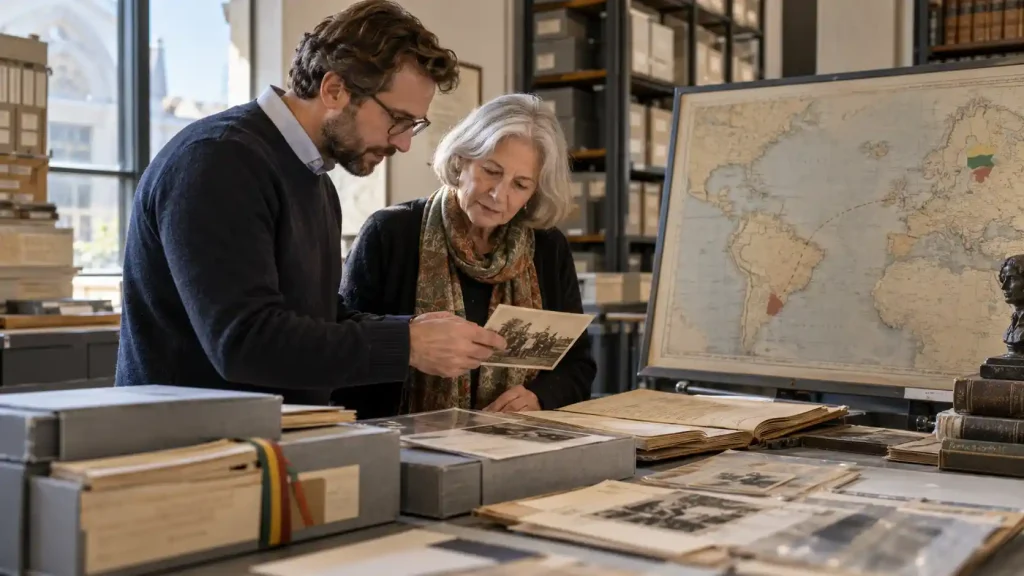
Tracing Lithuanian ancestors in Uruguay begins with records created after their arrival: passenger lists, birth and marriage entries, and documents kept by relatives. These sources can connect generations and point to a town or parish in Lithuania. Start with a named person and work backwards, checking each relationship before adding another generation. A birthplace or a description such as “Lithuanian” is a useful clue, but neither alone establishes that person’s citizenship.
Why Lithuanian Families Settled in Uruguay
Lithuanian family history in Uruguay often reaches back to the interwar years. A study by Vaida Jonušytė traces the formation of the community to the 1920s and identifies Montevideo’s Cerro district as a centre of Lithuanian life. This context can guide a search, but it cannot establish when a particular relative arrived. Use the family’s earliest dated Uruguayan document as a starting point, then look for an arrival record rather than assigning the ancestor to a migration wave.
Start with Names, Dates and Places in Uruguay
For Lithuanian genealogy research in Uruguay, prepare a short profile of the person you want to find. Record their full name, known spellings, approximate birth year, spouse, parents and earliest known residence. Note where each detail came from: a certificate, a letter or a relative’s recollection. Keep uncertain dates as ranges rather than turning estimates into exact years. This profile gives you search terms and a way to distinguish a likely match from someone who merely shares the surname.
Identify a Relative’s Last Known Address in Montevideo
Look for addresses on certificates, envelopes, identity papers and family correspondence. A dated address places a person in a neighbourhood at a particular time and may help identify a parish or local collection to investigate. Check whether the address belonged to the ancestor, a relative or the person reporting an event; these are different clues. If several documents show different homes, arrange them chronologically. Do not assume that a family’s last known address was also its first home in Uruguay.
Collect Family Papers and Spanish-Language Name Variants
Copy names exactly as they appear in each document, including accents and apparent mistakes. Keep the original spelling alongside any simplified search form. A Lithuanian given name may appear in a Spanish form, and letters such as č, š or ž may be absent from an index. Treat a translated name as a possibility to test, rather than proof of identity. Compare parents, spouse, age and residence before linking two entries, and preserve the document image so that you can review an uncertain transcription later.
Which Uruguayan Records Can Help Trace Lithuanian Ancestors?
Passenger Arrival Lists and Immigration Records
The FamilySearch collection Uruguay, Passenger Lists, 1888–1980 contains records held by the Archivo General de la Nación in Montevideo. Some are indexed; a name search therefore does not cover every available image. Search known spellings and a reasonable arrival-year range, then inspect the original entry when accessible. Record the vessel, date and identifying details actually shown. A departure port indicates part of the journey and should not be entered as the ancestor’s birthplace.
Birth, Marriage and Death Registration Records
Civil records help connect the immigrant to later generations. Begin with a known birth or marriage and use the names in that entry to identify the preceding generation. A marriage entry may supply parents or a birthplace; a death entry may contain details reported by someone else. Check what the original record says instead of relying only on an index or a family-tree transcription. Save its date, registration locality and reference number, where available, so that you can locate it again or request an official copy.
Where to Find Historical Family Records in Uruguay
Archivo General de la Nación in Montevideo
When tracing Lithuanian immigration to Uruguay, records held by AGN can help establish an arrival date. The AGN collections guide provides a request form for arrivals in 1896–1953 and notes a surviving book from 1888. Its inventories distinguish overseas arrivals from river arrivals, which matters if a relative entered Uruguay from a neighbouring country. Check the relevant inventory before assuming that a collection’s overall dates represent uninterrupted coverage.
The separate government service for information about overseas immigrant arrivals covers 1829–1872. It requires the person’s name, nationality and approximate arrival date; it is therefore not the appropriate route for an ancestor who arrived in the 1920s. For later arrivals, follow the instructions in the AGN collections guide. State whether dates are documented or estimated, and explain any uncertainty about nationality rather than supplying a guess. The archive warns that its arrival records are incomplete.
FamilySearch Passenger Lists and Civil Registration Collections
When searching Uruguay passenger lists for Lithuanian immigrants, begin with a broad date range and narrow it using independent family evidence. If a search produces several candidates, compare the details shown in each original entry before selecting one. Save the collection name, image number and any volume or page reference alongside your notes. The FamilySearch passenger collection is partly indexed, so a failed name search should be followed by a check of the available browsing options.
For civil documents, distinguish an online research entry from an official certificate. FamilySearch can help locate a record, but a database transcription is not a replacement for the document issued by the registration authority. Uruguay’s Solicitud de partidas service, administered by the Dirección Nacional del Registro de Estado Civil, provides a route for requesting certificates. Its birth-record search accepts an identity document or registration details, including the person’s name and birth or registration date.
How to Search Lithuanian Names in Spanish-Language Records
Turn the spellings collected from family papers into a search log. Try each documented form separately, noting the database, dates searched and result. If the interface permits it, remove an exact-match setting or search with fewer fields; entering uncertain parents or a birthplace can exclude a useful candidate. Our guide to Lithuanian surname variations explains why forms differ across historical records. Use an unexpected spelling as a lead to investigate, and record why you accepted or rejected the match.
Lithuanian Community Archives and Newspapers in Uruguay
For Lithuanian immigrants in Montevideo, community sources can add details absent from arrival and civil records. Vaida Jonušytė’s study describes photographs, letters, periodicals and other material from Uruguay’s Lithuanian community, dated 1928–2019 and transferred to the Lithuanian Archives of Literature and Art. This gives researchers a named institution to approach about surviving material and access conditions. When you find a relative in a newspaper, note the publication, issue date and page, and separate the event date from the date it was reported.
Step-by-Step Research: From Uruguay to Lithuania
Work backwards from the latest confirmed generation. First, obtain a record identifying the child and parents; next, locate the parents’ marriage or other evidence linking their names. Continue until you reach the immigrant, then seek a document giving a specific Lithuanian locality. Keep a list of missing links so that each new request answers a defined question. For a broader starting checklist, see how to find Lithuanian ancestors. Before searching Lithuania, gather the relevant Uruguayan evidence into a single timeline.
How to Cross-Check Uruguayan Records with Lithuanian Archives
Copy the place of origin exactly as written before looking for its modern equivalent. A historical district name may cover several settlements, while similar village names can lead to the wrong parish. Use the recorded parents, spouse, religion and approximate birth year to test a possible location. Our guide to Lithuanian archive records introduces the repositories to consider. In an archive enquiry, include the source of the place name and a readable image where permitted, so an archivist can assess the original wording.
What Family Records Can and Cannot Establish About Citizenship
Under official Lithuanian guidance, reinstatement requires evidence of a qualifying ancestor’s citizenship before 15 June 1940 and documents linking the applicant to that person. Uruguayan certificates can establish family relationships, but a birthplace alone does not establish historical citizenship. When gathering evidence of Lithuanian citizenship before 1940, use the precise legal date and examine what each document actually proves. Whether another citizenship can be retained is a separate question requiring assessment of the family’s circumstances.
For ancestors who emigrated before 1918, investigate whether later records establish citizenship of the Republic of Lithuania; the departure date alone does not resolve eligibility. If the family also has an Argentine branch, our guide to Lithuanian citizenship by descent for Argentinians covers issues relevant to that branch. Keep the documentary trail for each person separate, particularly where relatives moved between countries or acquired different citizenships.
A Certificate of Lithuanian Descent concerns Lithuanian origin; it is not proof that its holder has acquired Lithuanian citizenship. Assess this route separately from reinstatement based on an ancestor’s citizenship. Before ordering certified copies or translations, establish which application you intend to make and which documents it requires. This helps avoid assembling a file that proves a family connection but leaves the relevant legal status unsupported.
Frequently Asked Questions
Where Can I Find Lithuanian Immigration Records in Uruguay?
Start with AGN’s passenger inventories and the FamilySearch collection Uruguay, Passenger Lists, 1888–1980. Check the period and route of arrival before choosing a collection or submitting an archive request.
Are Uruguay Passenger Lists Available Online?
Some are available through FamilySearch, but only part of the collection is indexed. A failed name search does not establish that no record survives. Check browsing options and any access restrictions shown for the images.
How Can I Request a Birth or Marriage Record in Uruguay?
In Uruguay, civil registration is a source of family records available through the official Solicitud de partidas service. Select the event type and provide the identifying or registration details requested for that record.
What If My Lithuanian Ancestor’s Surname Was Changed?
Search every spelling supported by a document, then try simplified forms where appropriate. To find Lithuanian relatives in Uruguay, compare a possible match with known parents, spouses and dates before adding it to the family tree.
Can Lithuanian Community Records Help Trace a Family?
Yes. Letters, photographs and newspaper notices can identify relatives, addresses or community connections. Record the source and date, then look for independent evidence of any relationship that the item suggests.
Do Uruguayan Records Prove Lithuanian Citizenship?
They can support a case by documenting descent and an ancestor’s life abroad. They do not automatically prove citizenship of Lithuania. Historical citizenship, the family relationship and any conditions for retaining another citizenship must be assessed separately.