
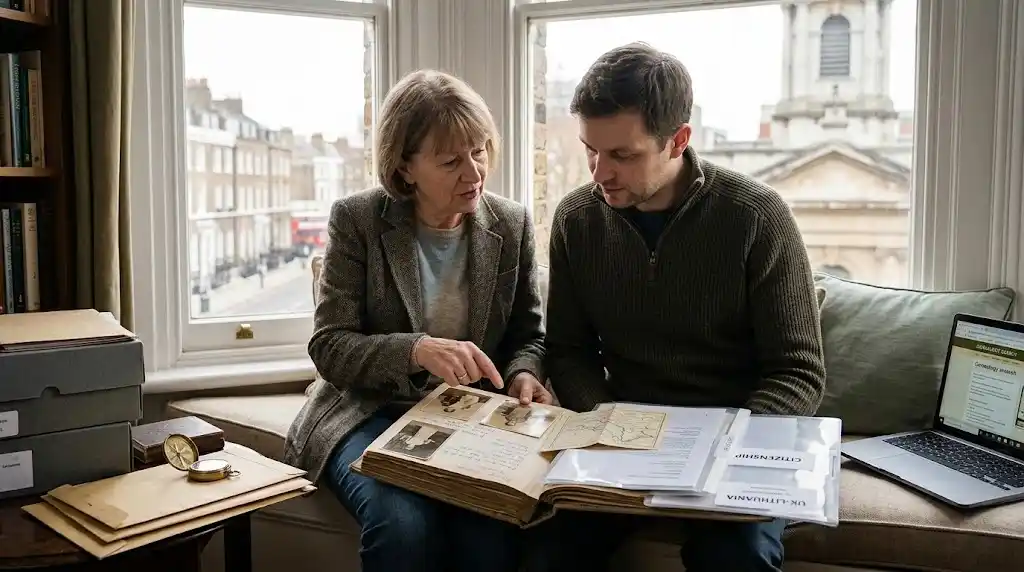
British citizens with Lithuanian parents, grandparents or great-grandparents may have a potential route to Lithuanian citizenship. However, ancestry alone does not determine eligibility. For people researching Lithuanian citizenship by descent UK options, the key questions are whether the relevant ancestor was a Lithuanian citizen, when that citizenship was held and whether the family connection can be documented.
For UK citizens with Lithuanian ancestors, records from both Lithuania and Britain may therefore be important. The ancestor’s citizenship status, historical circumstances and evidence connecting each generation must be considered together when assessing a possible claim to Lithuanian citizenship by descent.
Can UK Citizens Qualify for Lithuanian Citizenship by Descent?
British nationality itself does not create a right to Lithuanian citizenship. When considering Lithuanian citizenship for UK citizens, the focus is on the applicant’s Lithuanian family connection and the legal status of the ancestor on whom the claim is based.
This distinction is central to Lithuanian citizenship for British citizens because Lithuanian ancestry does not automatically establish citizenship eligibility. An ancestor may have been born in Lithuania or identified as Lithuanian without this alone proving that the person held Lithuanian citizenship.
For a British citizen, Lithuanian citizenship by descent therefore requires an individual assessment of the family history, relevant dates and available evidence. These factors help determine Lithuanian citizenship eligibility UK applicants may have under the applicable rules.
Which Lithuanian Ancestors May Create a Citizenship Claim?
The generation of the Lithuanian ancestor is only one part of the assessment. Whether the connection is through a parent, grandparent or great-grandparent, the applicant may need to establish the ancestor’s citizenship status and document the family relationship through each relevant generation.
Lithuanian Parent
A Lithuanian parent may provide a direct family connection for assessing citizenship. Relevant records generally need to establish the parent’s status and the parent-child relationship.
Lithuanian Grandparent
A Lithuanian grandparent may also provide a potential basis for a claim, but being Lithuanian by origin is not necessarily enough. Lithuanian citizenship through a grandparent may require evidence of the grandparent’s citizenship status together with records connecting the grandparent, parent and applicant.
Lithuanian Great-Grandparent
A great-grandparent may be relevant in certain cases as well. Because the family chain is longer, additional records may be required to connect the great-grandparent to each subsequent generation. Citizenship status and documented descent remain the central considerations.
Lithuanian Ancestry vs Lithuanian Citizenship: Why the Difference Matters
An ancestor being born in Lithuania, being ethnically Lithuanian and being a Lithuanian citizen are not necessarily the same legal circumstance. This distinction is especially important when researching Lithuanian citizenship by ancestry UK possibilities.
A family may have clear Lithuanian roots without possessing evidence that the relevant ancestor held Lithuanian citizenship. Conversely, historical or archival records may establish citizenship even when few original family documents have survived. For this reason, Lithuanian citizenship through Lithuanian ancestors UK cases require both the family relationship and the ancestor’s legal status to be examined.
Lithuanian descent can also be relevant under a separate legal concept. Depending on what the evidence establishes, a Certificate of Lithuanian Descent may be relevant instead of, or separately from, a citizenship restoration procedure.
Which Historical Dates May Affect Eligibility?
For UK applicants, family history often involves emigration from Lithuania followed by settlement and naturalisation in Britain. This makes the dates of an ancestor’s citizenship, departure and acquisition of another nationality potentially important when determining which legal basis may apply.
Lithuanian Citizenship Before June 15, 1940
June 15, 1940 is an important historical threshold in certain citizenship cases. The relevant question is not simply whether an ancestor was born or lived in Lithuania before that date, but whether the person held Lithuanian citizenship.
Historical passports, archival records and other official evidence may help establish this status. The ancestor’s citizenship history must therefore be distinguished from their place of birth or Lithuanian origin.
Leaving Lithuania Before March 11, 1990
The timing and circumstances of an ancestor’s departure from Lithuania can also be relevant. In certain cases, leaving Lithuania before March 11, 1990 may affect the applicable restoration basis and the possibility of retaining another citizenship.
For UK families, this may require establishing when the ancestor left Lithuania, where they subsequently lived and when another nationality was acquired.
What Documents May UK Applicants Need?
When preparing Lithuanian citizenship documents UK applicants usually need evidence from both countries. Lithuanian historical records can establish the ancestor’s citizenship status, while British civil and nationality records can document the family chain and later events.
The exact documents depend on the individual case and the number of generations between the applicant and the Lithuanian ancestor.
Proof of the Ancestor’s Lithuanian Citizenship
Historical Lithuanian passports, archival records and other accepted evidence may establish that an ancestor held Lithuanian citizenship. When original documents have not survived, relevant records may need to be located through Lithuanian archives.
UK Birth, Marriage and Death Certificates
British civil records can establish the connection between generations. Depending on the family line, these may include birth, marriage and death certificates belonging to the applicant, parents or grandparents.
Marriage records may also help explain surname changes and differences between Lithuanian and British documents.
British Naturalisation Records
If a Lithuanian ancestor later became a British citizen, naturalisation records can establish when British nationality was acquired. This date may be considered together with the ancestor’s Lithuanian citizenship and emigration history.
Cases involving an ancestor naturalised before 1940 may therefore require particular attention to the relevant chronology and historical circumstances.
Apostille and Lithuanian Translation
UK-issued documents may need to meet formal requirements before they can be used in a Lithuanian citizenship procedure. Depending on the document and applicable rules, this may include an apostille and translation into Lithuanian.
Applicants should therefore prepare British records according to the requirements applicable to their individual procedure.
Can You Apply for Lithuanian Citizenship From the UK?
British applicants do not necessarily need to travel to Lithuania to begin the procedure. Those who apply for Lithuanian citizenship from UK can initiate the relevant process electronically, with original documents subsequently presented according to the applicable procedure.
This also means that an applicant seeking to restore Lithuanian citizenship from UK can begin the process while residing in Britain rather than travelling to Lithuania simply to submit an initial application.
Submit the Application Through MIGRIS
Citizenship applications are submitted electronically through MIGRIS, Lithuania’s Migration Information System. Applicants provide the required information and upload supporting documents relevant to their citizenship case.
The electronic submission is the first stage; applicants must then follow the instructions concerning verification and presentation of their original documents.
Presenting Original Documents in the United Kingdom
After electronic submission, the required originals must be presented according to the applicable procedure. UK applicants may be able to present them through the Embassy of the Republic of Lithuania in London instead of travelling to Lithuania.
When the Embassy is selected, the procedure includes the relevant preliminary review by the Lithuanian Migration Department. Applicants should follow the instructions issued for their MIGRIS application before presenting the originals.
Does British Citizenship Affect Lithuanian Citizenship by Descent?
British and Lithuanian citizenship are governed by the laws of the respective countries. Having British citizenship does not automatically prevent an applicant from pursuing Lithuanian citizenship, but it does not necessarily mean that both citizenships can be retained.
Lithuania generally restricts dual citizenship, although exceptions exist in certain circumstances. Whether a British applicant can retain both citizenships therefore depends on the legal basis and facts of the individual case. The applicable Lithuanian dual citizenship rules should be considered separately when assessing this question.
Common UK Family Scenarios
UK applicants may have different emigration, naturalisation and document histories. These circumstances can affect both the assessment and the evidence required.
Your Lithuanian Ancestor Later Became a British Citizen
If a Lithuanian ancestor later acquired British citizenship, the dates of Lithuanian citizenship, departure and British naturalisation may be relevant. Naturalisation records can help establish this chronology.
Your Family Records Use Different Names or Spellings
Names may appear differently across Lithuanian and British records because of anglicisation, translation or marriage. The documentary family chain should establish that the records relate to the same person.
You Know Your Family Was Lithuanian but Have No Citizenship Documents
Original passports and citizenship records are not always preserved within families. If the original Lithuanian citizenship documents are missing, relevant evidence may still be available through Lithuanian archives and other historical repositories.
Certificate of the Right to Restore Lithuanian Citizenship
The Certificate of the Right to Restore Lithuanian Citizenship is different from the final restoration of citizenship. It confirms that a person has the right to restore Lithuanian citizenship under the applicable legal conditions.
For some descendants, obtaining the certificate may be relevant depending on their family history, available documents and intended procedure.
How the Lithuanian Citizenship Restoration Process Works From the UK
The Lithuanian citizenship restoration process generally involves establishing the legal basis, documenting the family connection and preparing the required Lithuanian and British records.
Step 1 — Assess Your Family History. Identify the relevant Lithuanian ancestor and establish the key dates relating to birth, residence, emigration and citizenship.
Step 2 — Confirm the Lithuanian Ancestor’s Status. Determine whether the ancestor held Lithuanian citizenship using available family or archival evidence.
Step 3 — Build the Documentary Family Chain. Collect records connecting each generation between the Lithuanian ancestor and the applicant.
Step 4 — Prepare UK Documents. Prepare the required British records, including an apostille and Lithuanian translation where applicable.
Step 5 — Submit Through MIGRIS. Submit the application and supporting documents electronically through MIGRIS.
Step 6 — Present the Required Originals. Present the required original documents according to the applicable procedure. UK applicants may be able to do this through the Lithuanian Embassy in London.
Frequently Asked Questions
Can a British citizen get Lithuanian citizenship by descent?
Potentially. Eligibility depends on the ancestor’s Lithuanian citizenship status, the family connection, relevant historical circumstances and supporting evidence.
Can I get Lithuanian citizenship if my grandparent was Lithuanian?
Potentially, but ancestry alone is not sufficient. The grandparent’s citizenship status and the documented family chain must be assessed.
Can I qualify through a Lithuanian great-grandparent?
A great-grandparent may be relevant in certain cases if the required citizenship status and family connection can be established.
Do I need to live in Lithuania to apply?
Not necessarily. Applicants may be able to complete the relevant citizenship procedure while living outside Lithuania.
Can I apply for Lithuanian citizenship from the UK?
Yes. The application can be initiated electronically through MIGRIS, followed by the applicable procedure for presenting original documents.
Can I keep my British citizenship if I become Lithuanian?
It depends on the individual circumstances. Lithuania restricts dual citizenship but provides exceptions in certain cases, so the applicable rules need to be assessed separately.