
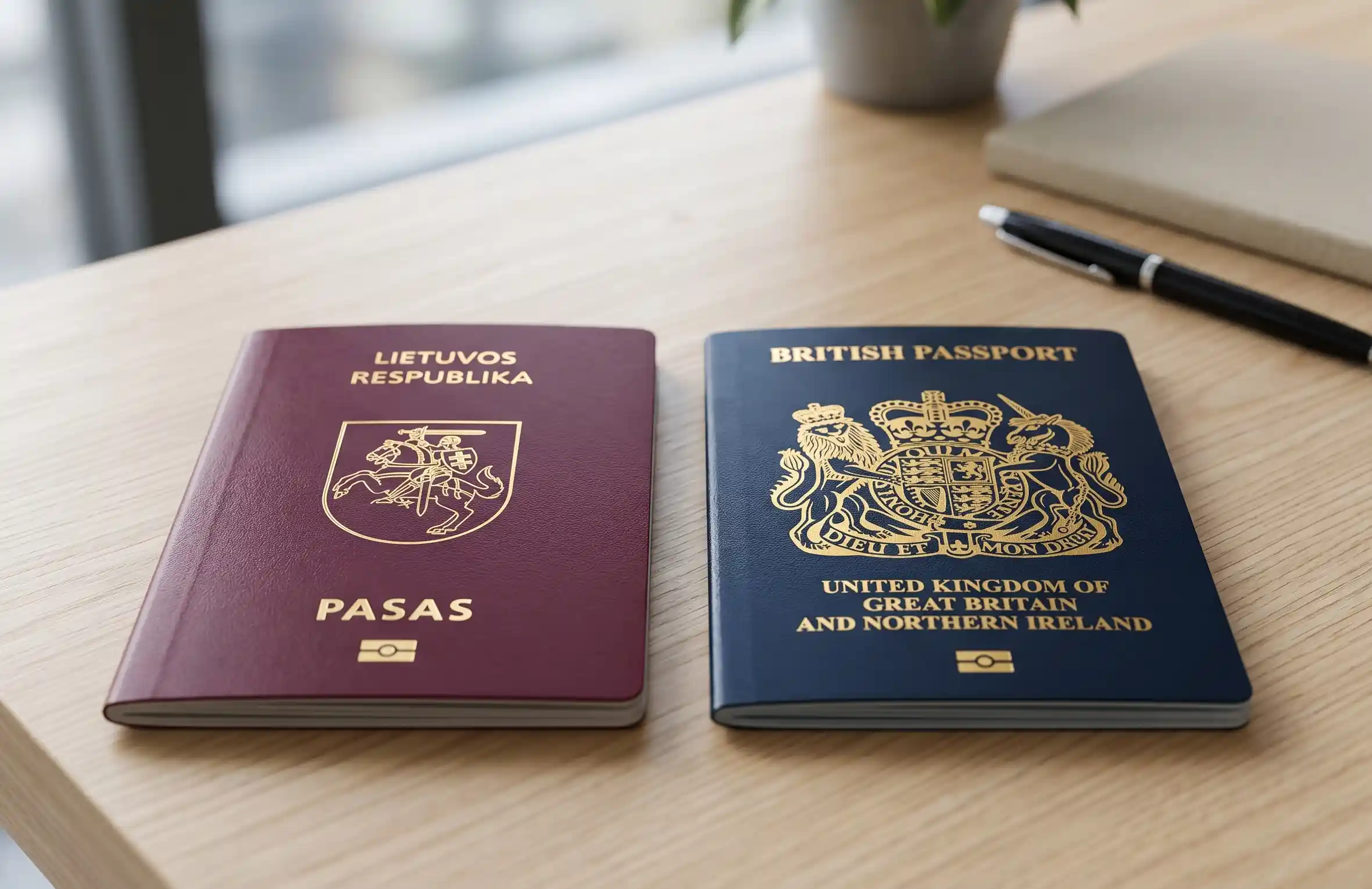
The comparison of a Lithuanian passport vs UK passport is not only about the number of visa-free destinations. It is also about where a person can live, work, study, build a business, and protect family mobility over the long term. Since Brexit, the difference between an EU passport and a British passport has become more practical for people with European plans.
A UK passport remains a strong travel document and gives full rights in the United Kingdom. A Lithuanian passport gives access to Lithuania, the European Union, and broader EU citizenship rights. For UK citizens with Lithuanian ancestry, this comparison may be especially important because citizenship restoration can create a second legal status without necessarily giving up British nationality in eligible cases.
Lithuanian Passport vs UK Passport: Quick Comparison
The Lithuanian passport vs British passport comparison depends on the user’s real goal. For global short-term travel, both documents are strong. For EU residence, work, study, healthcare coordination, and long-term family planning, the Lithuanian passport has a clear advantage because Lithuania is an EU member state. For living and working in Britain, the UK passport remains the stronger document.
A Lithuanian citizen can move within the EU under EU free movement rules. A British citizen no longer has automatic EU free movement after Brexit. At the same time, a British citizen has the unrestricted right to live and work in the UK, while a Lithuanian citizen usually needs to follow UK entry and immigration rules unless they already hold UK status.
Passport Strength and Global Mobility
Passport strength is often presented through rankings, but rankings are only one part of the analysis. The Lithuanian passport ranking and UK passport ranking can change as visa policies change. A ranking usually measures access to destinations without a prior visa, but it does not measure settlement rights, employment access, tax residence, healthcare, education, or family transmission of citizenship.
Both passports provide broad international mobility. The difference becomes more visible when a person wants more than tourism.
Lithuanian Passport Mobility
The list of Lithuanian passport visa free countries is extensive and includes many destinations across Europe, the Americas, Asia, and Oceania. However, the strongest feature is not simply travel. The main value lies in EU citizenship status. A Lithuanian passport holder can live, work, study, and establish a business in Lithuania and other EU member states, subject to local administrative rules.
For people considering Lithuanian passport by descent, this can be a long-term mobility tool rather than only a travel document.
UK Passport Mobility
British passport visa free countries also cover many major destinations. A UK passport is highly practical for business trips, tourism, and access to the UK itself. It also gives full domestic rights in Britain, including residence, work, healthcare access under UK rules, and political rights.
The limitation is Europe. After Brexit, UK citizens are treated as third-country nationals in the EU unless they have another EU nationality, residence permit, or specific status.
Why Passport Ranking Is Not the Only Factor
A passport ranking does not answer the core legal question: where can the holder build a life without immigration sponsorship? A British passport may be excellent for UK-based life. A Lithuanian passport may be stronger for European relocation. Therefore, the real comparison is not simply Lithuanian passport vs UK passport, but UK rights versus EU rights.
EU Rights: Main Advantage of a Lithuanian Passport
EU passport benefits are the main reason many people compare Lithuanian and British documents. A Lithuanian citizen is also an EU citizen. This gives the right to live, work, study, and conduct business across EU member states under EU rules.
These are not ordinary visa-free travel privileges. They are deeper legal rights connected to residence, employment, education, social security coordination, and family movement.
Right to Live and Work in the EU
A Lithuanian passport holder can relocate to another EU country for work, study, business, or family reasons. Local registration rules may apply, but the person is not applying as a typical non-EU migrant. This is one of the central Lithuanian passport benefits.
For a UK citizen without EU nationality, moving to France, Germany, Spain, Ireland, Portugal, or another EU country usually requires a national immigration route, such as employment, family, study, investment, or residence-based permission.
Access to Education, Healthcare and Social Benefits
Lithuania passport benefits may include access to EU tuition treatment in some countries, social security coordination, and healthcare rights under national and EU rules. The exact outcome depends on the country of residence, employment status, tax contributions, and local legislation.
For families, these rights can matter more than tourism access. A child’s education, a parent’s work options, and long-term residence stability may all be affected by whether the family holds EU citizenship.
Business and Relocation Opportunities in Europe
A Lithuanian passport can simplify relocation planning for entrepreneurs, consultants, remote professionals, and families who want a European base. EU citizenship can make it easier to register activity, move between markets, and settle in a chosen member state.
More details on the benefits of Lithuanian citizenship can help applicants understand why the passport is often evaluated as part of a wider mobility strategy.
UK Rights: Main Advantage of a British Passport
The UK passport remains the best document for a person whose main life, business, property, or family interests are in the United Kingdom. It provides the right to enter, live, work, and access public systems in the UK according to British law.
For people who do not intend to live in the EU, the British passport may already satisfy most practical needs. The value of a Lithuanian passport becomes clearer when the person wants EU rights in addition to UK rights.
Right to Live and Work in the United Kingdom
A British citizen does not need immigration permission to live and work in the UK. This is the core advantage of the UK passport. Lithuanian citizens can visit the UK under applicable entry rules, but they do not automatically receive the right to settle or work there unless they qualify under UK immigration law or already hold protected status.
UK Entry Rules for Lithuanian Passport Holders
Lithuanian passport holders can generally make short visits to the UK under visitor rules, but they may need to comply with digital entry systems such as the UK ETA where applicable. An ETA is not a residence permit and does not give the right to work or settle.
For long-term residence, work, study, or family migration, a Lithuanian citizen must review the relevant UK immigration category.
Post-Brexit Differences Between UK and EU Passports
Before Brexit, a British passport also functioned as an EU passport. That is no longer the case. The UK passport now gives strong UK rights and broad travel access, while a Lithuanian passport gives EU citizenship rights and Lithuanian national rights.
This is why dual status can be valuable for people with lawful access to both.
Lithuanian and British Dual Citizenship
The question of dual nationality is central for UK citizens with Lithuanian roots. The UK generally allows dual citizenship. Lithuania is more restrictive, but Lithuanian law contains exceptions, including cases connected to citizenship restoration by descent.
Anyone considering Lithuanian dual citizenship should assess the facts carefully before filing.
Can You Hold Lithuanian and British Citizenship?
In eligible cases, a person may be able to hold both Lithuanian and British citizenship. This is especially relevant where citizenship is restored through a qualifying ancestor who was a Lithuanian citizen before 15 June 1940 and where the statutory conditions for dual citizenship are met.
Because Lithuanian dual nationality rules are technical, the outcome depends on ancestry, emigration history, documentary proof, and the legal category used.
Lithuanian Citizenship by Descent for UK Citizens
Lithuanian citizenship by descent UK cases often involve descendants of people who left Lithuania before the restoration of independence. The applicant usually needs to prove the ancestor’s Lithuanian citizenship, the family line, name changes, emigration facts, and the applicant’s identity.
A preliminary review of Lithuanian citizenship eligibility is therefore important before relying on any general rule.
When Dual Citizenship May Be Possible
Dual citizenship may be possible where the applicant falls within an exception under Lithuanian law. It is not enough to have Lithuanian ethnicity or family stories. The case must be supported by documents, and some applicants may need archive records, civil certificates, translations, and legal analysis.
Lithuanian Passport by Descent for UK Citizens
For UK citizens with Lithuanian ancestry, the practical path may start with citizenship restoration rather than a passport application. A passport comes after citizenship is confirmed. The passport is the document, not the legal basis.
The Lithuanian citizenship application process usually includes eligibility assessment, archive research, document collection, translations, submission, and follow-up with the competent authority.
Who May Qualify
A person may qualify if a parent, grandparent, or great-grandparent was a Lithuanian citizen before 15 June 1940 and the applicant can prove the family connection. The facts of departure from Lithuania and later citizenship history can also matter, especially for dual citizenship analysis.
Documents Usually Required
Typical documents include birth certificates, marriage certificates, name change records, naturalisation records, passports, archive certificates, and proof of the ancestor’s Lithuanian citizenship. In some cases, a Certificate of Lithuanian Descent may also be relevant for confirming origin or preserving a legal connection with Lithuania.
From Citizenship Restoration to Passport Application
After citizenship is restored or confirmed, the applicant can proceed to passport issuance. This is when the comparison of Lithuanian passport vs UK passport becomes practical: the person may be able to combine UK domestic rights with EU rights through Lithuanian nationality.
Which Passport Is Better for Different Needs?
There is no universal answer. The better passport depends on the person’s intended life plan.
For EU relocation, the Lithuanian passport is stronger. For permanent life in Britain, the UK passport is stronger. For families with Lithuanian ancestry, the best outcome may be holding both where legally possible.
Best Passport for EU Mobility
The Lithuanian passport is the better option for EU mobility because it gives EU citizenship rights. It supports long-term relocation, employment, study, retirement, and family planning in Europe.
Best Passport for Living in the UK
The UK passport is better for living in Britain. It gives direct access to the UK labour market, public life, and domestic residence without visa sponsorship.
Best Option for Families with Lithuanian Ancestry
For families with Lithuanian roots, the strongest strategy may be to assess whether Lithuanian citizenship can be restored while retaining British citizenship. To begin, applicants can check your eligibility for Lithuanian citizenship before collecting a full document package.
FAQ
Is a Lithuanian passport stronger than a UK passport?
For EU rights, yes. For UK domestic rights, no. In global travel rankings, both are strong, but rankings change.
Can UK citizens get Lithuanian citizenship by descent?
Yes, some UK citizens may qualify if they can prove descent from a qualifying Lithuanian citizen and meet the legal criteria.
Can I have both Lithuanian and British citizenship?
It may be possible in specific Lithuanian citizenship restoration cases, but the facts must be checked individually.
Does a UK passport still give EU free movement?
No. A UK passport no longer gives automatic EU free movement after Brexit.
Which passport is better for living in Europe?
A Lithuanian passport is generally better for living in the EU because it gives EU citizenship rights.
Final Verdict: Lithuanian Passport vs UK Passport
The final verdict depends on geography. A UK passport is best for the United Kingdom. A Lithuanian passport is best for the European Union. For eligible UK citizens with Lithuanian ancestry, the strongest position may be dual nationality, because it can combine British domestic rights with EU mobility, residence, work, education, and family advantages.