
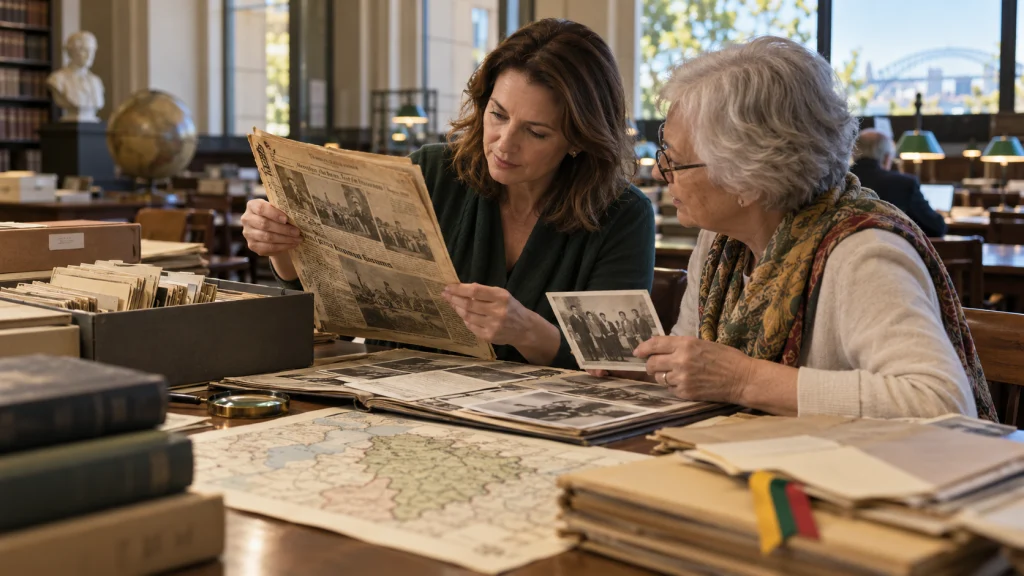
For Australians with Lithuanian roots, historical newspapers can reveal details that official documents often leave out. Community announcements, obituaries and reports about cultural events may help descendants identify relatives, discover family connections and learn more about their ancestors’ lives after immigration.
Researching Lithuanian newspapers in Australia is particularly useful for families whose relatives arrived after the Second World War. These publications recorded everyday community life and sometimes mentioned Lithuanian hometowns, migration experiences and family relationships.
Although newspapers cannot replace official genealogical documents, they can provide valuable clues for further research in Australian and Lithuanian archives.
Why Lithuanian-Australian Newspapers Matter for Family History
After the Second World War, many Lithuanians settled in Australia, including people who had spent time in European displaced persons camps. Lithuanian-language newspapers helped these communities maintain cultural connections, share news and preserve their traditions.
For anyone researching Lithuanian family history in Australia, these publications offer a different perspective from immigration files and civil records. They may describe an ancestor’s involvement in a community organisation, identify relatives attending an event or mention a family’s place of origin.
Newspaper references are especially helpful when family documents are missing or when descendants know little about their relatives’ lives in Australia.
However, published information was not always independently verified. Names, dates and locations should be compared with other historical sources before being accepted as facts.
Which Lithuanian Newspapers Were Published in Australia?
Several Lithuanian-language newspapers served immigrant communities across Australia. Their coverage included cultural activities, religious events, community organisations and personal announcements.
Lithuanian newspapers are valuable for genealogy research, especially when identifying publications that circulated in the area where an ancestor lived.
Mūsų Pastogė: Sydney’s Lithuanian Community Newspaper
Mūsų Pastogė became an important source of news for Lithuanian Australians, particularly within the Sydney community. It reported on cultural events, organisations, commemorations and matters affecting Lithuanian immigrants.
Its pages may contain family announcements, names of community members and references to relatives living in different Australian cities.
Researchers exploring the Musu Pastoge newspaper archive can search for surnames, approximate dates and known community connections. Even a short announcement may help identify an ancestor’s residence or social network.
Tėviškės Aidai: Melbourne’s Lithuanian Catholic Press
Tėviškės Aidai was closely associated with Lithuanian Catholic community life in Australia. Alongside religious reporting, it published community news and announcements involving Lithuanian families.
The Teviskes Aidai newspaper may be useful when researching ancestors connected with Catholic parishes, religious organisations or Lithuanian community activities in Melbourne and elsewhere.
Memorial notices and reports about religious celebrations can sometimes reveal family relationships, dates and other biographical details.
Australijos Lietuvis and Other Local Publications
Other publications, including Australijos Lietuvis, also contributed to Lithuanian community life in Australia. Smaller newspapers and organisational newsletters sometimes focused on particular associations or local events.
These sources may mention individuals who rarely appeared in larger publications. However, surviving collections are not always complete, and some issues have never been digitised.
Comparing several newspapers can improve the chances of finding useful information, particularly when an ancestor participated in local Lithuanian organisations.
What Family History Clues Can Newspaper Issues Reveal?
Historical newspapers often contain personal details that are difficult to find in official records. Reports about community events, family celebrations and local organisations may identify relatives, occupations or places of residence.
For researchers examining Australian Lithuanian newspapers, these references can help connect individuals across generations. Even a brief announcement may provide a date or family name worth investigating further.
Obituaries, Death Notices and Memorial Articles
Obituaries are particularly useful because they may summarise an individual’s life, including their birthplace, migration to Australia, occupation and family relationships.
Some memorial articles mention relatives who remained in Lithuania or settled elsewhere. Others describe an ancestor’s involvement in Lithuanian community organisations.
These details can guide further research, but dates and family connections should be checked against death certificates, immigration files and other records.
Weddings, Anniversaries and Family Announcements
Marriage announcements may identify spouses, parents and other relatives, while anniversary articles sometimes describe a family’s migration history.
Such notices are especially helpful when tracing women whose surnames changed after marriage or families who moved between Australian cities.
Researchers should record the publication date and newspaper title alongside any names or relationships mentioned.
Where to Find Lithuanian Newspapers Published in Australia
Historical publications can be located through Australian library catalogues, specialised newspaper collections and Lithuanian archival resources.
When searching Lithuanian newspaper archives in Australia, it is important to check whether a publication is available as digitised pages or only as a catalogue entry.
National Library of Australia and Trove Catalogue
The National Library of Australia’s Trove service provides access to digitised historical newspapers and information about publications held by Australian libraries.
Researchers can explore the Trove Newspapers & Gazettes collection using names, dates and locations.
However, not every Lithuanian-language newspaper or issue is available as searchable digital text. Some publications may only be listed in library catalogues, requiring researchers to contact the holding institution.
Spauda.org and Lithuanian Newspaper Collections
Spauda.org maintains a collection of Australian Lithuanian newspapers, including historical issues of Mūsų Pastogė and Tėviškės Aidai.
Researchers can examine available issues to locate family announcements, community reports and references to individual immigrants. Coverage varies by publication and year.
The Lithuanian Central State Archives also offers a historical exhibition about Lithuanian press in Australia, providing background on the development of these publications.
How to Search Lithuanian Names in Historical Newspapers
Lithuanian surnames may appear in several forms across historical newspapers. Diacritical marks were sometimes omitted, while other names were adapted to English spelling.
For example, Šimkus may appear as Simkus, while Černiauskas may be written as Cerniauskas. Lithuanian women’s surnames can also have different endings depending on marital status.
To search Lithuanian ancestors in Australian newspapers, begin with the known surname and try alternative spellings. Narrow the search using approximate dates, cities, relatives or community organisations.
Digitised newspapers may contain text-recognition errors, meaning a correctly spelled name will not always appear in search results. When this happens, browsing issues from a particular year may be more effective.
Keep a record of each useful reference, including the newspaper title, issue date and page number. This information will make it easier to verify findings and connect them with other family documents.
A Step-by-Step Newspaper Research Workflow
A structured approach helps researchers find relevant information without spending unnecessary time searching unrelated newspaper issues.
Begin with known family details, including names, approximate dates, Australian addresses and possible Lithuanian hometowns. Use these clues to identify newspapers published in the areas where relatives lived.
Next, search surname variations and examine obituaries, announcements and community reports. Save promising findings with their publication dates and page numbers.
Compare these discoveries with existing Lithuanian ancestry records to establish whether they concern the same individual.
For families who arrived after the Second World War, displaced persons camp records may provide additional information about their journey from Europe to Australia.
How to Verify a Newspaper Mention Against Other Records
A newspaper reference becomes more useful when its details can be confirmed through independent documents.
Compare names, dates and family relationships with Australian birth, marriage and death certificates, immigration files and naturalisation records.
If a newspaper identifies an ancestor’s birthplace, examine relevant Lithuanian archival records. Church registers and historical civil documents may help establish a connection between the person mentioned in Australia and their Lithuanian family.
Minor spelling differences do not necessarily indicate different individuals. However, conflicting dates or family details should be investigated rather than ignored.
What Lithuanian Newspapers Cannot Prove About Citizenship
Lithuanian-language newspapers can reveal ancestry, migration history and community connections, but they do not automatically establish historical Lithuanian citizenship.
An obituary describing someone as Lithuanian may refer to ethnicity or birthplace rather than legal nationality.
This distinction matters for descendants exploring Lithuanian citizenship by descent for Australians. Eligibility depends on the applicable citizenship laws, family relationships and supporting documentation.
Depending on the circumstances, applicants may need evidence of Lithuanian citizenship before 1940.
Research involving Lithuanian citizenship through grandparents may also require documents connecting each generation to the relevant ancestor.
Some descendants may qualify for a Certificate of Lithuanian Descent, which is legally distinct from Lithuanian citizenship.
Newspaper findings can help locate supporting evidence, but they should be assessed alongside official records.
Frequently Asked Questions
Where Can I Find Old Lithuanian Newspapers from Australia?
Historical issues may be available through Spauda.org, specialised archives and Australian library collections. Trove can also help identify relevant publications and holdings.
Is Mūsų Pastogė Available Online?
Yes. Historical issues of Mūsų Pastogė are available through Spauda.org, although coverage varies by year.
How Do I Search for Lithuanian Surnames Without Diacritics?
Try original and simplified spellings, such as Šimkus and Simkus. Alternative surname endings and shorter name fragments may also produce useful results.
Can Obituaries Identify Relatives or Lithuanian Hometowns?
Yes. Some obituaries mention spouses, children, other relatives or places of origin. Verify these details through independent records.
Does Trove Include Every Lithuanian Newspaper Issue?
No. Trove does not contain every Lithuanian newspaper issue published in Australia. Additional material may be held by specialised archives or libraries.
Can a Newspaper Article Prove Lithuanian Citizenship?
Generally, no. Newspaper articles may provide genealogical clues, but official documents are normally required to establish historical citizenship and family relationships.